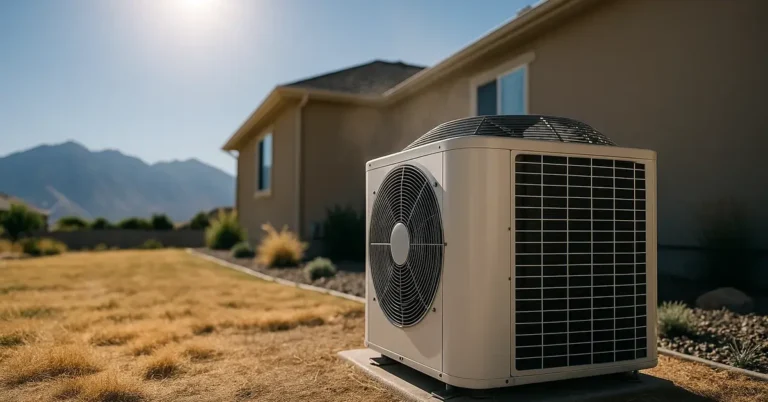
You moved to Utah from the coast and your AC just doesn’t hit the same way it did back home. It runs fine. Not leaking. But on those 95-degree afternoons in July, your house never quite gets to 72 no matter how long the system runs. It’s not broken — it’s just fighting thinner air at 4,000+ feet above sea level. And if you want to know what happens when temperatures push past 100°F, that altitude penalty gets even steeper.
Air density is the culprit. For every 1,000 feet you climb, your AC loses about 3% of its cooling power. That’s not a defect. That’s physics. Across the Wasatch Front — where our service area spans from Salt Lake Valley at 4,226 feet to Park City at 7,500 feet — that adds up to a 13-22% loss compared to sea level. Despite that altitude penalty, you can cut summer AC costs through proven efficiency strategies.
If your AC feels weak and you’re wondering why, give us a call at (801) 997-8909. We’ll check whether it’s altitude, airflow, or something else.
Why Your AC Loses 3% of Its Cooling Power for Every 1,000 Feet You Climb
Air conditioners don’t create cold air. They move heat. Refrigerant in your system absorbs heat from inside your home and carries it outside, where the condenser coil dumps it into the outdoor air. That transfer depends on air density — how many air molecules are there to absorb the heat.
At sea level, air is dense. Packed with molecules. At 4,226 feet in Salt Lake City, air is only about 86% as dense. At 7,500 feet in Park City, it’s down to 78%. Fewer molecules means less mass to carry heat away from the coil. Your system has to work harder to do the same job — and it can’t always keep up.
Think about athletes training at altitude. Lungs work harder because there’s less oxygen per breath. Your AC faces the same challenge. It’s built for sea-level air, and in Utah’s thin air, it’s running with one hand tied behind its back.
The 3% rule is an industry standard used when sizing gear for high elevation cooling, per the U.S. Department of Energy. In Utah, where most homes sit between 4,000 and 7,500 feet, that factor is the gap between comfort and constant frustration.
Salt Lake Valley vs. Park City: A 3,300-Foot Difference in Your AC’s Job
We’re based in Eagle Mountain at about 5,100 feet. From here, we serve homes in Salt Lake City at 4,226 feet, Provo at 4,551 feet, and Park City up around 7,000 to 7,500 feet. That’s a 3,300-foot elevation spread within a single service area, and it creates wildly different cooling needs from one call to the next.
Here’s what that looks like in real numbers. A 3-ton AC unit — rated for 36,000 BTUs per hour at sea level — drops to about 31,300 BTUs in Salt Lake City (13% loss). In Provo, it’s around 31,000 BTUs (14% loss). In Park City, that same 3-ton unit performs like a 2.3-ton unit, delivering only 28,000 BTUs (22% loss).
That AC capacity at altitude difference isn’t small. It’s the space between a system that keeps your home at 70 degrees all summer and one that struggles to stay below 76 on hot days. If you bought your home from someone who moved here from California or Texas and brought their sea-level sizing with them, your AC might be undersized by half a ton or more.
We see this all the time with Utah altitude HVAC challenges. A homeowner in Draper calls us in August because their 5-year-old system can’t keep up. Unit runs great — clean coils, full coolant charge, no mechanical issues. But it was sized for 2,200 square feet at sea level, not 2,200 square feet at 4,500 feet. It’s not broken. It’s just doing math that doesn’t work in Utah.
Sizing for Utah homes requires more than a square footage chart. It requires a Manual J load calculation that factors in your elevation and applies the derating factor. For more on sizing, check our guide on what size AC your home actually needs.
4 System Components That Struggle at Utah’s Elevation

Altitude doesn’t affect every part of your AC the same way. Some parts barely notice. Others work much harder. Here are the four that take the biggest hit.
Compressor: Working Harder to Move the Same Heat
Your compressor is the heart of the system. It compresses coolant so it can absorb heat inside and release it outside. At higher elevations, lower air pressure outside means the compressor has to work harder to reject that heat into thinner air. All that extra effort wears on the part that gets it started, which is why capacitors tend to fail during Utah’s July heat.
Blower Fan: Moving 20% Less Air at High Elevation
Blower moves indoor air across the evaporator coil. At sea level, it might move 90,000 pounds of air per hour. At 6,000 feet, that same fan moves only 72,000 pounds per hour — a 20% drop. Less air mass means less heat gets absorbed per cycle, and when airflow drops too far the coil can drop below freezing, which is how an evaporator coil ices over in summer. Keeping the blower system clean is critical at altitude — check out our guide on how often to change your AC filter in Utah’s dusty conditions.
Refrigerant Pressure: Why Standard Charts Don’t Work in Utah
HVAC techs use pressure charts to check coolant charge. Those charts assume sea-level conditions. In Utah, coolant pressures read 2-4°F different than what the gauge shows. A tech who doesn’t account for this might misdiagnose your system. That’s why you want a Utah-trained tech checking your coolant.
Condenser Coil: Fighting Thin Air to Reject Heat
Condenser coil sits outside and dumps heat into outdoor air. At sea level, dense air pulls heat away fast. At altitude, thinner air can’t absorb heat as quickly, which means the coil has to work harder and coolant stays hotter longer. Read more about how condenser placement affects performance.
How to Size Your AC for Utah Altitude (It’s Not Just Square Footage)
Walk into a big-box store and they’ll sell you an AC based on square footage. “2,000 square feet? You need a 3-ton unit.” That works fine in Miami. In Utah, it’s a recipe for disappointment.
Square footage charts assume sea level. They don’t account for altitude, insulation quality, window orientation, or the fact that a 2,000-square-foot home in Salt Lake City needs 13% more cooling capacity than the same house in Houston. That’s why Utah building code requires a Manual J load calculation for every new HVAC install and replacement.
Manual J is the industry-standard method for calculating heating and cooling loads. It factors in your home’s size, insulation, windows, orientation, and — critically for Utah — your elevation. Once the load is calculated, Manual S applies the altitude derating factor to select the right gear. A home that needs a 3-ton unit at sea level might need a 3.5-ton unit in Salt Lake or a 4-ton unit in Park City.
Warning signs your system was sized for sea level? It runs all day and never hits the thermostat setting on 95-degree days. Indoor humidity climbs above 55-60% in summer. Electric bills are higher than your neighbors’ with similar homes. Some rooms never cool down. These are all signs the system is undersized — not broken, just wrong for the altitude. Check out our post on why your AC struggles in Utah’s extreme heat.
Right sizing matters more than brand or SEER rating. A correctly sized 14 SEER unit will outperform an undersized 18 SEER unit every time. If you’re replacing your AC or installing one in a new home, get a Manual J. It’s required by code in Utah.
What Utah Building Code Says About Altitude Derating (Yes, It’s Required)
Utah isn’t alone in requiring altitude adjustments, but it’s one of the few states where nearly everyone lives above the 2,000-foot threshold that triggers derating.
Utah Code Title 15A Chapter 3 says HVAC gear installed here must be sized using ACCA Manual J and Manual S. Those standards require altitude derating for installs above 2,000 feet. Salt Lake City is at 4,226 feet. Provo is at 4,551 feet. Park City is at 7,500 feet. Every one of those requires derating.
This isn’t a suggestion. It’s code. And it’s enforced by building inspectors. Undersized systems fail inspections, void warranties, and leave homeowners with uncomfortable homes and high bills.
For homeowners, this means two things. First, any good HVAC contractor in Utah should account for altitude when sizing your system. If they don’t mention it, that’s a red flag. Second, if you’re replacing an older system that was installed before these codes were enforced, your new system will likely be larger — not because they’re upselling you, but because the old one was undersized from day one. If you’re adding cooling to a historic home that never had it, ductless mini-splits sized for altitude can provide properly-rated capacity without tearing through plaster walls.
Dry Air + Altitude: Utah’s Unique One-Two Punch
Colorado gets attention for high-altitude HVAC challenges, but Utah’s climate is tougher in one way: we’re drier. Summer humidity in Salt Lake Valley often drops below 20%.
Low humidity is good for your AC. It means less latent heat load — your system doesn’t work as hard to pull moisture from the air. That offsets some of the cooling loss from altitude. An AC that loses 13% of its capacity might only feel like it lost 8-10% because dehumidification load is lower.
But dry air makes homes feel warmer at the same temp. Your skin relies on evaporative cooling to regulate temperature. In humid climates, evaporation is slow. In Utah’s dry air, evaporation is rapid, which cools your skin more. But a 78-degree house in Utah can feel as warm as an 80-degree house in Florida.
Bottom line? Altitude cuts your AC’s capacity, but dry air cuts the load it handles. They don’t cancel out — you still need to size for altitude — but they do moderate each other. If you’re weighing different cooling options for Utah’s climate, see our comparison of swamp coolers vs central AC for Utah homes.
That rapid evaporation is also why ceiling fans work exceptionally well in Utah — they create airflow that accelerates evaporative cooling on your skin, letting you raise your thermostat 4 degrees without sacrificing comfort. It’s one of the most effective ways to reduce the load on an altitude-stressed AC.
5 Signs Your AC Was Sized for Sea Level (And What to Do)

Not sure if your system is undersized? Here are the telltale signs.
1. It runs constantly on hot days but never reaches the thermostat setting. If your AC runs from noon to 8 PM on a 98-degree day and your house never drops below 76, that’s a capacity problem.
2. Indoor humidity climbs above 60% in summer. Even in Utah’s dry climate, a correctly sized AC should keep indoor humidity between 40% and 55%. If you’re seeing 60% or higher, the system isn’t cycling enough to pull moisture out of the air.
3. Your electric bills are higher than neighbors with similar homes. An undersized system runs longer to try to hit the setpoint, which burns more electricity.
4. Some rooms never cool right. This can be an airflow or ductwork issue, but if the whole upstairs is warm and the system runs nonstop, undersizing is a strong suspect.
5. Your system is less than 10 years old but struggles. Modern ACs are reliable. If a new system can’t keep up on hot days, the most common cause isn’t mechanical failure — it’s that the system was sized wrong from the start.
What to do? Get a Manual J from a Utah HVAC contractor who understands altitude derating. Sometimes the fix isn’t replacement — it might be airflow issues, coolant charge, or thermostat placement. But if the load calculation shows your system is undersized, replacement is the only permanent solution. Need a professional assessment? Learn more about our AC repair and diagnostic services or check out our guide on what to expect from a Utah AC tune-up.
Frequently Asked Questions
Does altitude affect air conditioner performance?
Yes. Air conditioners rely on air density to transfer heat. At higher elevations, thinner air means fewer molecules to absorb heat, which reduces cooling capacity by about 3% per 1,000 feet. A 3-ton unit at sea level performs like a 2.6-ton unit at 4,500 feet.
How much does AC efficiency decrease with altitude?
Cooling capacity decreases by roughly 3-4% per 1,000 feet of elevation. In Salt Lake City at 4,226 feet, that’s a 13% loss. In Park City at 7,500 feet, it’s a 22% loss. Compressor, blower, and condenser all work harder to compensate, which can also reduce overall efficiency.
Why does my AC not cool well at high elevation?
Two main reasons. First, the system may be undersized — it was spec’d for sea level and can’t handle the reduced capacity at altitude. Second, thinner air makes heat rejection harder, so the compressor and condenser have to run longer cycles to dump the same amount of heat.
Do I need a bigger AC unit at high elevation?
Usually, yes. A Manual J load calculation will tell you the exact size you need for your home, but as a general rule, you’ll need a larger unit at altitude than you would at sea level for the same square footage. A 2,000-square-foot home that needs a 3-ton unit in Florida might need a 3.5-ton unit in Salt Lake City. For more on how system types compare in Utah, see our post on mini-splits vs central air.
What is derating for HVAC at altitude?
Derating is the process of adjusting an AC’s rated capacity to account for reduced performance at altitude. Industry standard is a 3% reduction per 1,000 feet above sea level. Manual S uses this derating factor to select gear that will deliver the needed cooling capacity at your specific elevation. Utah building code requires derating for installs above 2,000 feet, which covers nearly the entire Wasatch Front. If you’re also considering a heat pump, check out our comparison of heat pumps vs air conditioners for Utah homes.
Conclusion
Altitude isn’t an excuse for a weak AC — it’s a real factor that affects every cooling system in Utah. From Salt Lake Valley to Park City, the air is thin enough that sizing assumptions from sea-level states don’t apply here. If your system struggles on hot days, it might not be broken. It might just be fighting physics with the wrong gear.
Sizing starts with a Manual J that accounts for your elevation, your home’s specifics, and Utah’s dry climate. If you’re replacing a system or diagnosing a capacity issue, that load calculation is the only way to know for sure whether you’ve got the right gear for your altitude.
If you’re not sure whether your AC is sized right for Utah’s elevation, give us a call at (801) 997-8909. We’ll run the numbers, check your system, and give you a straight answer. We’re open 7 days a week, and the $49 weekday dispatch fee (9 AM-5 PM) is applied to your repair.