You’re finally ready to upgrade the HVAC in that 1920s bungalow in Sugar House. Or maybe you’re adding cooling to a bonus room in Park City that stays hot all summer. Either way, you’re probably asking: mini split vs central air?
Both systems cool your home. Both move heat from inside to outside. But they do it differently, and those differences matter — especially here in Utah, where elevation, dry air, and temperature swings create challenges that most HVAC guides ignore.
We’ll walk through the real costs (using actual Utah pricing), explain how altitude affects output, and give you a decision framework that fits your home. By the end, you’ll know which system makes sense.
If you need help sorting through your options, give us a call at (801) 997-8909. We’re happy to take a look.
What’s the Difference? Mini-Split vs Central Air Basics

Let’s start with the fundamentals.
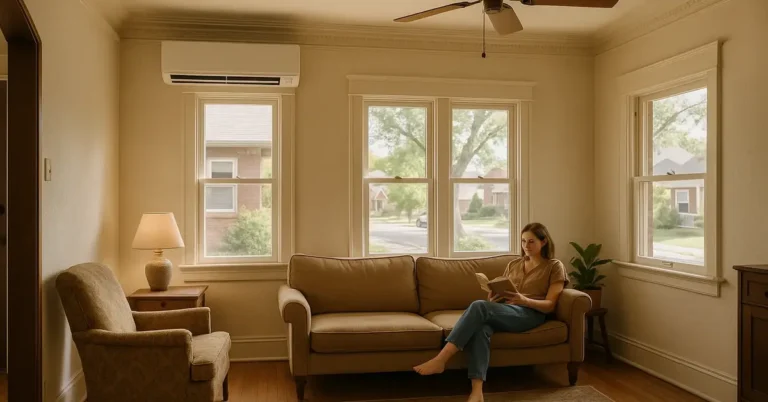
A mini-split — also called a ductless mini split — has two main parts: an outdoor compressor and one or more wall or ceiling units. Refrigerant lines run between them through a small hole in the wall (usually 3 inches). No ducts.
Each indoor head controls the temperature in its own zone, and you can mix and match sizes depending on the room.
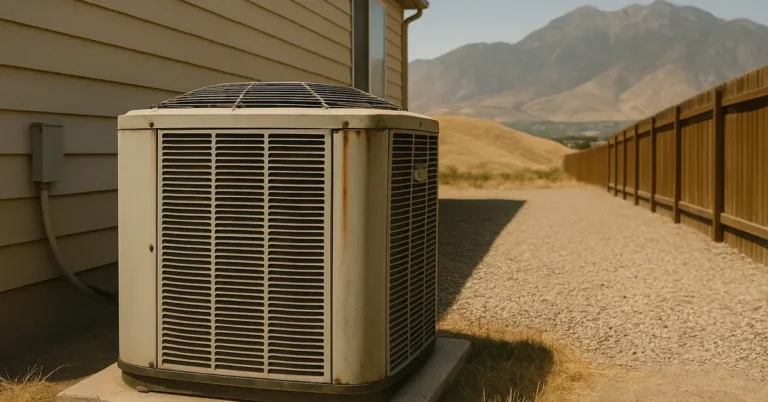
A central system uses an outdoor condenser, an indoor air handler, and a network of ducts running through your attic, walls, or crawlspace. One thermostat controls the whole system. Cool air gets pushed through the ducts to every room in the house.
The key difference: mini-splits remove ductwork entirely, which means they avoid the energy loss that comes with it. The U.S. Department of Energy says ductwork can waste more than 30% of your cooling energy — air leaks through gaps, heats up in a hot attic, or gets lost before it reaches the room you’re trying to cool.
Another big difference: mini-splits are heat pumps, so they heat and cool. Central AC only cools — you’ll need a separate furnace for winter heat. If you’re comparing all your heat pump options, check out our post on ducted heat pumps vs air conditioners. Ready to install a heat pump system? Learn more about our heat pump installation services or call (801) 997-8909.
Energy Output: SEER2 Ratings and Real Utah Performance
Mini-splits win on output — and it’s not close.
Most mini-splits hit SEER2 ratings of 20 to 30+, with high-end models past 35. Central systems range from 14.3 SEER2 (the 2026 federal minimum) to about 26 SEER2.
The advantage comes from two things: no ducts (so no 30% energy loss) and zoned control. With a mini-split, you cool only the rooms you’re using. With central air, you cool the entire house whether anyone’s in the back bedroom or not.
Utah’s dry climate helps both systems. Low humidity (20-30% in summer, though monsoon season can change that equation) means less moisture to remove from the air, which reduces the cooling load compared to humid climates. For pure cooling output, mini-splits extract the most from every watt.
One more thing: if you’re installing a mini-split heat pump (not just AC), you may qualify for a federal tax credit up to $2,000. The system has to meet the Consortium for Energy Efficiency’s highest tier, but most modern mini-splits do. See our 2026 HVAC tax credit guide for details.
Cost Comparison: What You’ll Actually Pay in Utah
Generic national pricing won’t help you budget. Here’s what systems actually cost in Utah, pulled from our pricebook.
Single-Zone Mini-Split Costs
A single-zone mini-split — one outdoor unit, one indoor head — runs $5,500 to $10,745 installed, depending on capacity and mounting type.
For example, a 12,000 BTU Bosch wall-mount unit costs $6,260. If you want a ceiling cassette instead (flush-mounted in the ceiling, less visible), that same 12k BTU unit jumps to $6,654. A 24,000 BTU ceiling cassette hits $10,745.
Price includes the outdoor condenser, the indoor head, refrigerant lines, install labor, and startup.
Multi-Zone Mini-Split Costs
Multi-zone systems use one outdoor condenser with multiple indoor heads — one per room. You get separate temperature control in each zone.
Expect to pay $11,172 to $20,262 installed for a 2-4 zone system. A 2-zone Daikin system (18,000 BTU total capacity) costs $11,172. A 4-zone Daikin (36,000 BTU) runs $20,262.
That’s the full ductless mini split cost — outdoor unit, all the indoor heads, refrigerant lines, and labor.
Central Air Costs
Central AC for a whole home runs $8,440 to $13,055 installed, assuming your ductwork is already in good shape.
A 3-ton, 14.3 SEER2 Goodman system (the most common size for an average Utah home) costs $9,025 to $12,376. If you want a more efficient 15.2 SEER2 unit, expect $9,388 to $13,055.
That price assumes ducts exist and don’t need major work. Many older homes need ducts from scratch — add $10,000 to $18,000+ for that. Suddenly the $16,000 multi-zone mini-split looks reasonable.
Cost Comparison Scenarios

So which is cheaper? Depends on your situation.
Single room: Mini-split wins at $5,500 to $7,000 with separate zone control. Call us at (801) 997-8909 for a duct-extension estimate.
Whole home with existing ducts: Central air wins — $8,400 to $13,000 vs $16,000+ for multi-zone.
Whole home without ducts: Mini-split wins. Central AC plus new ductwork runs $18,000 to $30,000 vs $16,000 to $20,000 for multi-zone.
Want a quote tailored to your home? Give us a call at (801) 997-8909. We’ll walk through your layout, ductwork situation, and budget.
For more on central AC pricing, see our guides on 2-ton AC replacement costs and general AC replacement pricing.
Installation: What Each System Requires
Ductless installs are less invasive. The tech mounts the indoor head on a wall or ceiling, drills a 3-inch hole through the exterior wall for the refrigerant lines and wiring, sets the outdoor condenser on a pad, and connects everything. For a single zone, that’s usually a one-day job. Multi-zone systems take two days.
Central systems take more work if you’re starting from scratch. With existing ductwork, install takes one to two days — swap the condenser, connect lines, check airflow, start it up.
But if you need new ductwork, you’re looking at a 5 to 10 day project. They’ll need attic or crawlspace access, they’ll cut into drywall, run metal ducts to every room, seal and insulate everything, then patch and paint. It’s a big job.
That’s why mini-splits are so attractive for older Utah homes. A 1920s bungalow in Sugar House or a Victorian in the Avenues probably has radiators or baseboard heat — no ducts. Retrofitting ducts costs $10,000 or more. A professional ductless mini-split installation lets you skip that entire headache. If you’re specifically looking at cooling an old home without ductwork, we’ve installed hundreds of historic home retrofits across the Wasatch Front.
Pros and Cons for Utah Homes
Let’s break down the advantages and disadvantages, with Utah-specific context.
Mini-Split Advantages
Higher output and lower electric bills, especially when you cool only the rooms you use.
Zoned control. Cool only the rooms you need, when you need them. No ductwork required — ideal for older homes and room additions.
Heats and cools year-round. Quiet at 19 to 30 decibels. Up to $2,000 in federal tax credits.
Mini-Split Disadvantages
Visible indoor units. Wall-mounted heads are functional, but some homeowners — especially in design-conscious areas like Park City, Draper, or Daybreak — don’t love the look.
Monthly filter cleaning per zone. Each indoor head has a filter that needs cleaning every month. During Utah’s wildfire smoke season (July through September), bump that to every two weeks.
Higher whole-home cost when ducts already exist.
Central Air Advantages
Lower upfront cost when ductwork exists. All equipment stays out of sight — attic, basement, or outside.
Whole-home air filtration through one central filter. One filter swap every 1 to 3 months.
Central Air Disadvantages
Duct energy loss up to 30%. Lower peak SEER2 ratings than mini-splits.
No zoned control — the whole house cools even when you only use two rooms. Requires existing ductwork. Cooling only — no heat.
The Utah Factor: How Altitude Affects Performance

Most HVAC guides skip this part: altitude matters. A lot.
Salt Lake Valley sits at about 4,200 feet. Utah Valley is 4,500 feet. Park City is 7,000 feet. At those elevations, the air is thinner — there’s less oxygen per cubic foot, which means HVAC systems can’t move as much heat.
Manufacturers rate mini-splits at sea level. A unit rated for 20,000 BTU at sea level doesn’t deliver 20,000 BTU in Park City.
Fujitsu and Mitsubishi altitude correction tables show a 17% or greater capacity drop at 5,000+ feet.
Example: A Fujitsu 18RLB mini-split is rated at 20,000 BTU. At 5,350 feet (typical for Park City or Heber), it delivers roughly 16,600 BTU. That’s a 17% drop.
Central systems face the same derating, but contractors have upsized for altitude for decades. Mini-splits are newer, and many installers skip the correction.
If you’re getting a mini-split installed in Utah — especially above 5,000 feet — ask the contractor for an altitude-corrected Manual J calculation. If they don’t know what that means, find a different contractor.
Our techs use altitude-corrected sizing for every install. It’s not optional. Call us at (801) 997-8909 and we’ll walk through the numbers.
For more on sizing HVAC systems for Utah homes, see our guide on how to size an AC unit based on square footage and altitude.
Maintenance: What Each System Needs in Utah’s Climate

Each indoor head has a reusable filter you rinse monthly — about 5 minutes per head.
During wildfire smoke season (July through September), bump that to every two weeks.
Annual professional service is also recommended: coil cleaning, drain line check, and refrigerant level verification. Contact us for multi-zone maintenance pricing.
Central systems are simpler — one filter to swap every 1 to 3 months. Utah’s dusty climate means you’ll change it more often. During peak seasons, go monthly.
Annual tune-up for central air costs $69 at Ninja (weekdays 9 AM-5 PM only). The tech checks refrigerant, cleans coils, inspects electrical connections, and makes sure airflow is balanced. Takes about an hour.
One more Utah factor: snow. The Wasatch Front gets 50 to 60 inches per year.
If snow piles up around your outdoor unit, airflow drops. Clear it after big storms.
For general HVAC maintenance tips, see our homeowner maintenance guide. Or sign up for our Home Health Plan — it covers two tune-ups per year, priority scheduling, and 15% off repairs for $18.99 per month.
Which System Makes Sense for Your Utah Home?
There’s no universal answer. The right choice depends on your home’s layout, existing setup, budget, and priorities.
Choose a Mini-Split If…
No ductwork in your home? Common in older neighborhoods like Sugar House, the Avenues, and downtown Salt Lake, where homes were built with radiators or baseboard heat.
Cooling or heating only specific rooms? Bonus room, home office, mother-in-law suite, finished basement, garage conversion — anywhere that wasn’t part of the original HVAC design.
Maximum output matters to you? SEER2 ratings of 20 to 30+ mean lower electric bills, and zoned control lets you cool only what you’re using.
High altitude location? Park City, Heber, Midway, anywhere above 5,000 feet. Demand altitude-corrected sizing.
Choose Central Air If…
Existing ductwork in good shape? Why pay $16,000+ for a multi-zone mini-split when an $8,400 to $13,000 system uses the setup you already have?
Whole-home consistent cooling is priority? Every room at the same temperature, no zone control needed.
Aesthetic concerns about visible wall units? Or you prefer simpler maintenance — one filter location beats hunting down three or four wall-mounted filters.
Better whole-home air filtration matters? Wildfire smoke, allergies, dust — a system with a good MERV 11 or MERV 13 filter handles it better than room-level mini-split filters.
Consider a Hybrid Approach If…
Central AC handles most of your home, but one room is always too hot or too cold. West-facing bonus room, finished basement that never gets enough airflow, upstairs bedroom that bakes in summer. Budget allows $14,000 to $18,500 for a system plus one supplemental mini-split.
Frequently Asked Questions
Is a mini split cheaper than central air?
For single rooms or homes without ducts, yes — a single-zone starts at $5,500. For whole-home cooling with existing ductwork, central air ($8,400 to $13,000) costs less than a multi-zone mini-split.
Are mini splits worth it?
Yes, if you’re cooling specific zones, lack ductwork, or want top output (SEER2 20 to 30+). They cut duct energy loss and may qualify for a $2,000 federal tax credit. They cost more for whole-home cooling when ducts exist.
What are the disadvantages of a mini split?
Visible wall units, monthly filter cleaning per zone, higher whole-home cost when ducts exist, and less effective air filtration during wildfire smoke season.
Do mini splits work at high altitude?
Yes, but expect 17% or more capacity loss above 5,000 feet. A 20,000 BTU unit delivers about 16,600 BTU at Park City elevation. Demand altitude-corrected Manual J sizing from your contractor.
Can a mini split replace central air?
Yes — a 3 to 4 zone system ($16,000 to $20,000) can cover a whole home. But if you already have good ductwork, central air is more cost-effective.
Making the Call
There’s no one-size-fits-all answer. A 1920s Sugar House bungalow without ducts needs a different setup than a 2015 Daybreak build with central air already running. If you’re also considering evaporative cooling, check out our guide on swamp coolers vs central AC for Utah homes.
What matters: altitude-corrected sizing, honest pricing for your actual home, and a clear picture of what you’re solving. One room or the whole house? Ducts or no ducts? Those answers point you to the right system.
Give us a call at (801) 997-8909 and we’ll walk through your options. No pressure, no upselling — just honest advice from techs who’ve been doing this in Utah for 20+ years. The $49 dispatch fee (weekdays 9 AM-5 PM) is applied to your installation.