Walk through older neighborhoods in Salt Lake Valley, and you’ll notice those big metal boxes on rooftops. Swamp coolers. For decades, they’ve been Utah’s go-to cooling solution. But lately, more homeowners are making the switch to central air.
With 100-degree days becoming common and late-summer humidity creeping in, the swamp cooler vs AC Utah debate keeps coming up. Utah’s dry climate makes swamp coolers work better here than almost anywhere else. But that doesn’t automatically make them right for your home.
Weighing your cooling options? Call us at (801) 997-8909. We guarantee 120-minute emergency response during business hours, and we’ve installed both systems across the Wasatch Front for 20+ years — we’ll help you figure out what works best.
How Swamp Coolers and Central Air Actually Work
Before comparing costs and performance, it helps to understand how these systems work. The mechanism explains why each thrives in different conditions.
Evaporative Cooling: How Swamp Coolers Work
These systems rely on a simple principle: when water evaporates, it cools the air. The cooler pulls outside air through wet pads, where water evaporates and drops the temperature 15 to 20 degrees.
The system needs three things: outdoor air constantly coming in, water flowing through the pads, and low humidity. Utah’s dry climate is perfect — dry air makes water evaporate fast. If the air’s already humid, evaporation slows and the system struggles. You’ll need to crack a window or two for airflow — it’s not a sealed system like AC.
Refrigerant-Based Cooling: How Central Air Works
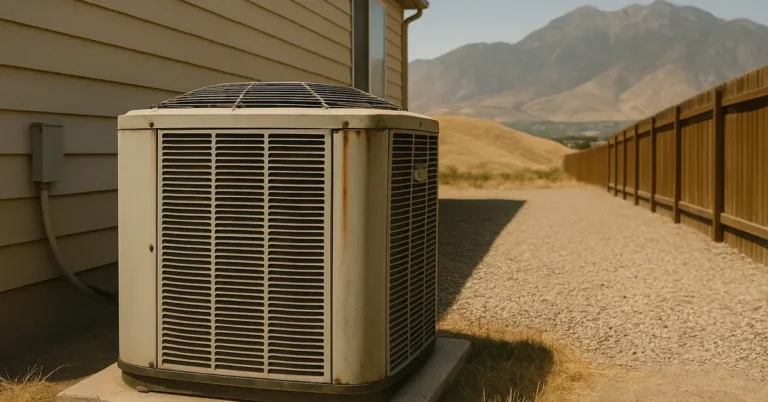
Air conditioning systems use refrigerant to move heat from inside your home to outside. The refrigerant absorbs heat through the evaporator coil. Then it carries that heat outside where the condenser releases it. Cooled air circulates back through your ductwork.
Unlike swamp coolers, central air removes humidity as it cools. It recirculates indoor air rather than pulling fresh air from outside. Outdoor humidity doesn’t matter — the system maintains whatever temperature you set.
Swamp Cooler vs AC Utah: Installation and Operating Costs

Let’s talk real numbers. The cost difference is significant, both upfront and over time.
Installation Costs
A whole-house swamp cooler typically costs $1,500 to $4,000. That’s for a rooftop unit sized for an average Utah home.
Central air runs $8,440 to $13,055 if you have existing ductwork. Need new ducts? That jumps to $13,000 to $18,000+. If you’re considering ductless alternatives, see our guide on mini-splits vs central air for Utah homes. According to the U.S. Department of Energy, evaporative coolers cost about half as much to install.
Monthly Operating Costs in Utah
This is where swamp coolers shine. Running one costs $20 to $40 monthly for electricity, plus $5 to $20 for water. Total: $25 to $60 during summer.
Central air costs $75 to $200 monthly during peak Utah summer. The DOE says evaporative coolers use 75 to 82 percent less energy. This energy gap makes the swamp cooler vs AC Utah cost comparison dramatic.
Maintenance Costs
These coolers need more frequent maintenance, but parts are cheap. Expect $100 to $200 yearly for pad replacement, spring startup, and fall winterization. Most basic maintenance you can do yourself.
Your AC unit runs $69 to $150 yearly for professional tune-ups and filters. Our AC tune-up service starts at $69. Less frequent maintenance, but you’ll usually need a pro.
The Utah Climate Reality: When Each System Thrives
Utah creates specific situations where one system clearly outperforms the other. The swamp cooler vs AC Utah choice often comes down to understanding these climate factors.
Humidity Limits: When Swamp Coolers Stop Working
Below 40% humidity, these coolers work great — which is most Utah summer. Salt Lake Valley averages 36% humidity in July, perfect for evaporative cooling (though monsoon weeks push higher, making whole-house dehumidifier installation pricing for monsoon season humidity relevant for some homes).
Between 40% and 50% humidity, performance drops. Above 50%, your home feels muggy instead of cool. The swamp cooler humidity limit is around 50% — above that, they struggle. According to evaporative cooling research, relative humidity should stay below 40% for maximum efficiency.
Late summer brings monsoon moisture from the southwest. When humidity spikes to 50% or 60% for days, your swamp cooler won’t keep up.
How Utah’s Altitude Affects Central Air Performance
Altitude reduces efficiency. Air conditioners lose about 3% cooling capacity per 1,000 feet of elevation.
Salt Lake City sits at 4,300 feet. Your system runs at roughly 87% of rated capacity right away. Park City, at 7,000 feet, loses about 21%. Thin air holds less heat.
That’s why altitude-specific refrigerant charging matters here. Swamp coolers don’t have this problem — evaporation works the same regardless of altitude.
Hard Water and Swamp Cooler Lifespan
The Wasatch Front has some of the hardest water in the country. High mineral content means calcium and lime buildup on swamp cooler pads.
In soft-water areas, aspen pads might last a year or two. Here? You’re replacing them annually. Cellulose pads last two to three years instead of three to five.
100-Degree-Plus Days: Which System Handles Utah Heat Better?
Salt Lake Valley sees at least five days over 100 degrees most summers, and 56 days above 90. When it hits triple digits, the performance gap becomes obvious.
A swamp cooler drops temperature 15 to 20 degrees. On a 102-degree day, expect indoor temps around 82 to 87 — better than outside, but not exactly comfortable.
The AC maintains whatever temperature you set, no matter how hot it is outside. The saving grace? Utah’s cool nights. When temperature drops into the 60s or 70s overnight, your swamp cooler can bring the house down to comfortable levels by morning.
Central Air vs Evaporative Cooler: Performance and Control
Beyond numbers, how do these systems actually feel day to day?
Temperature Control
Your swamp cooler lacks precise thermostat control. You turn it on, adjust fan speed, and hope for the best. How cool your home gets depends on outdoor temperature and humidity.
Central air gives you a thermostat. Set it to 72 degrees, and that’s where it stays. The system cycles to maintain that exact temperature, regardless of conditions.
Evaporative coolers also cool unevenly. Rooms near vents feel great. Rooms farther away, not as much.
Air Quality and Freshness
These units constantly bring in fresh outdoor air. Great for circulation, but also brings in pollen, dust, and during Utah’s wildfire seasons in July through September, smoke.
The AC recirculates indoor air through filters. Better filtration means fewer allergens and pollutants. During fire season, that’s a significant advantage. When air quality spikes, you don’t want outdoor air inside.
Lifespan in Utah Climate
Central air typically lasts 10 to 15 years in Utah. Our harsh winters and hot summers stress the system more than milder climates, shortening lifespan.
Swamp cooler lifespan varies wildly. With excellent maintenance and soft water, maybe 20 years. With poor maintenance and hard water, maybe eight. It depends more on upkeep than the system itself.
Both systems need proper winterization. Our freeze-thaw cycles are brutal.
Maintenance: What You’re Actually Signing Up For

Be honest about maintenance. It’s not just cost — it’s time and willingness to do the work.
Swamp Cooler Maintenance Calendar
Spring startup: Clean the reservoir, replace pads, check the pump and motor, reconnect the water line. Budget an hour or two if doing it yourself.
During the season: Check pads monthly for mineral buildup. In hard-water areas, you might need to clean or replace them mid-season.
Fall winterization: Drain all water, disconnect and drain the water line, seal vents, and cover the unit. This is critical — trapped water freezes and cracks components.
Central Air Maintenance Calendar
Spring tune-up: Professional inspection, proper refrigerant charging for Utah altitude, thorough coil cleaning, and component testing. We do it right the first time — attention to detail matters. This is the single most important maintenance task.
During the season: Change or clean filters every one to three months depending on filter type. Keep the outdoor unit clear of debris. No seasonal winterization needed.
We handle maintenance for both systems — $49 dispatch fee (M-F 9am-5pm) applied to your repair – $149 after 5pm, weekends, and holidays. Family-owned, 20+ years serving Utah. Annual AC tune-ups start at $69. Call (801) 997-8909 to schedule.
Swamp Cooler vs AC Utah: Which System Is Right for Your Home?

Let’s give you real guidance based on specific scenarios.
Choose a Swamp Cooler If…
Your home sits in consistently dry areas — Salt Lake Valley, Utah Valley, or most Wasatch Front locations. If summer humidity rarely breaks 40%, swamp coolers will serve you well.
Lower upfront cost is critical. Spending $1,500 to $4,000 fits your budget better than $3,000 to $10,000. Minimal operating costs matter — saving $50 to $140 monthly on cooling adds up.
Comfort with seasonal maintenance exists, and you don’t mind getting on the roof twice yearly for winterization and startup. An existing swamp cooler works fine. If it does the job, there’s no compelling reason to switch just because someone says AC is “better.”
Choose Central Air If…
Consistent cooling during 100-degree-plus heat waves matters. Intolerance for your home being 85 degrees on the hottest days means AC is the answer.
Occasional humidity spikes hit your area. Late-summer monsoons affect different neighborhoods differently — if yours gets humid in August, AC makes sense. Precise thermostat control and even cooling throughout your home appeal to you.
Low maintenance with no seasonal changeover is preferred. Allergies or air quality concerns exist. Wildfires, pollen, and dust are easier to filter out when you’re not constantly pulling outdoor air inside.
Plans to sell your home exist in the next few years. Air conditioning adds more resale value than swamp coolers, especially in higher-end neighborhoods. If considering the switch to central air, you might want to read about whether a heat pump makes more sense than traditional AC for year-round efficiency.
The Hybrid Strategy: Best of Both Worlds
You don’t have to choose just one. Some Utah homeowners run their swamp cooler during dry months — May, June, and July — when it works great and costs almost nothing.
When late-summer humidity hits or extreme heat makes the swamp cooler struggle, they switch to AC. Another approach: keep your whole-house swamp cooler and install a mini-split unit in one or two key rooms. This hybrid approach maximizes energy efficiency while ensuring comfort during all conditions.
Switching from Swamp Cooler to Central Air: What It Takes
If you’ve decided to make the switch, here’s what conversion involves.
Most Utah homes have ductwork from forced-air heating. If ducts are in good shape, expect $8,440 to $13,055 for AC-only installation. That includes the outdoor condenser, indoor evaporator coil, refrigerant lines, electrical work, and labor.
Electrical work is required. Air conditioning needs a dedicated 240-volt circuit. Most swamp coolers run on 120 volts, so an electrician must run new wiring.
The project typically takes one to three days depending on ductwork and electrical needs. For more on AC replacement costs for typical Utah homes, we’ve got a detailed breakdown. And if you’re trying to figure out the right AC size for Utah altitude, that’s worth researching.
Swamp Cooler vs AC Utah: Common Questions

Here are answers to the most common questions about choosing between swamp cooler vs AC Utah systems.
Do swamp coolers work in Utah?
Yes. Utah’s low humidity — averaging 35% to 40% in summer — is ideal. They can drop temperatures 15 to 20 degrees on typical Utah days. Performance drops during late-summer monsoon humidity. The main limitation is extreme heat over 100 degrees, when even a 20-degree drop leaves your home in the mid-80s.
What humidity is too high for a swamp cooler?
Below 40%, swamp coolers work excellently. Between 40% and 50%, performance declines. Above 50%, you’ll notice significant loss and the air feels muggy. Above 70%, they essentially stop working. Utah’s average July humidity of 36% is perfect, but late-summer monsoons can temporarily push humidity above 50%.
How much does it cost to run a swamp cooler vs AC in Utah?
Swamp coolers cost $25 to $60 monthly — that’s $20 to $40 for electricity plus $5 to $20 for water. Air conditioning costs $75 to $200 monthly. The DOE reports swamp coolers use 75% to 82% less energy.
Is it worth switching from swamp cooler to central air in Utah?
It depends on your priorities. Worth switching if you struggle during extreme heat, have allergies or air quality concerns from wildfire smoke, want low maintenance, or plan to sell soon. Not worth it if your swamp cooler meets cooling needs, lower operating costs are a priority, and you’re comfortable with seasonal maintenance. Consider a hybrid approach — keep the swamp cooler and add a mini-split in key rooms for backup.
Can you use a swamp cooler and AC together?
Not simultaneously. Swamp coolers need open windows for airflow, while AC requires a sealed home. But you can use them strategically — run the swamp cooler during dry months for energy savings, then switch to AC during humid periods. This hybrid approach maximizes efficiency and covers all weather conditions.
Final Thoughts
Utah’s dry climate gives you a choice most of the country doesn’t have. When considering swamp cooler vs AC Utah systems, both have real advantages. Evaporative coolers save serious money on operating costs and work great during Utah’s consistently dry months. Central air delivers precise control, handles extreme heat and occasional humidity, and requires less maintenance. For homeowners evaluating ductless mini-split systems compared to traditional central air, each system solves different challenges in Utah homes.
Your best choice depends on your specific home, budget, comfort priorities, and willingness to deal with maintenance. Don’t let upfront cost alone drive your decision. You’ll live with this system for 10 to 15 years.
As a family-owned Utah company, we’ve installed and serviced both systems across the Wasatch Front for 20+ years. We know Utah’s climate, your neighborhood’s microclimates, and what actually works. Helping you stay comfortable matters to us. Call us at (801) 997-8909 — we’ll help you figure out the best cooling solution for your specific situation. No pressure, just honest advice.
Need help? Learn more about our AC installation or call us at (801) 997-8909.
Homeowners in Salt Lake City can learn more about our Salt Lake City AC repair services.