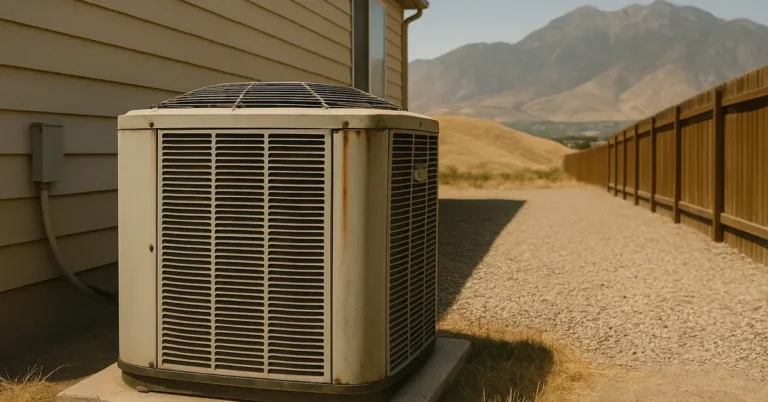
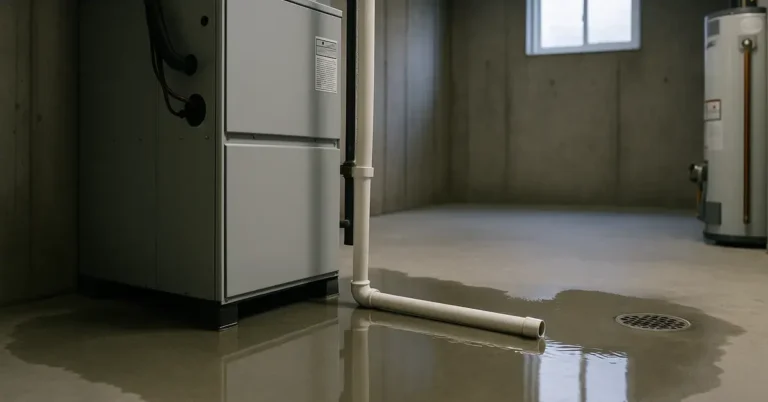
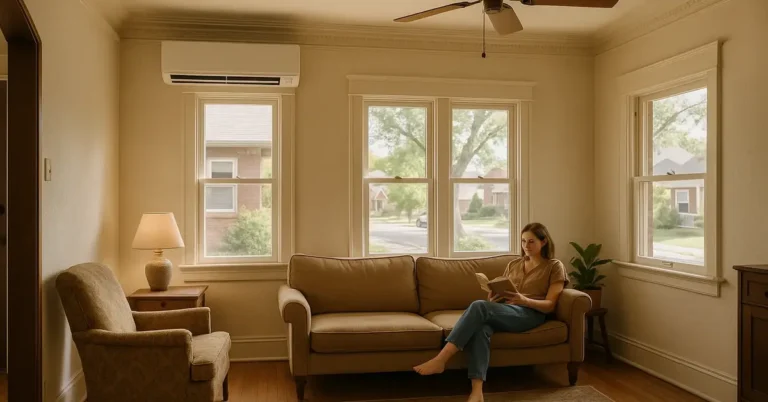
We met a family in Lehi last summer who’d gotten three bids on a new AC system. One contractor said they needed 3 tons. Another insisted on 4 tons. The third said 2.5 tons would be plenty. Once your system is properly sized, you can cut your AC operating costs with proven energy-saving strategies.
Same house. Three completely different answers.
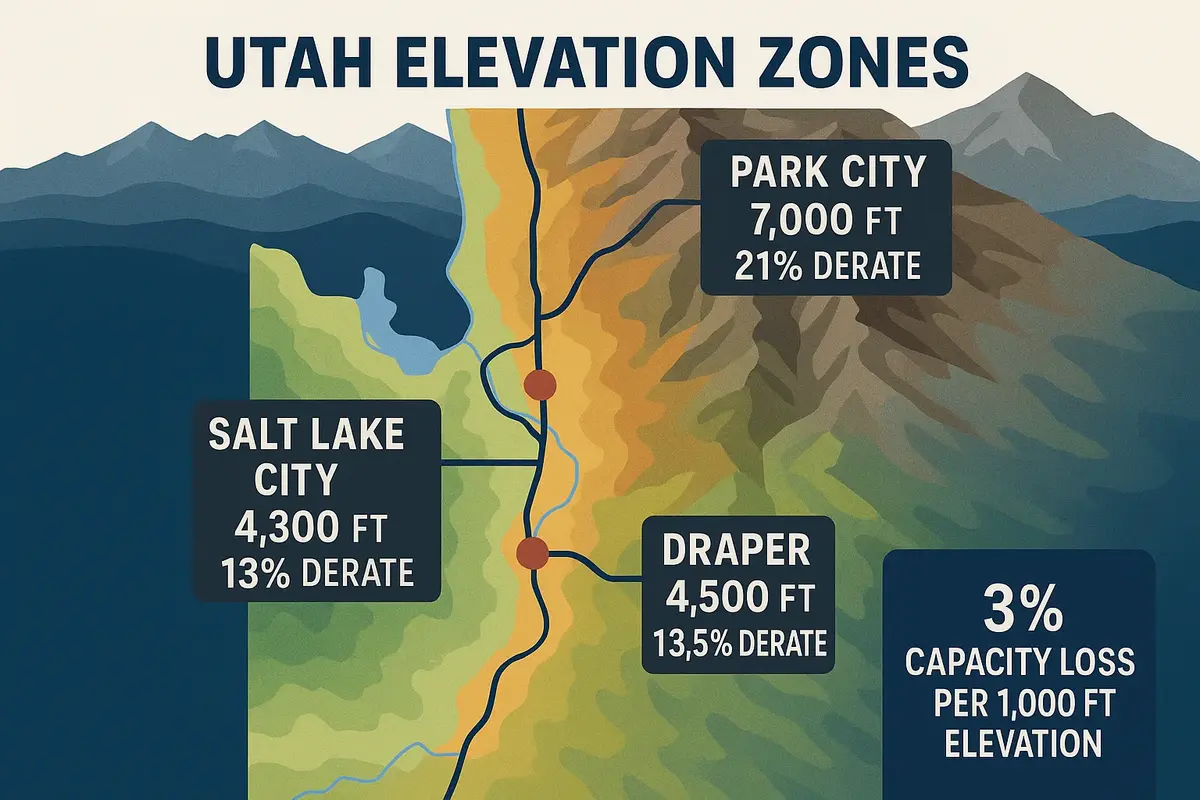
Here’s the thing about AC sizing in Utah that most guides miss: altitude matters. At 4,300 feet in Salt Lake City, your AC loses about 13% of its capacity compared to sea level. In Park City at 7,000 feet? You’re looking at a 21% drop. And even a perfectly sized system will struggle when outdoor temperatures push past 100°F and exceed design limits.
Add in our dry climate, extreme temperature swings, and high UV exposure, and suddenly those national sizing charts don’t mean much. This guide walks through the relationship between AC size and home square footage for Utah homes — where altitude and desert air change the calculation.
If your AC sizing needs attention, give us a call at (801) 997-8909. We’re happy to help.
Why Square Footage Alone Doesn’t Tell the Whole Story
Square footage is where most people start. And that’s fine — it’s a useful starting point.
But two 2,000-square-foot homes on the same street can need completely different tonnages.
One home might have vaulted ceilings, single-pane windows, and face west. The other has 8-foot ceilings, new double-pane windows, and sits in the shade most of the day. That first home might need a 4-ton unit while the second gets by with 3 tons.
Your home’s insulation quality, ceiling height, sun exposure, window types, and even the number of west-facing windows all affect how much cooling you actually need. In Utah, altitude and dry climate throw in two more variables that most online calculators completely ignore.
The Basic BTU Formula (Before Utah Adjustments)
Let’s start with the baseline. A BTU — British Thermal Unit — measures the amount of heat needed to raise one pound of water by one degree Fahrenheit. In air conditioning, we’re removing heat, so higher BTUs mean more cooling power.
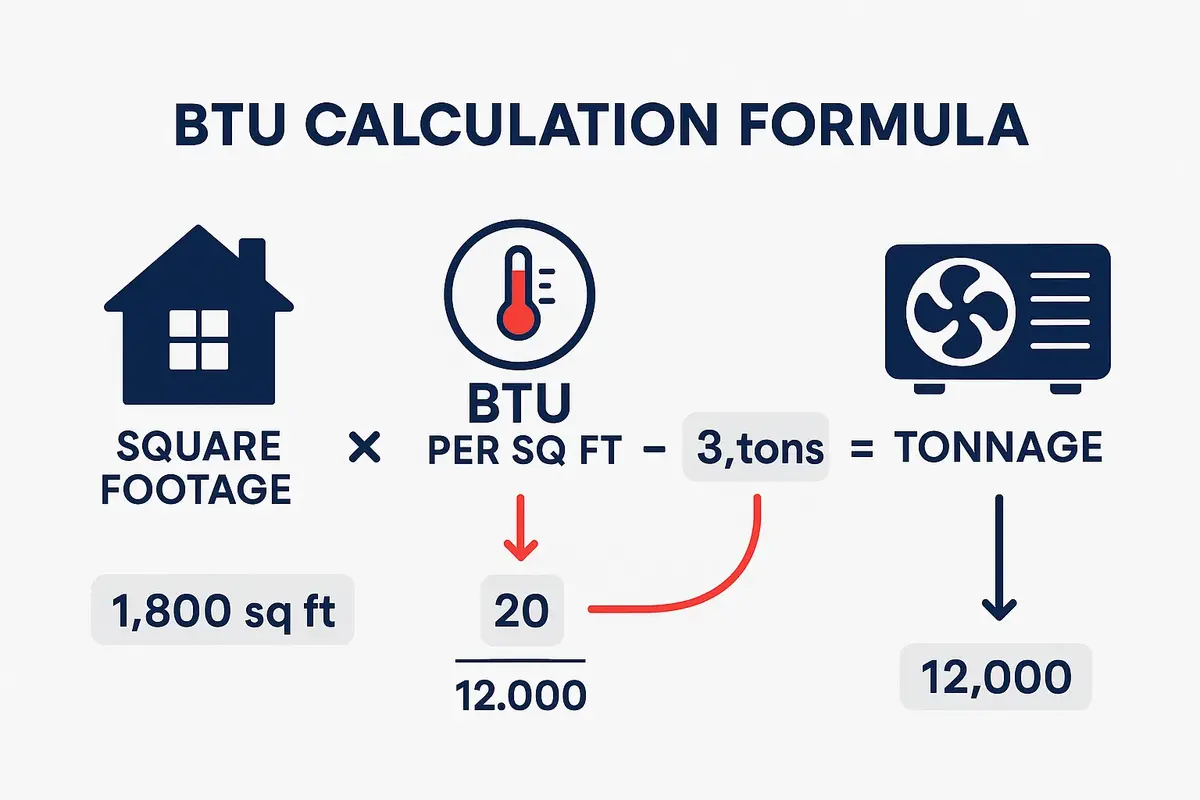
One ton of air conditioning equals 12,000 BTU per hour. A 2-ton AC moves 24,000 BTU per hour. A 3-ton moves 36,000 BTU per hour. You get the idea.
The standard formula at sea level: take your square footage, multiply by 20 to 25 BTU per square foot, then divide by 12,000 to get tonnage. For an 1,800-square-foot home, you’d calculate 1,800 × 22 = 39,600 BTU ÷ 12,000 = 3.3 tons. You’d probably round that to a 3.5-ton unit.
Why the range of 20 to 25 BTU per square foot? Climate and insulation. Utah’s dry climate typically lands around 22 to 25 BTU per square foot.
But remember — this is a sea-level calculation. In Utah, altitude changes everything.
Quick Reference: AC Size for Home Square Footage
Here’s a quick guide to AC size for home square footage. These are starting points, not final answers — Utah-specific factors (covered next) will adjust these numbers up or down.
| Home Size | Tonnage Range | BTU Range |
| 600–1,000 sq ft | 1.5–2 tons | 18,000–24,000 BTU |
| 1,000–1,500 sq ft | 2–2.5 tons | 24,000–30,000 BTU |
| 1,500–2,000 sq ft | 2.5–3 tons | 30,000–36,000 BTU |
| 2,000–2,500 sq ft | 3–4 tons | 36,000–48,000 BTU |
| 2,500–3,000 sq ft | 4–5 tons | 48,000–60,000 BTU |
| 3,000+ sq ft | 5+ tons | 60,000+ BTU |
If you’re looking at 2-ton AC replacement costs or wondering whether a 5-ton AC is right for your space, those posts have cost breakdowns and installation details for specific tonnages.
Now let’s talk about what makes Utah different.
Utah-Specific Factors That Change Everything
Utah isn’t like Houston or Phoenix. We don’t have the humidity. We do have the altitude. And that changes how AC systems perform — in ways that most national guides never mention.
Altitude Impact: The 3% Rule
Here’s what most contractors from out of state don’t know: air conditioning capacity drops by roughly 3% for every 1,000 feet of elevation. Thinner air means your AC’s compressor, coils, and fans all work harder to move the same amount of heat.
Salt Lake City sits at 4,300 feet. That’s a 13% capacity reduction right there. If you install a 3-ton unit, it’s effectively performing like a 2.6-ton unit compared to the same system at sea level.
Park City, at 7,000 feet, sees about a 21% reduction. A 4-ton unit there performs more like a 3.2-ton unit.
Most sizing charts you’ll find online assume sea level. If you plug your square footage into an AC tonnage calculator without adjusting for Utah’s elevation, you’ll undersize your system — and spend every July afternoon wondering why your house won’t cool down.
Dry Climate = Lower Cooling Load
Here’s the good news: Utah’s low humidity works in your favor. Humid air requires extra energy to remove moisture. That’s why a 2,000-square-foot home in Houston needs a 4-ton unit, while the same home in Salt Lake City can often get by with 3 to 3.5 tons.
Dry climates typically need 10 to 15% less capacity than humid regions at the same temperature. Our average summer humidity hovers around 22% in the Salt Lake Valley. Compare that to Florida at 75% humidity, and you can see why we need less cooling power per square foot.
100°F+ Days and Temperature Swings
Salt Lake City sees at least five days over 100°F every summer, and about 56 days over 90°F annually. When it’s 107°F in St. George or 102°F in West Valley, your AC gets put to the test.
Undersized systems struggle during these heat spikes. They run constantly but never quite catch up. Utah’s cool nights — we often drop into the 60s or 70s overnight — help homes recover.
Sizing consideration: you want enough capacity to handle peak heat days without short-cycling the rest of the summer. It’s a balance.
High UV Index and Sun Exposure
Altitude doesn’t just affect your AC’s performance — it intensifies the sun. Utah’s UV index peaks at 6.9 in Salt Lake City between 1 and 2 PM. That’s higher than most places at lower elevations.
West-facing homes in neighborhoods like Sugar House and The Avenues get hammered by afternoon sun. Same goes for south-facing homes in newer developments. Solar heat gain through windows can add 10 to 20% to your cooling load.
Window films can block up to 99% of UV rays and reduce heat gain by 70%. If your home has a lot of west or south exposure, that’s worth considering before you oversize your AC to compensate.
Other Factors That Affect AC Sizing
Beyond Utah’s unique climate, a few universal factors affect AC sizing in every home.
Ceiling height: Standard 8-foot ceilings are built into the basic formula. Vaulted or 10-foot ceilings can add 15 to 25% to your cooling load.
Insulation: Modern Utah homes typically have R-38 attic insulation and R-21 walls. Older homes from the 1970s and 80s often have R-11 walls and minimal attic insulation. Poor insulation increases your cooling load.
Windows and home age: Single-pane windows lose more heat in winter and gain more in summer compared to modern double-pane low-E glass. Pre-1980s homes often need more capacity.
Ductwork condition: Leaky ducts can increase your cooling load by 20 to 30%, especially if they run through unconditioned spaces. For multi-story homes dealing with uneven temperatures between floors, you may also want to consider whether HVAC zoning makes sense as part of your system planning — though proper sizing comes first.
What Happens When You Get It Wrong
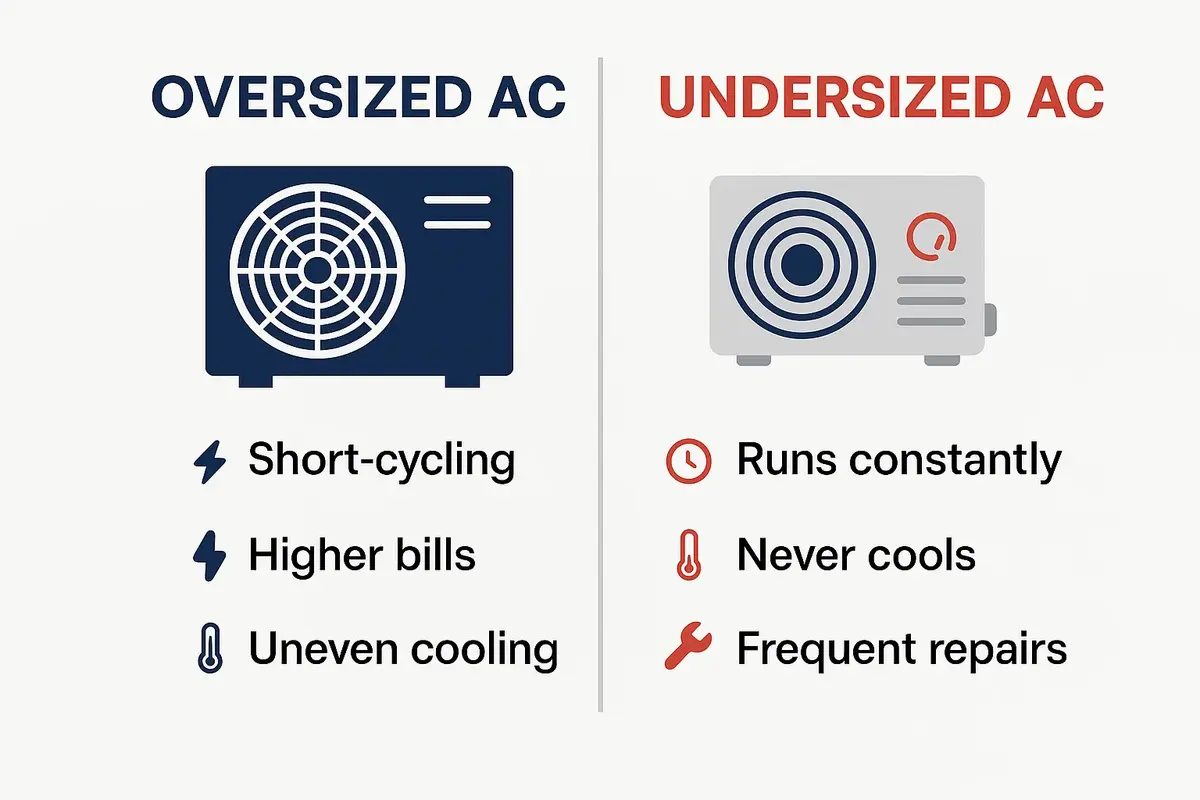
Wrong sizing isn’t just about comfort. It’s about energy bills, repair frequency, and how long your system lasts.
Oversized AC Problems
An oversized unit cools your house fast. Sounds good, right? Not really.
It reaches your thermostat setpoint so quickly that it shuts off before completing a full cooling cycle. This is called short-cycling. It means your AC starts and stops constantly, which uses more energy than steady operation. You’ll see higher electric bills.
Rooms farthest from the thermostat never quite get comfortable. And because humidity removal happens during longer run cycles, you might end up with a cold but clammy house.
In Utah’s dry climate, the humidity issue is less critical than in Florida, but short-cycling still wears out compressors, contactors, and capacitors faster. You’ll replace parts more often and shorten the system’s lifespan, which is one reason it helps to understand how many years a Utah AC typically lasts.
Undersized AC Problems
An undersized unit is the opposite problem. It runs constantly but never gets your house to the temperature you want.
On those five 100°F+ days in Salt Lake City, it just can’t keep up.
You’ll notice uneven cooling — bedrooms stay warm while the living room is tolerable. Your energy bills climb because the system never shuts off. And because it’s under constant strain, parts fail more often. Compressors burn out. Motors overheat.
Manual J: The Only Way to Get It Right
So how do you get accurate sizing when determining AC size for home square footage? A Manual J calculation. It’s the ANSI standard set by the Air Conditioning Contractors of America (ACCA), and it’s the only method that accounts for all the variables in your specific home.
A Manual J doesn’t just plug your square footage into a formula. It goes room by room. It considers insulation R-values, window solar heat gain coefficients (SHGC), home orientation, air leakage, duct losses, and local climate data.
A Utah contractor familiar with altitude should also adjust for elevation in the calculation.
A proper Manual J takes one to two hours. It’s not something you can DIY with an online BTU calculator because those tools don’t account for Utah-specific factors like altitude, dry climate, or UV intensity.
It prevents over- and undersizing. It protects your investment. And it ensures you’re comfortable year-round without wasting energy or shortening your system’s life.
We run a full Manual J calculation for every Utah home we size — accounting for altitude, sun exposure, and your home’s unique factors. Call (801) 997-8909 to schedule.
What AC Systems Cost in Utah (2026 Pricing)
Once you know what tonnage you need, you’ll want to know what it costs. Here’s what new AC installations run in Utah as of 2026:
2-ton system: $8,440 to $10,996 installed
3-ton system: $9,025 to $12,376 installed
4-ton system: $9,905 to $13,055 installed
5-ton system: Priced after on-site assessment (systems this large vary based on home configuration)
Costs vary based on SEER2 rating, brand, and installation complexity. Don’t let a small price difference push you into the wrong size — an undersized unit costs you more in energy bills and repairs over time.
For more detailed cost breakdowns, check out our guide on how much AC replacement costs in Utah. If you’re shopping for a new system in 2026, you’ll also want to know about the R-410A refrigerant phase-out and how newer R-454B systems compare in performance and efficiency.
Step-by-Step: Sizing an AC for a Utah Home
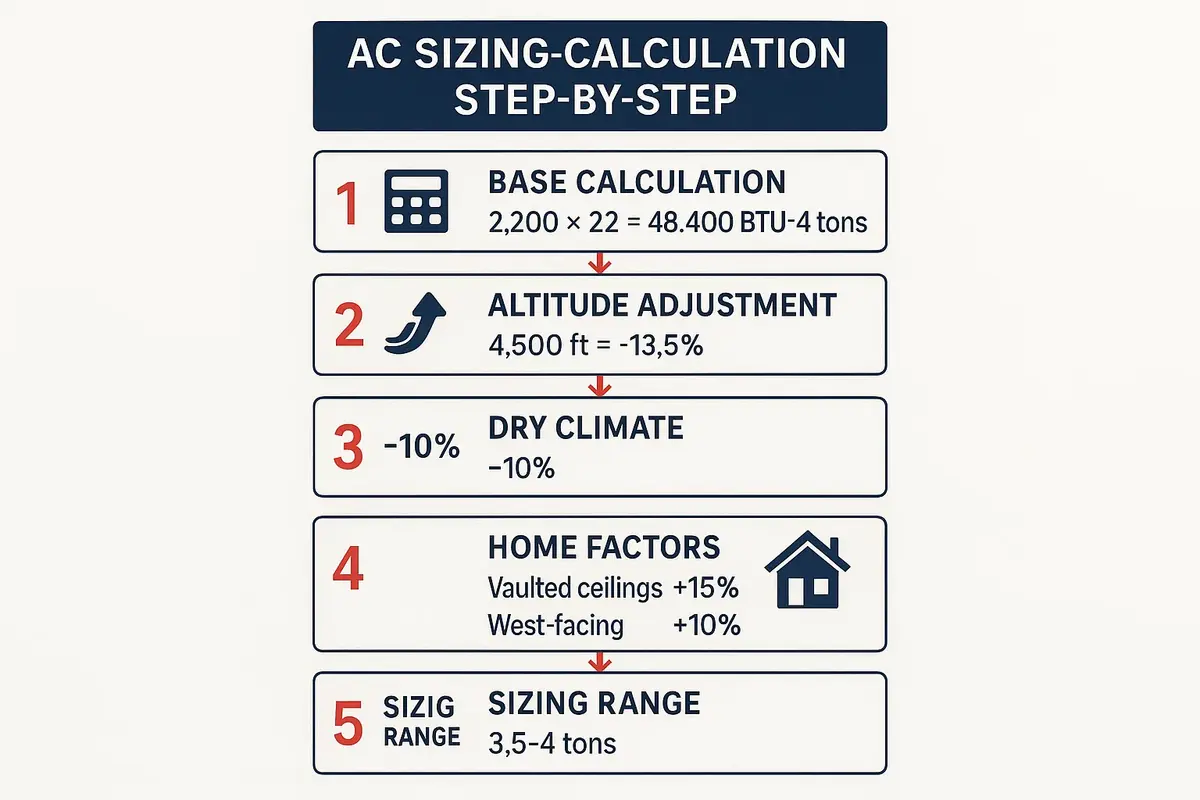
Let’s walk through a real example. Say you’ve got a 2,200-square-foot home in Draper at 4,500 feet elevation.
Base calculation: Multiply 2,200 square feet by 22 BTU per square foot (Utah’s dry climate baseline). That’s 48,400 BTU. Divide by 12,000 to get tons: 48,400 ÷ 12,000 = 4 tons.
Adjust for altitude: At 4,500 feet, you’re looking at roughly 13.5% capacity loss. A 4-ton unit at 4,500 feet performs like 3.5 tons at sea level, so you need to account for this.
Factor in dry climate: Utah’s low humidity reduces cooling load by about 10%. Subtract that from your base calculation: 4 tons × 0.90 = 3.6 tons.
Add home-specific factors: This Draper home has vaulted ceilings (add 15%) and faces west (add 10%). That adds roughly 25% back. So 3.5 tons × 1.25 = 4.4 tons.
Final sizing range: After all adjustments, we’re looking at a range of 3.5 to 4 tons. Most Utah contractors familiar with altitude would recommend a 3.5-ton unit here to avoid short-cycling.
Confirm with Manual J: A full Manual J calculation for this home came back at 3.5 tons as optimal. Without Utah adjustments, this home would have been oversized at 4 tons, leading to short-cycling and comfort issues.
Frequently Asked Questions
What AC size for home square footage do I need in Utah (1,500 sq ft example)?
Base range is 2.5 to 3 tons. In the Salt Lake Valley at 4,300 feet, altitude reduces capacity by 13%, so you’d size toward the higher end — around 2.6 to 3 tons. A Manual J calculation gives you the accurate answer.
How does altitude affect AC sizing in Utah?
AC capacity drops roughly 3% per 1,000 feet of elevation. Salt Lake City at 4,300 feet sees about 13% capacity reduction. Park City at 7,000 feet sees around 21%. Most online calculators ignore altitude, which leads to undersized systems.
What is a Manual J load calculation?
Manual J is the ANSI standard for HVAC sizing. It’s a room-by-room calculation covering insulation, windows, orientation, ductwork, air leakage, and climate data. It prevents costly sizing mistakes.
Can I use an online AC size calculator for my Utah home?
Online calculators give ballpark estimates but don’t account for altitude or dry climate. Use them as a starting point, but get a Manual J calculation before you buy.
Why is my AC running but not cooling my house?
Most likely it’s undersized for your home’s cooling load. Other causes include refrigerant leaks, dirty coils, failing compressors, or blocked airflow. Check out our post on signs your AC needs replacement for troubleshooting help.
Understanding the relationship between AC size and home square footage is critical, but it’s not the whole story. In Utah, altitude cuts your AC’s effective capacity by 13% or more. Dry climate helps by reducing the load. Extreme heat days, high UV exposure, and your home’s insulation all play a role.
Manual J load calculations are the only accurate method — especially at Utah’s elevations. DIY formulas and online calculators will get you close, but close isn’t good enough when you’re spending thousands on a system that needs to last 15 years.
We’ve been sizing and installing AC systems across the Wasatch Front for 20+ years. We know Utah’s climate and what works in your neighborhood. Give us a call at (801) 997-8909 — we’ll run a full Manual J and get you the right size, the first time.
Need help? Learn more about our AC installation or call us at (801) 997-8909. If you’re comparing ducted and ductless systems, see our guide on mini-splits vs central air for Utah homes.