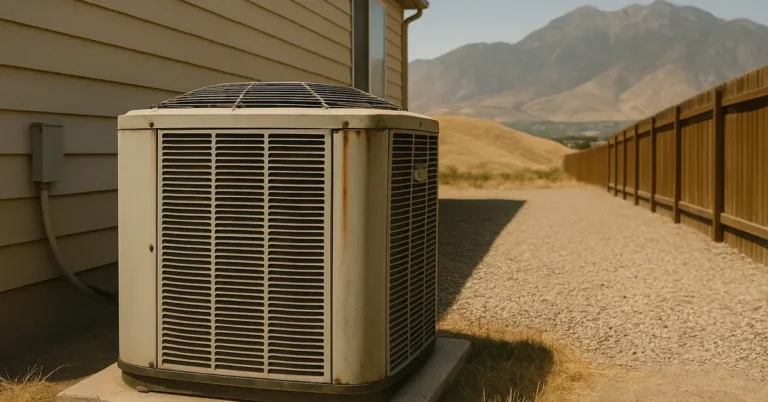
Last summer in Lehi, we got a call from a homeowner whose AC ran constantly during a stretch of 100-degree days. System looked fine at first glance — recent tune up, clean filter, refrigerant levels good. Then we walked around the side of the house.
South-facing wall. Full sun from noon to sunset. The condenser was boxed in by a fence on one side and arborvitae shrubs on the other, planted maybe 18 inches away.
The homeowner put them there for “shade.” Good intention, terrible result.
Your AC condenser placement matters. A lot. But probably not in the way you’ve heard.
If your AC struggles during Utah’s July heat — or your energy bills keep climbing even though nothing’s broken — give us a call at (801) 997-8909 and we’ll take a look.
Does AC Condenser Placement Actually Affect Cooling Performance?
Yes. And the numbers are bigger than most people think.
Heating and cooling systems account for nearly half your home’s energy use — somewhere between 48% and 55%, according to the U.S. Department of Energy. When the outdoor condenser can’t breathe, that percentage climbs fast.
Here’s what we see in the field: poor AC condenser placement can cut your system’s cooling capacity by 15 to 20 percent. One-fifth of your cooling ability, gone, just because of outdoor AC unit location.
Energy costs? Those can jump by 30% when airflow is restricted. Your compressor works harder, runs longer, uses more electricity, and wears out faster.
Clearance Matters More Than Shade (The 1% vs. 30% Story)

Let’s kill a myth right now.
You’ve probably heard that shading your AC condenser improves efficiency by 10%. It’s all over the internet. And it’s wrong.
The real number? 1 to 2.5 percent. That’s from actual research — the Florida Solar Energy Center tested condenser shade performance in 1996, and a study in Kuwait confirmed it in 2010.
Shade helps a tiny bit. But it’s not the game-changer people think.
You know what does matter? Clearance.
When your condenser doesn’t have enough space around it — when shrubs press against the sides, or a fence blocks airflow, or it’s tucked under a deck — efficiency doesn’t drop by 1%. It drops by 15, 20, sometimes 30 percent.
The condenser’s only job is to dump heat from the refrigerant into the outside air. If the air can’t move — trapped by a fence or choked off by bushes — the heat just sits there.
The condenser has to work harder. Head pressures go up. The compressor strains. And your cooling capacity falls off a cliff.
That compressor? It wasn’t designed to run at high head pressures all summer. A properly installed condenser with good clearance avoids this entirely.
But let it run hot for a few years and you’re looking at early failure. A compressor replacement on an R410a system runs $2,188 to $3,150 around the Wasatch Front. Clearance is cheap. Compressor replacements are not.
How Much Clearance Does Your Outdoor AC Unit Need?
As of 2026, Utah follows the 2021 International Mechanical Code, which says you need a minimum 30-by-30-inch working space on the side where the electrical panel and service valves are. That’s code — meaning it’s the legal minimum, not the ideal.
Manufacturers typically call for more. Most want 12 to 24 inches of open space on the sides where air gets pulled in or pushed out, and at least 5 feet of clearance above the unit.
Check your installation manual if you still have it. If not, call us — we can pull the specs for your model.
- Clearance from the house counts. You need room for airflow and service access.
- Fences and walls block air just like shrubs do.
- Decks above the condenser trap heat unless all four sides are open.
- Storage sheds, grills, trash cans — anything within two feet restricts airflow.
Here’s a Utah-specific wrinkle: we’re at 4,200 feet elevation in the Salt Lake Valley. Some manufacturers require capacity derating above 2,000 feet because the air’s thinner. Your condenser is already working harder than it would at sea level.
That altitude penalty makes airflow even more critical.
If you’re not sure whether your condenser has enough room, we’re happy to come take a look. Our spring AC startup service includes a check of the outdoor unit and the area around it. Call (801) 997-8909 to schedule.
Best Condenser Locations for Utah Homes
North side of the house is the gold standard. East side is a close second.
Why? Less direct sun. Your condenser heats up just from doing its job — it’s designed to radiate heat. Putting it in full sun on a south or west-facing wall just makes it work harder.
Does it matter in Utah? Absolutely. We’re dealing with intense heat at high altitude. The sun here hits harder than it does at sea level.
When it’s 104 degrees in West Jordan on a July afternoon, AC unit sun exposure on a south-facing wall means the condenser runs maybe 10 to 15 degrees hotter than one on the north side in the shade.
That’s not a comfort issue. That’s an efficiency issue.
When evaluating proper AC condenser placement for new installs, we recommend:
- North or east side of the house if possible.
- Level concrete pad or compacted gravel base — not bare dirt.
- Away from bedroom windows. Condensers aren’t loud, but they hum.
- Away from dryer vents and BBQ grills. Lint clogs coils.
- Out of the sprinkler zone. Utah’s got hard water — 180+ ppm in most of the valley. Sprinkler overspray means mineral buildup on your condenser coils.
The Shade Myth: What Actually Works
Shade helps. Just not as much as people think.
We’ve already covered the numbers — 1 to 2.5 percent efficiency gain, not 10. But there’s a right way and a wrong way.
Wrong way: planting shrubs around the condenser to “protect” it from the sun. This is what most people do. And it backfires every time.
The shrubs block the sun, sure. But they also block airflow. You lose 1% from heat and gain 20% in restricted airflow.
Right way: shade from above, with open sides.
A tree 10 or 15 feet away that provides afternoon shade without hanging branches over the unit? Great. A simple shade screen or awning mounted two feet above the condenser with all four sides open? Also fine.
The key is that air can still move horizontally.
If you’re landscaping around your condenser, think native Utah plants that don’t need a ton of water and won’t grow into the unit. Just keep them at least three feet away.
And honestly? If your condenser has proper clearance, you don’t need to obsess over shade. The efficiency gain is small. Focus on the airflow first.
Utah-Specific AC Condenser Placement Challenges
Utah’s tough on AC systems. Always has been.
Start with altitude. At 4,200 feet in the Salt Lake Valley — higher in Park City or Heber — AC capacity drops roughly 3% per 1,000 feet of elevation. You’re already down 12% at 4,000 feet. Poor AC condenser placement on top of altitude loss compounds the problem.
Then there’s Utah’s hard water (180 to 250 ppm on the Wasatch Front). Sprinkler overspray causes mineral scaling on coils — a white crust that acts like insulation, preventing heat release. Keep the condenser out of the spray zone and hose off the coils once or twice a summer. Not a pressure washer — that’ll bend the fins.
Our arid climate means dust and pollen cake onto coils faster than in humid states. If your condenser’s hard to reach — tucked behind shrubs or under a deck — you’re less likely to maintain it.
And temperature extremes matter. We get 100-degree days in July and sub-zero nights in January. Proper outdoor AC unit location — on a solid pad, with good drainage, away from ice buildup zones — affects how long the unit lasts.
Want to make sure your system’s sized right for Utah’s altitude and climate? Check out our guide on AC sizing for Utah homes.
5 Common Condenser Placement Mistakes in Utah Homes

We see the same AC condenser placement problems over and over. Here are the big ones.
1. Boxed in by shrubs or a fence. This is the most common mistake. People think they’re hiding an ugly box. What they’re actually doing is choking off airflow and cutting efficiency by 20% or more.
2. Under a deck with limited airflow. Decks trap heat. If your condenser’s underneath one and three sides are closed off, the hot air just circulates back into the intake. Recipe for high head pressure and early compressor failure.
3. On dirt or gravel without a level pad. Dirt settles. The unit tilts.
Refrigerant pools where it shouldn’t. The compressor has to work harder.
4. South-facing in full sun without clearance. Double whammy. The sun heats up the condenser, and poor airflow means that heat can’t escape. Your system runs hot, works harder, costs more, and wears out faster.
5. Near sprinkler heads. Hard water plus condenser coils equals mineral buildup. Also, water and electricity don’t mix.
Can You Move an Existing Poorly-Placed Condenser?
Yes, it’s doable. It depends on severity.
If airflow is severely restricted, relocating could pay for itself in 3 to 5 years through lower bills and fewer repairs. Minor issues? Probably not worth the move unless you’re replacing the unit anyway.
If your condenser’s in a tough spot and causing cooling problems, our AC repair technicians can evaluate whether relocation makes sense or if there’s a simpler fix. Call us at (801) 997-8909 and we’ll walk you through your options.
If you’re thinking about a full system replacement with better AC condenser placement, take a look at our heat pump vs. AC guide — it covers what makes sense for Utah’s climate.
Frequently Asked Questions
Does shading your AC condenser improve efficiency?
Yes, but only by about 1 to 2.5 percent. Research from the Florida Solar Energy Center and other studies shows the benefit is much smaller than the commonly claimed 10%. Shade is nice to have, but clearance and airflow matter way more.
Where should AC condenser be placed?
AC condenser placement is critical. The north or east side of the house — less direct sun, cooler in the afternoon. It should be on a level concrete pad or compacted gravel base, with at least 2 to 3 feet of clearance on all sides and 5 feet of clearance above. Keep it away from bedroom windows, dryer vents, sprinklers, and anything that blocks airflow.
How much clearance does an AC unit need?
Building code requires at least a 30-by-30-inch working space on the service side. Manufacturers typically call for 12 to 24 inches of clearance on the sides and 5 feet above the unit. We recommend at least 2 feet all the way around for good airflow and easy maintenance access.
Can AC condenser be in direct sunlight?
It’ll work fine. But a condenser in full sun on a south or west-facing wall runs hotter, especially in Utah’s intense high-altitude sunlight. That cuts efficiency slightly and can shorten compressor lifespan.
North or east side placement is better when possible.
Can you put an AC condenser under a deck?
Only if all four sides are open and there’s plenty of clearance above. If the deck traps heat or restricts airflow, you’ll lose efficiency and put extra strain on the compressor.
We’ve seen this setup cause problems more often than it works well.
Want a professional to evaluate your AC condenser placement? Our $69 AC tune up includes a full inspection of the outdoor unit, coil cleaning, and airflow assessment. Weekdays 9 AM-5 PM only.
Final Thoughts
Clearance beats shade. Every time. Give your condenser room to breathe — 2 to 3 feet on all sides, open sky above — and it’ll run cooler and last longer.
If your outdoor unit’s crammed into a corner or boxed in by shrubs, you’re leaving money on the table.
Take a walk around your house and look at your condenser. Does it have space? Can air move freely? Is it sitting level?
If the answer to any of those is no, give us a call at (801) 997-8909.
Quick fixes? We’ll tell you. Worth relocating? We’ll give you a straight quote with no pressure. The $49 dispatch fee applies weekdays 9am-5pm and is applied to your repair; after 5pm, weekends, and holidays it is $149.
We’re a family-owned company that’s been doing this for 20+ years across the Wasatch Front. We know Utah homes, Utah weather, and what actually works at 4,200 feet.
Ninja HVAC also serves Henefer and surrounding communities.
Ninja HVAC also serves Hideout and surrounding communities.