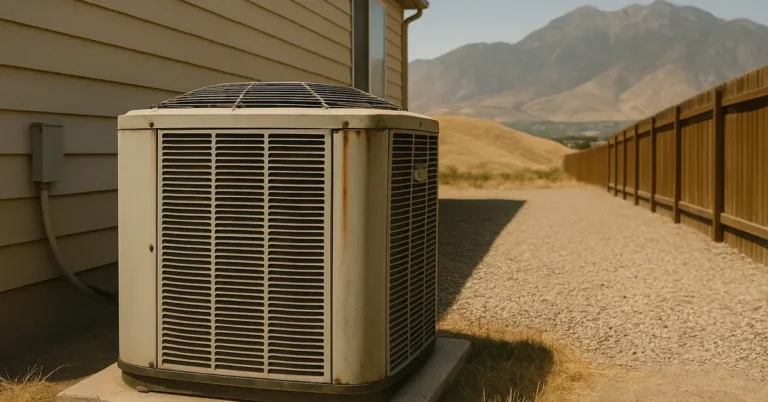
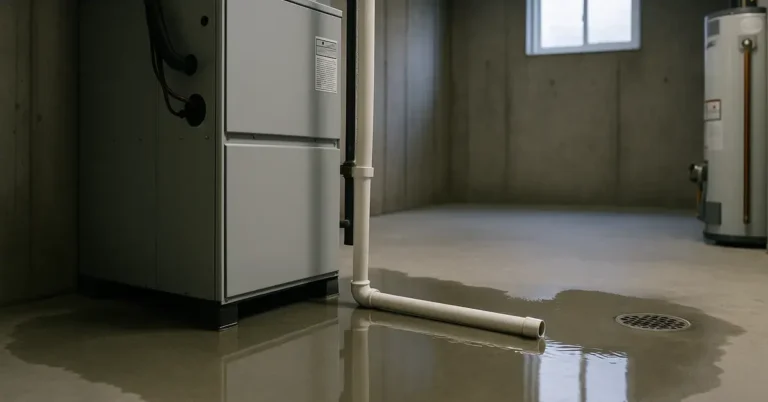
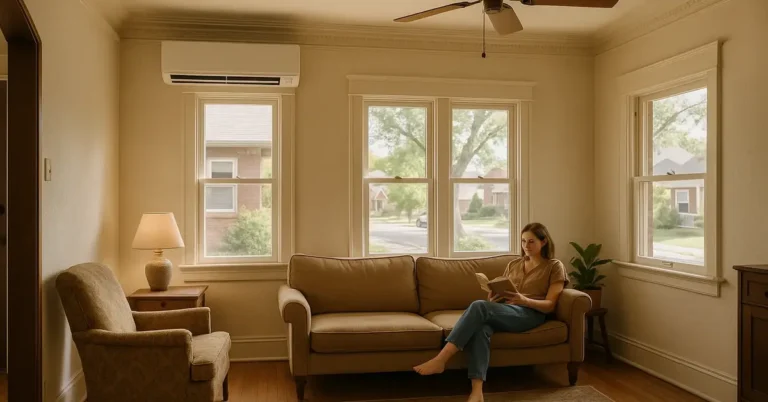
It’s 97°F outside in the Salt Lake Valley. Your thermostat is set to 72°F. The house won’t drop below 78°F, and your AC has been running nonstop for six hours.
You’re standing in front of the vent checking for cold air. Is my system broken?
Here’s the truth. When temperatures hit 95°F and above, your AC is probably working exactly as designed — even though your house feels warmer than you want. The physics of cooling, combined with Utah’s unique altitude challenge, means your system has limits. Those limits kick in right around the temperature we see 23 days a year. Even within those limits, you can reduce your summer AC energy costs without sacrificing comfort.
Struggling right now? Give us a call at (801) 997-8909. We’ll check whether you’re dealing with normal design limits or a real problem.
Why Your Air Conditioner Not Keeping Up When Utah Temperatures Hit 95°F+
Air conditioners aren’t built to cool your home to any temperature you want. They’re sized based on something called a design temperature — and in Salt Lake City, that number is 95°F.
This comes from ACCA Manual J, the national standard for sizing HVAC systems. Engineers use 30-year climate averages to find the temperature exceeded only 1% of the hours per year. In the Wasatch Front, that’s 95°F.
The system is built to maintain comfort the other 99% of the year — not during the extreme days.
Salt Lake City averages 23 days per year above 95°F. Five to eight days push past 100°F. Those are the 1% hours your AC wasn’t designed for.
Then there’s the 20-degree rule. Most air conditioners cool about 20°F below outdoor temperature. Not a defect. Physics.
When it’s 95°F outside, a working system holds your house around 75°F — not the 72°F you’ve set.
Push beyond that gap and the system works exponentially harder. A Georgia Tech professor put it this way: it’s like climbing a mountain. The higher you go, the harder every step becomes.
Continuous operation during extreme heat isn’t a breakdown. When AC struggles in heat beyond design limits, it’s working as hard as it can to get you as close to comfortable as thermodynamics allows.
Utah’s Double Challenge: Altitude and Extreme Heat

National HVAC advice won’t tell you this. Utah’s elevation makes everything harder. At 4,300 feet in the Salt Lake Valley, the air is thinner. Thinner air means less heat transfer.
Air conditioners lose about 4% of cooling capacity for every 1,000 feet above sea level.
Do the math. A system rated for 24,000 BTUs at sea level delivers only about 20,000 BTUs in Salt Lake City. That’s a 17% capacity loss before you turn the unit on.
So when it’s 97°F outside and your AC is rated for a 95°F design day, you’re already starting behind. The unit is undersized compared to its nameplate rating because of where you live. Add the temperature climb above design conditions, and the system is working double-time.
Park City, Heber Valley, or another mountain community above 7,000 feet? The penalty is even steeper. You’re looking at a 28% capacity reduction. A 3-ton unit performs like a 2-ton unit.
The physics gets worse as temperatures rise. Your outdoor condenser coil is trying to reject heat into air that’s already blazing hot. The hotter the air outside, the harder it is to dump heat — you’re pushing against your AC capacity limits. This is why the same unit that keeps you comfortable in May starts to struggle in late July when the valley bakes.
Utah’s dry climate does give you one advantage. Low humidity — usually below 30% in summer — means your AC doesn’t work as hard to dehumidify. That’s a hidden boost. But it doesn’t fully offset the altitude penalty.
What “Normal” Performance Actually Looks Like
Let’s reset expectations. On a 95°F afternoon in West Valley or South Jordan, your AC should hold the house around 75°F to 77°F. Not 72°F.
Walk in and see 76°F inside while it’s 98°F outside? Your system is doing its job.
Continuous operation is normal. The unit runs continuously. No cycling off. No breaks.
Normal during peak heat. The system is sized to cycle during moderate temperatures. But when you’re in the extreme 1% of hours, continuous operation is what you want.
Cold air from the vents — check your supply registers. You should feel a strong, cold stream. A temperature gap of about 15°F to 20°F between return air and supply air.
Steady, consistent operation without weird noises, ice buildup, or warm air. If you do spot frost on the indoor coil, that is a different problem worth knowing why an AC coil freezes in peak Utah heat.
Seeing those signs? Your AC isn’t struggling. It’s working at the edge of its design envelope — exactly where it should be when it’s 100°F in Eagle Mountain.
When It’s NOT Normal: 6 Problems That Make Heat Worse
Now that you know what’s normal, here’s when to worry. These six issues turn a managing system into a failing one.
Dirty Air Filter
A clogged filter chokes your system. Restricted airflow forces the blower to work harder. Less air means less cooling. During extreme heat, a dirty filter can be the difference between 76°F and 80°F indoors.
Check your filter monthly. Replace it every one to three months. This is a $15 fix you can do in two minutes. For Utah’s dusty summer conditions, see our guide on how often to change your AC filter during Utah’s dusty summer.
Dirty Condenser Coils

The outdoor unit has metal fins that reject heat. In Utah, those fins collect dust, cottonwood seeds, and hard water scale from sprinklers. A coated coil can’t shed heat well. Your system runs hotter and cools less.
Gently rinse the coils with a garden hose — spray from inside out to avoid bending fins. But a professional cleaning during a tune-up gets deeper and removes mineral buildup that water alone won’t touch.
We see this all the time. A coil cleaning brings back 10% to 15% of lost capacity. That can mean the difference between struggling and keeping up.
Low Refrigerant (Leak)
Refrigerant doesn’t get “used up” like gas in a car. If you’re low on refrigerant, there’s a leak. Low levels reduce cooling capacity and can cause ice on the lines — even when it’s 95°F outside.
Signs: ice on copper lines near the indoor unit, warm air from vents, and a system that runs constantly but never reaches setpoint. For a complete breakdown of what to look for, see our guide on 5 signs your AC is low on refrigerant. Not a DIY fix. Refrigerant leaks need a licensed tech to locate, repair, and recharge.
Undersized System
Some homes in older Utah neighborhoods — the Avenues, Sugar House, parts of Holladay — have AC units sized in the 1980s. Back then, Salt Lake’s summer highs were cooler.
A unit that was adequate 40 years ago might be undersized for today.
Has your system always struggled during heat? More than 20 years old? You might be dealing with a capacity mismatch — and at that age, you’re also well past when most Utah AC units need replacement. A Manual J load calculation can tell you if your home needs a bigger unit.
Worth having this conversation before you spend thousands repairing an undersized system.
Our AC replacement guide walks through sizing and cost considerations.
Leaky Ductwork
30% of your cooled air escaping into the attic or crawlspace? Your system will never keep up. Leaky ducts are common in Utah homes, especially older construction. You’re paying to cool spaces that don’t matter while the rooms you live in stay warm.
Signs: hot and cold spots, dusty return vents, and higher energy bills. Duct sealing and insulation can recover that lost capacity. Not glamorous, but it works. Learn exactly how much this costs you in our breakdown of how leaky ducts waste $600 a year.
Failing Compressor
Compressors are the heart is the heart of the AC. When it starts to fail, cooling capacity drops. A 15-year-old compressor working overtime during a Utah heat wave is under serious stress. Weak cooling, hard starts (often a cheap capacitor giving out in the July heat), or the outdoor unit struggling to kick on — these are the signs. If you’re hearing odd sounds too, check our guide to 6 weird AC noises and what they mean before the compressor fails completely.
Compressor replacement is expensive. Often $2,000 to $3,000. On an older system, that cost pushes you toward full replacement instead of repair. We’ll walk you through the math.
Seeing any of these six problems? Call us at (801) 997-8909 and we’ll get a tech out to diagnose what’s happening. Our AC repair technicians can pinpoint whether you’re hitting design limits or facing a real failure. Our tune-up service catches most of these issues before they become expensive failures.
What to Do During Utah’s Extreme Heat Days
You can’t change the physics. But you can help your AC work smarter.
Close the blinds on south- and west-facing windows during the afternoon. Solar heat gain through glass is brutal. A closed blind cuts heat gain by 40% or more.
Your AC is fighting the sun as much as the outdoor temperature.
Run ceiling fans counterclockwise to push air down and create a wind-chill effect. Moving air feels cooler even if the actual temperature hasn’t changed. In Utah’s dry climate, a fan lets you feel comfortable at 76°F or even 78°F instead of demanding 72°F from a system that can’t deliver it on 95°F+ days.
Never set your thermostat more than 20 degrees below outdoor temperature. It’s 100°F outside? Setting the thermostat to 68°F won’t cool the house faster. It forces the system to run past its design limits, which stresses the compressor and wastes energy.
Set it to 78°F or 80°F and let the system work within capacity.
Take advantage of Utah’s cool evenings. When outdoor temperatures drop below 75°F after sunset, consider using a whole house fan to flush out the day’s heat. This gives your AC a head start the next morning and can reduce runtime during peak afternoon hours.
Schedule a pre-summer tune-up in May or early June — before the heat wave hits. A clean system with proper refrigerant charge performs at its peak. Our Home Health Plan includes two tune-ups per year and priority scheduling. You’re not waiting three days for service when it’s 105°F.
Frequently Asked Questions
Can my AC keep up with 95-degree weather?
Yes, when it’s properly sized and maintained. Most Utah systems are designed for 95°F outdoor temperature. Your home should stay around 75°F to 77°F when it’s 95°F outside. Hotter than 95°F?
Expect the indoor temperature to climb a few degrees. Normal.
Is it normal for my AC to struggle in 100-degree heat?
Absolutely. Systems in the Wasatch Front are sized for 95°F, exceeded only 1% of the year. On the 5 to 8 days per summer when it hits 100°F or higher, your AC is working beyond its design capacity.
Continuous operation and indoor temps in the mid-to-upper 70s are expected.
What temperature should I set my AC to in extreme heat?
Set it no more than 20 degrees below outdoor temperature. It’s 98°F outside? Set your thermostat to 78°F.
Setting it lower won’t cool faster. It just makes the system work harder without delivering more comfort.
How do I know if my AC is undersized?
Your system has always struggled — even on 85°F days? Might be undersized. Age is another clue. A unit installed in the 1980s or 1990s may have been sized for a cooler climate.
A Manual J load calculation from a licensed tech will tell you if your home needs more capacity.
Why does my AC struggle when it’s hot outside?
Two reasons: the 20-degree rule and altitude. Most ACs cool about 20°F below outdoor temperature. At 4,300 feet in the Salt Lake Valley, your system also loses 17% of rated capacity due to thinner air. When outdoor temps climb above 95°F, you’re asking the system to perform beyond what it was designed to deliver.
Conclusion
Most AC “struggles” during extreme Utah heat are just physics. System running nonstop and keeping the house in the mid-70s when it’s 97°F outside? It’s working.
But ice on the lines, weak airflow, or indoor temps above 80°F on a 95°F day? That’s a real problem worth diagnosing.
Give us a call at (801) 997-8909 and we’ll send a tech out with a 120-minute response guarantee during business hours. We’re open 7 days a week — and emergency calls are handled after hours. Utah state licensed, family-owned, and backed by 20+ years of keeping Wasatch Front homes comfortable through every heat wave.