You’re sitting in your 1920s Liberty Wells bungalow on a 102-degree July afternoon. The plaster walls are beautiful. The crown molding is original. And you’re absolutely miserable because there’s no air conditioning — just a box fan in the window that’s pushing hot air around.
Adding central air would mean tearing through those plaster walls, ripping out sections of ceiling, and probably destroying the very features that made you fall in love with the house. The contractor quoted $12,000 for ductwork alone, before they even talked about the AC unit. There’s got to be a better way.
There is. Mini-splits were practically invented for homes like yours — historic Utah houses that were built before anyone imagined needing air conditioning. A 3-inch hole through the wall. No demolished plaster. No destroyed moldings. Just cool air where you need it.
If your old Utah home needs AC without tearing up the walls, give us a call at (801) 997-8909. We’ve retrofitted hundreds of Wasatch Front historic homes.
Why Utah’s Historic Homes Were Never Built for AC
Walk through Liberty Wells, the Avenues, or the older parts of Sugar House, and you’ll see thousands of homes built between 1900 and 1935. Beautiful brick bungalows. Victorian painted ladies. Solid construction with plaster-and-lath walls, ornate moldings, and absolutely zero ductwork.
Because they didn’t need it. These homes were designed for coal stoves or radiators — heat sources that didn’t require ducts. Cooling? That was what shade trees and open windows were for.
Fast forward to today. Salt Lake Valley summers regularly hit 100°F or higher. Those same homes that were designed for natural ventilation are now sweltering boxes. And retrofitting them with traditional central air means cutting through walls that have stood for over a century.
The problem gets worse at altitude. At 4,300 feet in Salt Lake City — or 7,000+ feet in Park City — air conditioners work harder because the air is thinner. Your old home wasn’t designed for modern cooling loads, and Utah’s elevation makes those loads even heavier. It’s a mismatch that leaves a lot of homeowners choosing between comfort and preserving their home’s character.
Unless you skip the ductwork entirely. That’s where ductless mini split retrofit solutions come in.
The Problem: Why Adding Ductwork Destroys Historic Homes
Let’s say you call a traditional HVAC contractor about cooling old home without ducts — specifically, adding central air to your 1920s bungalow. They’ll tell you: we need to cut through your plaster walls to run supply ducts. We need to open up your ceiling to install return air plenums. We might need to remove that decorative ceiling medallion. Oh, and the total for ductwork installation? Priced after assessment, and that’s before we even talk about the air conditioner itself.
Because old homes weren’t built with modern HVAC in mind, there are no convenient chase spaces to run ducts. Wall cavities are often filled with plaster and lath, not the open stud bays you’d find in a newer home. Ceilings have decorative elements you can’t just cut through without losing the character of the house.
And even if you’re willing to accept the cost and the mess, you’re still facing a system that’s inherently inefficient. The U.S. Department of Energy says that ducted systems lose 20-40% of conditioned air through leaks and poor insulation. In a retrofit scenario — where ducts are being squeezed into spaces they were never meant to occupy — that loss can be even higher.
Some homeowners in Salt Lake City’s historic districts face an additional hurdle: the Historic Preservation office may require approval for major modifications that alter the exterior or key interior features. That 1910 brick exterior? You can’t just punch a bunch of vent holes in it without going through the proper channels.
So you’re left with a choice that feels impossible: stay hot, or gut your home’s historic character.
How Mini-Splits Cool Old Homes Without the Demolition
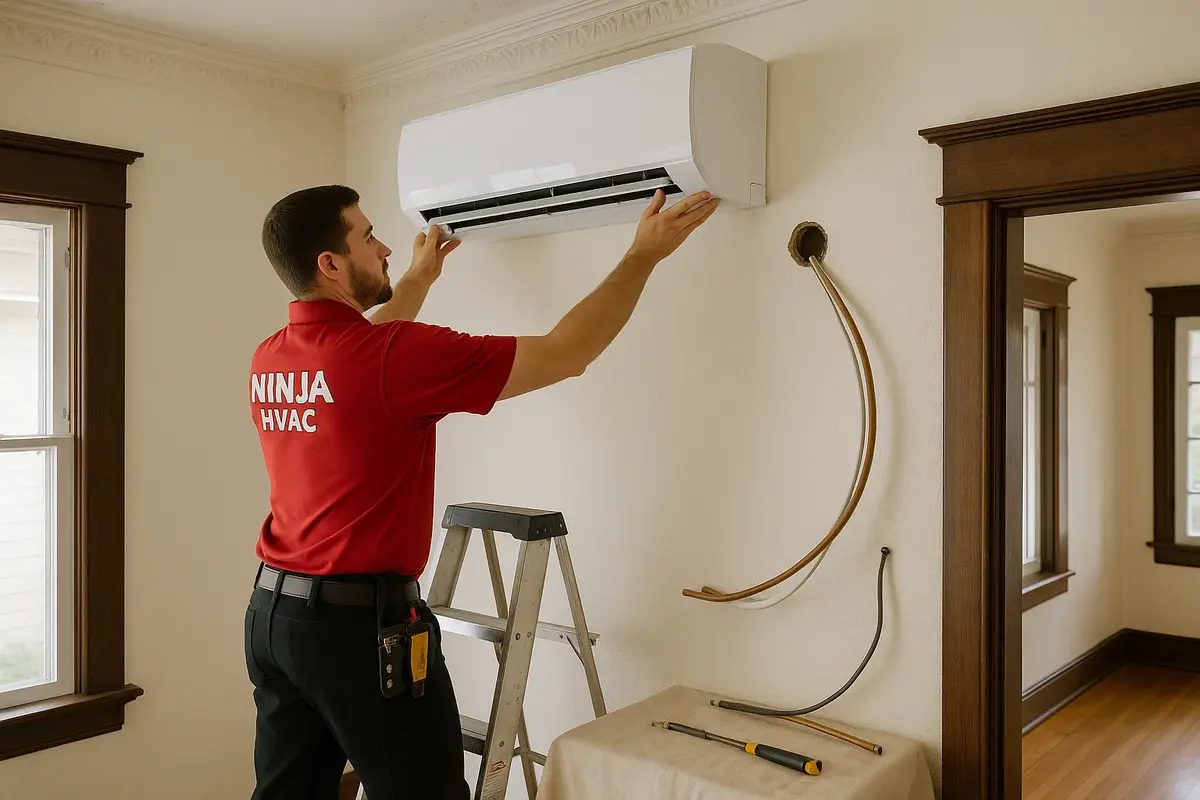
A mini-split installation in an old Utah home looks like this. The installer drills a single 3-inch hole through the exterior wall. They mount a slim indoor unit on the wall (or a recessed cassette in the ceiling if you want it even less visible). They run refrigerant lines and a condensate drain through that 3-inch hole to an outdoor compressor unit. Done.
No ductwork. No demolition. The plaster walls stay intact. Crown molding doesn’t get touched. The ceiling medallion remains exactly where it’s been for the last hundred years.
And because there are no ducts, you don’t lose 20-40% of your cooling to leaks and poor insulation. Every bit of cool air the system produces goes directly into the room where you need it. That efficiency matters in Utah, where cooling loads are high and electricity isn’t cheap.
These systems also give you room-by-room control. In a typical bungalow, you might cool the living room and bedrooms during the day, then shift to cooling just the bedrooms at night. That kind of zoning saves energy and gives everyone in the house the temperature they want.
Here’s the bonus: most mini-splits are heat pumps, which means they provide both heating and cooling. If your old radiators are on their last legs or you’re still heating with baseboard electric, a mini-split can replace both your cooling and heating systems. One unit, year-round comfort.
Installation takes one to two days, not weeks. You’re not living in a construction zone. You’re not patching and repainting half your house. You drill a hole, mount some equipment, and you’re done. Need professional installation? Learn more about our AC installation services or call (801) 997-8909.
What Makes Utah Old-Home Mini-Split Installs Different
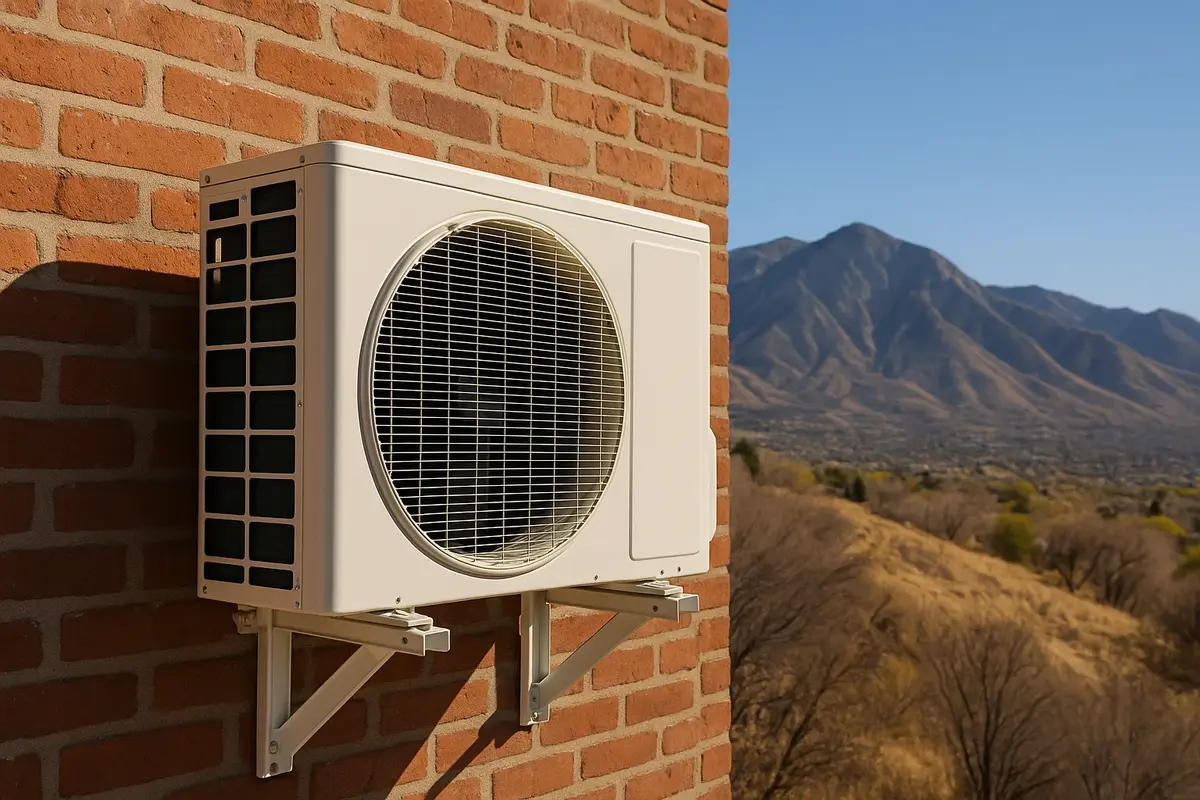
Installing a mini-split in a Utah historic home isn’t the same as installing one in a newer house in Phoenix or Portland. Utah’s combination of altitude, extreme temperature swings, and hard water creates challenges that don’t show up in the national how-to guides. Here’s what actually matters when you’re cooling a 1920s bungalow in Salt Lake City or the Avenues.
Sizing for Utah’s Altitude
At 4,300 feet in Salt Lake City — or higher in foothill neighborhoods — air conditioners lose about 24% of their rated capacity because the air is thinner. That means a mini-split rated for 12,000 BTU at sea level is really delivering closer to 9,000 BTU here.
In an old home with minimal insulation and single-pane windows, undersizing is a disaster. You need a contractor who knows how to account for altitude derating and can properly size the system for both your elevation and your home’s cooling load. Generic online calculators won’t cut it.
Cold-Climate Models Are Essential (Not Optional)
Standard mini-splits lose efficiency fast when the temperature drops below 5°F. They’re designed for mild climates, not Utah winters where it can hit -10°F in January.
Cold-climate mini-splits are rated to maintain 80% of their heating capacity at -22°F. That’s the difference between a system that actually keeps your house warm all winter and one that makes you fire up the space heaters every time the temperature drops. If you’re planning to use your mini-split for heating — which makes sense if you’re replacing old baseboard heaters or a dying furnace — cold-climate models aren’t optional. They’re essential.
Not every contractor stocks or recommends cold-climate units. Make sure you’re getting one that’s actually rated for Utah winters, not just summers.
Utah’s Hard Water Affects Maintenance
Utah has some of the hardest water in the country — 300 to 400+ parts per million of calcium and magnesium. That’s great if you like mineral deposits, terrible if you have any equipment that produces condensate.
Mini-splits generate condensate when they cool. In most of the country, that condensate drains away without issue. In Utah, those minerals build up in the condensate pan and drain line faster than the national average. You’ll need to flush the drain annually, not every 2-3 years like the manuals suggest. If you’ve dealt with Utah’s hard water on your plumbing, you already know the drill.
How Mini-Splits Compare to Swamp Coolers in Utah
If you live in an old Utah home, someone has probably suggested a swamp cooler. And honestly, in Utah’s dry climate, swamp coolers work pretty well. They consume only 15-35% of the electricity a mini-split uses, which is a big deal if you’re trying to keep costs down.
But swamp coolers don’t heat. They don’t work when humidity climbs above 30%. And they require opening windows, which isn’t ideal if you’re trying to preserve conditioned air. For a full breakdown, check out our swamp cooler vs AC comparison. Mini-splits cost more upfront and use more electricity, but they work all year and handle both heating and cooling.
Electrical Panel Upgrades for Old Homes
Most homes built in the 1900s through the 1930s have 60 to 100 amp electrical service. That was plenty for a few lights and a refrigerator. It’s not enough for a modern mini-split, which needs a dedicated 20 to 30 amp circuit.
You might need a panel upgrade. The cost is priced after assessment and it’s not optional if your current panel can’t handle the load. The good news: once it’s done, you’ll have capacity for other modern upgrades, too.
Every old home is different — wall thickness, insulation, electrical capacity, elevation. We’ll assess all of it before recommending a system. Call (801) 997-8909 for a free evaluation.
What Mini-Splits Actually Cost for Old Utah Homes
Let’s talk numbers. A single-zone mini-split — one indoor unit, one outdoor compressor — runs $5,500 to $10,745 installed, depending on capacity and brand. That’s enough to cool a bedroom, a home office, or a main living area.
For whole-home coverage, you’re looking at a multi-zone system: $11,172 to $20,262 installed. That covers 2 to 4 indoor units connected to a single outdoor compressor. Most 1,500 square foot bungalows need 1 to 2 zones. A larger 2,500 square foot Victorian might need 3 to 4.
Compare that to adding ductwork to an old home: priced after assessment for the ducts, then priced after assessment for the central air unit. You’re easily over $20,000, and you’ve torn up your walls in the process. Mini-splits skip the demolition and often come in cheaper.
The final price depends on a few factors. Cold-climate models rated for Utah winters cost more than standard units. Altitude and insulation levels affect sizing, which affects cost. If you need an electrical panel upgrade, that’s priced separately after assessment.
A budget-friendly approach: start with the main living area or the bedrooms, then add more zones later. You don’t have to do the whole house at once. ENERGY STAR-rated models may also qualify for federal tax credits, which can offset some of the upfront cost.
Common Questions About Mini-Splits in Old Utah Homes
Can you install a mini-split in an old house?
Yes. Mini-splits are designed specifically for retrofit situations. They require only a 3-inch wall penetration — no ductwork, no tearing open ceilings, no demolishing plaster. They’re ideal for Liberty Wells bungalows, Avenues Victorians, and Sugar House homes that were built before anyone thought about central air.
Do mini-splits devalue a house?
No. Realtors rarely penalize a home for having ductless mini-splits, especially when the alternative is no cooling at all. In Utah’s 100°F+ summers, adding AC — any AC — increases value. And because mini-splits preserve historic features instead of covering them with ductwork and vents, they’re often the better choice for older homes where character matters.
Do mini-splits work in Utah’s cold winters?
Only if you install a cold-climate model. Standard mini-splits lose efficiency and stop working below 5°F, which means they’ll fail you during a Utah winter cold snap. Cold-climate models are rated to -22°F and maintain 80% of their heating capacity even in extreme cold. If you’re using a mini-split for heating, make sure it’s a cold-climate unit, not a standard one.
How many mini-splits do I need for my old house?
It depends on square footage, insulation, elevation, and how your rooms are laid out. A typical 1,500 square foot bungalow needs 1 to 2 zones. A 2,500 square foot Victorian might need 2 to 4. And because Utah’s altitude reduces cooling capacity by about 24%, proper sizing is more critical here than at sea level. Don’t guess — get a load calculation from a contractor who knows how to account for elevation.
Do mini-splits need permits in Utah?
Yes. You’ll need a building permit for the wall penetration, an electrical permit for the 220/240V circuit, and a mechanical permit for the refrigerant work. If your home is in a Salt Lake City historic district, you may also need approval from the Historic Preservation office before modifying the exterior. Permit requirements vary by city, so check with your local building department or ask your contractor to handle it.
Final Thoughts
Ductless mini-splits were made for old Utah homes. A 3-inch hole instead of demolishing walls. Dual heating and cooling for Utah’s extreme climate. Room-by-room control that saves energy. And they preserve the historic character that makes these homes worth living in.
We’ve installed mini-splits in hundreds of Wasatch Front historic homes — Liberty Wells bungalows, Avenues Victorians, Sugar House cottages. We’re Utah state licensed, family-owned, and we’ve been serving the Wasatch Front for 20+ years. We know how to work with plaster walls, tight electrical panels, and Utah’s altitude. Call (801) 997-8909 for a free assessment that accounts for your home’s age, insulation, electrical capacity, and elevation.