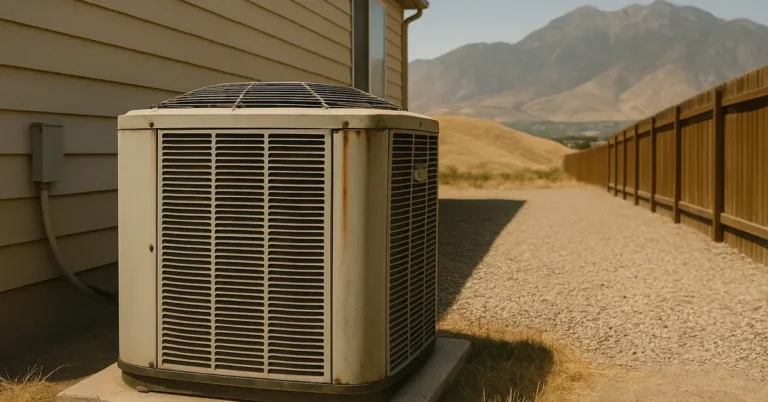
You pull the filter out after 30 days, just like you always do. And it’s caked — completely gray, packed solid with what looks like fine powder. You live in Eagle Mountain, and there’s been construction two streets over for the last three months. Welcome to summer 2026 in Utah.
How often to change AC filter on the Wasatch Front is different than anywhere else. If you’ve been following the “change your filter every 90 days” rule you read online, you’re already behind. That guideline works in places like Seattle or Charleston. But here, where dust from the Great Salt Lake mixes with construction activity, altitude, and 100-degree days, it makes all the difference.
Most Utah homes need to change their AC filter every 30 to 60 days during the cooling season — not 90. Depending on where you live, what you’re running, and what’s happening outside your windows, you might need to check even more often.
How Often to Change AC Filter in Utah: Every 30-60 Days
The national baseline for filter replacement is 30 to 90 days, depending on variables like pets, allergies, and system runtime. That’s a wide range, and it assumes you’re living at sea level in a moderate climate.
Utah throws all of that out the window.
Between 4,000 and 6,000 feet elevation, your HVAC system is moving about 15 to 20 percent more air volume than it would at sea level just to achieve the same cooling. Air density at our altitude is only 82 percent of what it is on the coast. Your blower works harder and pushes more air through that filter every day.
Add Utah’s dust — from dried lake beds, sagebrush, and all the new housing going up from Lehi to Saratoga Springs — and you’ve got a filter that clogs faster than anywhere else in the country. The EPA says indoor air can be two to five times more polluted than outdoor air. In Utah, that gap gets even wider if your filter isn’t doing its job.
So the rule: check your filter once a month. If it looks dirty or airflow feels weak, swap it out. Most homes will land in the 30- to 60-day range during peak cooling season.
If your filter needs attention and you’re not sure where to start, give us a call at (801) 997-8909. We’ll walk you through it based on where you live and what you’re running.
Why Utah Filters Get Dirty Faster

You’ve probably noticed — dust just doesn’t settle here the way it does in other places. You wipe down the kitchen counter in the morning, and by evening there’s a thin layer of grit again. That’s not in your head.
Utah’s a dustier place than most of the country, and your AC filter is the front line of defense. This changes how often to change AC filter compared to the national average.
At 4,500 feet in Salt Lake Valley or 5,200 feet in Park City, the air is thinner. Your HVAC system compensates by moving more volume through the filter to deliver the same amount of cooling. That’s 15 to 20 percent more air — and more dust, pollen, and particulates — every hour the system runs.
Then there’s the Great Salt Lake. As water levels drop, exposed lake beds release fine dust that drifts across the Wasatch Front. The Utah Department of Environmental Quality has flagged this as a worsening air quality issue, especially during dry, windy conditions.
Construction makes it worse. If you’re in Eagle Mountain, Lehi, or Saratoga Springs, you know what I’m talking about. New developments mean dirt roads, grading equipment, and dust clouds that blanket entire neighborhoods. Homes within a quarter mile of active construction sites can see filters clog in as little as 20 to 30 days.
Because Utah’s so dry, that dust stays airborne longer. Low humidity means particles don’t clump together and drop to the ground the way they do in humid climates. Instead, they circulate — right into your return vents and straight into your filter.
Utah’s cooling season is long. May through September, sometimes into early October, your AC is running. The U.S. Department of Energy says heating and cooling account for 52 percent of household energy use. That’s a lot of runtime — and a lot of exposure for your filter.
AC Filter Replacement Schedule by Utah Season
Not all months hit your filter the same way. How often to change AC filter varies by Utah season.
Spring (March-May): Every 30-45 Days
Spring is when tree pollen peaks across the Wasatch Front. Cottonwood, juniper, and maple trees release clouds of pollen that coat cars, sidewalks, and air filters. If you or anyone in your house has allergies, this is when you’ll feel it most.
Temperature swings also increase how often your system cycles on and off. That means more air movement and faster filter loading. Upgrade to a MERV 11 filter if you’re still running basic MERV 8s. The extra allergen capture makes a noticeable difference during pollen season.
If you’re firing up your AC for the first time after winter, check out our spring AC startup checklist — filter replacement is step one.
Summer (June-August): Every 30 Days
Summer is the toughest season on filters, hands down.
Grass pollen peaks in June and July, adding another layer of allergens to the mix. Dust levels hit their highest point as the ground dries out and afternoon winds kick up — and that’s the same dust that clogs your condensate drain too. Your AC is running constantly — sometimes 10 to 12 hours a day — when temperatures push into the mid-90s and beyond.
Late summer also brings the risk of wildfire smoke. If you see hazy skies or smell smoke, your filter will clog faster. We’ve seen filters completely choked after just two weeks during heavy smoke events. During wildfire season, upgrading to a MERV 13 filter and running your fan continuously can make a huge difference — see our guide on how wildfire smoke gets inside Utah homes and what to do about it.
Bottom line: check your filter every 30 days in summer. If it looks gray or you notice weak airflow from your vents, swap it right away. A clogged filter is also the top reason your AC coil freezes over in summer heat.
Fall (September-November): Every 45-60 Days
Fall gives your filter a bit of a break. Ragweed and sagebrush pollen show up in September and October, but overall particulate levels drop as temperatures cool and construction activity slows.
Your system isn’t cycling as hard, either. Moderate temps mean less runtime and less air moving through the filter. You can usually stretch the interval to 45 or even 60 days during this window — just keep an eye on it.
Winter (December-February): Every 60 Days
Winter is the lightest load for filters. No pollen, lower dust levels, and if you’re running a furnace instead of a heat pump, the system isn’t cycling as frequently.
That said, if you’re in the Salt Lake Valley or Utah Valley and you run your furnace heavily during temperature inversions, you’ll want to shorten the interval to 45 days. Inversions trap particulates close to the ground. Recirculating that air puts extra demand on your filter.
AC Filter Schedule by Utah Location (Not Just Season)
Forget the 90-day rule. Here’s the AC filter replacement schedule Utah homeowners actually need, based on location and season.
High-risk areas (Farmington Bay, Eagle Mountain, Layton, Syracuse, west-side communities downwind of the lake): change every 30 to 45 days during dust season. During calmer months, stretch to 60 days — but check every two weeks.
Moderate-risk areas (Salt Lake Valley, Utah Valley, Bountiful, Cottonwood Heights): 45 to 60 days during dust season, 60 to 90 days otherwise. You still get dust, just not the direct blast from the lakebed.
Lower-risk areas (Park City, higher elevations): 60 to 90 days year-round. Altitude effects still apply — your system works harder in thinner air, so monthly checks are non-negotiable.
Got pets? Cut your timeline by a third. A 60-day schedule becomes 40 days. Pet dander plus Utah dust is a double load.
Allergies or respiratory conditions? Change every 30 days no matter where you live.
Filter type matters for Utah dust air filter performance. Fiberglass filters (MERV 1-4) last 30 days max in Utah — they’re too weak. Pleated filters (MERV 8-11) can hit 60 to 90 days in moderate zones. High-efficiency MERV 13+ might restrict airflow on older systems at altitude, so have a tech check static pressure before upgrading.
Which MERV Rating for Utah Homes?

Walk into any hardware store and you’ll see filters labeled MERV 8, MERV 11, MERV 13. The higher the number, the finer the filtration. But there’s a tradeoff: higher MERV ratings can restrict airflow if your system isn’t designed to handle them.
As a Utah state licensed HVAC company serving the Wasatch Front since 2004, we’ve tested all three tiers. Your MERV choice affects how often to change AC filter. Here’s how they stack up for Utah homes.
MERV 8: Basic Filtration
These capture dust, pollen, carpet fibers, and lint. They cost about $8 to $15 per filter and offer good airflow. In high-dust areas — anywhere near construction, or west of I-15 where Great Salt Lake dust is heavier — you’ll be replacing these every 30 days.
MERV 11: The Sweet Spot
These capture pet dander, mold spores, and some smoke particles. They cost $20 to $30 per filter and last 45 to 60 days. It’s the sweet spot for most Wasatch Front homes — meaningful allergen capture without excessive airflow restriction.
MERV 13: High-Efficiency
At the high end, you get bacteria filtration, tobacco smoke, virus carriers, and fine dust from the dried Great Salt Lake beds. They cost $25 to $50 per filter and can last 60 to 90 days. Best for homes with allergy or asthma sufferers, but verify your system can handle the airflow restriction first.
Not sure if your system can handle a MERV upgrade? Our $69 AC tune-up includes a filter check and airflow assessment. Call (801) 997-8909 to schedule.
5 Signs Your Filter Needs Changing Now

The calendar is just a guide. Your filter will tell you when it’s done — you just have to know what to look for.
1. Visible dust on vents and registers. If you see dust collecting around the edges of your supply vents, it means the filter is saturated and bypassing. Dust is recirculating instead of getting caught.
2. System running longer than usual to reach set temp. A clogged filter restricts airflow. Your system works harder to move cool air through the house. If it’s taking 20 minutes to drop the temperature two degrees when it used to take 10, check the filter.
3. Spike in your energy bill without a usage change. The Department of Energy says a clogged filter can increase energy consumption by 5 to 15 percent. In Utah’s summer heat, that’s real money.
4. More dust on furniture even with regular cleaning. If you’re dusting twice a week and it’s still building up, your filter isn’t capturing particles anymore. It’s just pushing them back into the air.
5. Allergy symptoms worse indoors than outdoors. Indoor air should be cleaner, but a dirty filter can’t trap pollen and allergens. You end up breathing the same air over and over. If you’re feeling worse at home, that’s a red flag.
For more on how filters affect indoor air quality during allergy season, check out our post on spring allergies and HVAC filters.
Does a Better Filter Save Money?
Let’s do the math.
Say you’re using MERV 8 filters and changing them every 30 days. At $12 per filter, that’s $144 a year. Now compare that to MERV 11 filters at $25 each, changed every 60 days. That’s $150 a year — basically the same. But the MERV 11 is capturing more allergens, protecting your system better, and keeping your indoor air cleaner. You’re getting more value for roughly the same annual cost.
A clean filter reduces resistance. Your blower motor doesn’t have to work as hard. The DOE estimates a clean filter can lower cooling costs by 5 to 15 percent. On a $200 summer electric bill, that’s $10 to $30 a month — or $60 to $180 over a full Utah cooling season.
The bottom line: a MERV 11 filter changed on schedule beats cheap filters changed late, every time.
3 Filter Change Mistakes We See All the Time
We’ve been serving Utah homes for over 20 years, and some mistakes just keep showing up. Here are the big three.
Installing the Filter Backwards
Every filter has an arrow printed on the frame. That arrow shows airflow direction — it should point toward the furnace or air handler, away from the return vent. Install it backwards, and the filter can’t capture particles properly.
Using the Wrong Size
Filter sizes are printed right on the frame — 16x25x1, 20x20x1, whatever yours is. Use a filter that’s even slightly undersized, and air will bypass around the edges. You’ll get unfiltered air circulating through your home.
Waiting for the ‘3-Month Mark’ in Utah
National recommendations say 90 days, so people set a reminder on their phone and forget about it. How often to change AC filter in Utah is 30-60 days, not the national 90-day guideline. The dust, pollen, and altitude change the math. Do a monthly visual check. If it looks dirty at six weeks, go ahead and change it.
Common Questions About AC Filters in Utah
Why is my AC filter so dirty?
In Utah, it’s usually a combination of Great Salt Lake dust, construction activity, dry climate, and high pollen. Altitude also forces your system to move more air. That means more particles passing through the filter. A dirty filter faster than the national average isn’t a defect — it’s just geography.
Can a dirty air filter cause a high electric bill?
Yes. The Department of Energy says clogged filters increase energy consumption by 5 to 15 percent. In a Utah summer with your AC running constantly, that’s $20 to $50 a month. A $15 filter versus $40 extra on your electric bill is an easy choice.
Do I really need to change air filters every 3 months?
The national guideline is 90 days, but Utah’s different. You’re looking at 30 to 60 days depending on season and location. Check monthly — if it looks dirty, change it. The calendar is just a guide.
What MERV rating do I need for my home?
MERV 11 for most Utah homes. It balances allergen capture with airflow. MERV 13 is great for allergies and asthma, but verify your system can handle it before upgrading. MERV 8 works if your budget is tight and you’re committed to changing it every 30 days.
Is Utah dustier than other states?
Yes. Great Salt Lake dust, desert climate, and the construction boom along the Wasatch Front all contribute. The Utah DEQ has reported worsening dust pollution from dried lake beds. Homes here deal with more airborne particulates than the national average. That’s why Utah filter schedules are shorter.
For more on keeping your system running smoothly year-round, check out our guide to essential HVAC maintenance.
Utah’s dust, altitude, and climate demand more from your AC filter than just about anywhere else in the country. The 90-day guideline for how often to change AC filter doesn’t apply here. Most homes on the Wasatch Front need changes every 30 to 60 days during the cooling season, with monthly visual checks to catch problems early.
It’s simple preventive maintenance. A clean filter keeps your energy bills down, extends the life of your system, and makes your home more comfortable. And at $15 to $30 per filter, it’s one of the cheapest ways to protect a system that cost thousands of dollars to install.
Need help figuring out the right filter schedule for your home? Or think your system might be working too hard? Give us a call at (801) 997-8909 — we’re happy to take a look.
Need help? Learn more about our AC tune up or call us at (801) 997-8909.