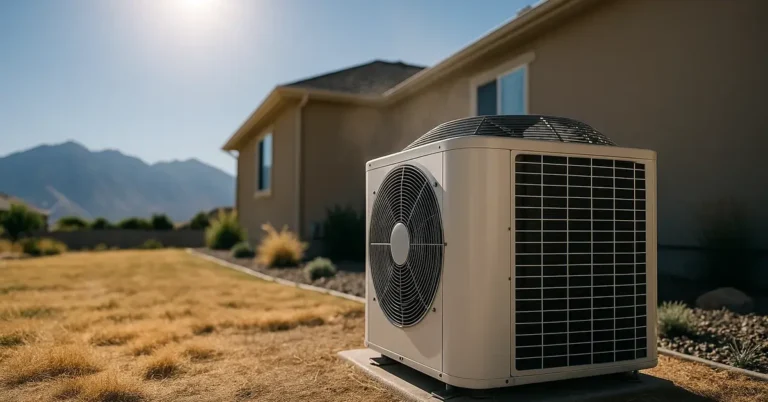
It’s 3 PM on a July afternoon in Salt Lake City. Your AC is humming. The electric meter is spinning. You’re wondering if there’s a cheaper way to cool your house. Here’s the thing — by midnight tonight, that same thermometer will drop to 62°F. Utah’s dramatic temperature swings create an opportunity most of the country doesn’t have: cooling your home for pennies instead of dollars.
Whole house fans take advantage of Utah’s cool evenings. They pull fresh outdoor air through open windows and push hot air out through the attic. When outdoor air is cooler than indoor air, they work brilliantly. When it’s 100°F outside, they don’t. AC comes in then. Best strategy? Using both at the right times.
If you’re curious whether a whole house fan makes sense for your Utah home, give us a call at (801) 997-8909. We’ve installed AC systems across the Wasatch Front for 20+ years, and we’re happy to talk through cooling strategies that work for your situation.
How Whole House Fans and AC Systems Work Differently

Air conditioning removes heat from your home using a refrigerant cycle. Your outdoor unit compresses refrigerant, which releases heat outside. Your indoor unit expands that refrigerant, which absorbs heat from your indoor air. This system recirculates the same air over and over, filtering it and cooling it. It works no matter the outdoor temperature.
A whole house fan is simpler. It mounts in your attic and pulls cool outdoor air in through open windows while pushing hot indoor air out through attic vents. They exchange air, not condition it. When Salt Lake City drops to 60°F overnight and your house is still 78°F from the afternoon heat, a whole house fan flushes that warm air out in minutes.
One fundamental difference is simple: AC works when it’s hot outside. A whole house fan only works when outdoor air is cooler than indoor air. In Utah, that happens every single night from May through September. That’s why this technology thrives here and fails in Houston.
Why Utah’s Climate Is Perfect for Whole House Fans

Most of the country can’t use whole house fans well. Humid regions like the Southeast see overnight lows in the mid-70s with 80% humidity. That air doesn’t cool anything — it just makes your house feel sticky. But Utah’s semi-arid climate creates ideal conditions.
Wasatch Front temperature swings hit 20–30°F between afternoon highs and overnight lows, making whole house fan Utah installations especially effective. When Lehi hits 93°F at 4 PM, it drops to 63°F by sunrise. That 30-degree range is your cooling window. Low humidity (often below 30% in summer) means that cool air actually feels cool. Miami’s 68°F at night still feels muggy. Salt Lake City’s 62°F is refreshing.
Altitude plays a role too. Higher elevations like Park City and Eagle Mountain see even more dramatic temperature drops at night. Cold air sinks. Utah’s mountain valleys collect it. At the same time, altitude reduces AC efficiency by about 3–4% per 1,000 feet above sea level. A system that works great in Phoenix struggles at 4,300 feet. This makes whole house fans more attractive the higher you go.
Last summer in Eagle Mountain, we installed a whole house fan in a home at 5,200 feet elevation. Owner ran it every evening from 7 PM to midnight and didn’t touch the AC for the entire month of May. Compare that to a similar home in Atlanta, where a whole house fan would sit unused because the overnight low barely dips below 75°F.
Cost Comparison: Installation and Operating Expenses
Price difference between these cooling alternatives Utah homeowners consider is dramatic. If your budget is tight, that matters. Weighing long-term savings? Matters even more.
Installation Costs
Industry data shows most whole house fan installations from specialty contractors run $900–$2,400, with most homeowners paying around $1,700. That includes the fan unit, labor, structural framing, electrical work, and permits. You may need more attic ventilation, which adds $300–$650.
Central AC installation starts around $8,400 for an economy-tier 2-ton unit and goes up from there. A 3-ton system averages $9,000–$12,000 installed. Larger homes needing 4- or 5-ton systems can hit $13,000 or more. That’s 6–10 times the cost of a whole house fan.
Replacing both systems? AC replacement costs start around $8,400 while a whole house fan upgrade from a specialty contractor typically stays under $2,500.
Operating Costs (Utah Rates)
Rocky Mountain Power charges about $0.14 per kWh across the Wasatch Front. That’s 33% lower than the national average. Summer bills still triple or quadruple when you run AC all day.
On full blast, a whole house fan uses 200–600 watts depending on size and speed. That’s about 2–5 cents per hour. Run it six hours a night. You’ll spend $10–$15 for the entire month of June.
For 3-ton central AC systems, expect 2,000–5,000 watts depending on efficiency. At Utah’s rates, that’s roughly 24 cents per hour. Run it six hours a day, and June’s bill jumps $43. Over a full summer (May–September), the difference is $50 for the fan versus $450 for AC.
That’s 80–90% cheaper to operate. Even with Utah’s low electricity rates, the savings add up fast.
Energy Savings: 50-90% Less Than AC
The U.S. Department of Energy reports that whole house fans use 50–90% less energy than air conditioning, making them the most energy efficient cooling option for Utah’s climate. That’s not marketing — it’s physics. A fan motor spinning at 600 watts simply can’t compete with a compressor running at 3,000 watts.
Why the wide range? It depends on your home’s insulation, your AC’s SEER rating, and how well you size the fan. A properly sized whole house fan should move at least half your home’s air volume per minute. For an 8,000-cubic-foot house, that’s a minimum 4,000 CFM fan. Undersized fans run longer and save less.
In practical terms, a homeowner in Utah Valley can skip AC entirely in May and September with a whole house fan. June and August become hybrid months — fan at night, AC during the hottest afternoon hours. July might still need AC most days. Even then, the fan handles mornings and evenings.
Here’s the catch: whole house fans can’t replace AC when it’s 98°F outside at 2 PM. They’re cooling assistants, not complete substitutes. But used strategically, they cut your cooling costs in half.
Want to get ahead of summer bills? Our AC tune-up service keeps your system running efficiently when you need it. Or just call us at (801) 997-8909 to talk through your cooling setup.
When to Use a Whole House Fan vs When You Need AC
Timing is everything. Use the wrong system at the wrong time, and you’ll waste energy. Use the right one, and you’ll save money and stay comfortable.
Turn the fan on whenever outdoor temperature drops below indoor temperature. In Utah, that typically means:
- Early morning (5–9 AM): Outdoor temps in the 55–65°F range, indoor air still warm from yesterday.
- Evening and night (7 PM–midnight): As soon as outdoor air drops below indoor, usually around 7 or 8 PM in summer.
- Shoulder seasons (May, September): All day when highs stay below 85°F.
Switch to AC when outdoor air is hotter than indoor air. That’s usually:
- Mid-day summer heat (11 AM–5 PM): When it’s 90°F or higher outside, the fan just pulls in hot air.
- Heat waves: When overnight lows don’t drop below 75°F, the fan loses effectiveness.
- Poor air quality days: More on that below.
Best approach? Use both. Run the whole house fan from 7 PM to 8 AM to flush out heat. Run AC from 2 PM to 6 PM when the sun is brutal. Set your thermostat to 78°F during AC hours and turn it off when you switch to the fan. On cooler days, skip AC entirely.
Last August, a homeowner in Lehi ran this exact schedule and cut their cooling bill by 60% compared to the year before. They didn’t suffer. They just stopped cooling the house when nature was doing it for free.
Need help setting up a programmable thermostat to coordinate both systems? We can walk you through it. If your AC struggles during peak heat even with the fan helping overnight, read our guide on why AC struggles in 95°F Utah heat to understand what’s happening.
Noise Levels: Modern Fans Are Much Quieter
Remember whole house fans from the 1980s? You remember the roar. Old models hit 60–70 decibels — about as loud as a vacuum cleaner running in the hallway. They worked. They weren’t pleasant.
Modern whole house fans operate at 40–52 decibels on low to medium speed. That’s comparable to a babbling brook or normal conversation. You’ll hear it, but it won’t drown out the TV or keep you awake. High speed pushes closer to 55–60 decibels. Noticeable but not unbearable for a few hours.
Technology improved. Better motors, insulated housings, and variable-speed controls make newer fans much quieter. Multi-speed models let you balance airflow against noise. Low speed for gentle overnight cooling. High speed for rapid cooldown after a hot day. Ceiling fans running the right direction can supplement whole house fans with whisper-quiet air circulation during the day.
Central AC systems, for comparison, run around 50–60 decibels at the outdoor unit and near-silent indoors. Whole house fans are louder than AC inside your home. Quieter than the old reputation suggests, though. Noise-sensitive? Look for units rated under 50 decibels.
Can You Run Both Systems at the Same Time? (No)
Never run a whole house fan and AC simultaneously. They work against each other, and you’ll waste a shocking amount of money.
Here’s why: whole house fans pull outdoor air into your home. Your AC, if running, tries to cool that incoming outdoor air — which is pointless. You’re paying to cool air that’s already being replaced by more outdoor air. Like filling a bathtub with the drain open.
Common mistake: leaving your thermostat at 72°F and turning on the whole house fan. AC kicks on. Fan runs. Electric bill doubles. Don’t do it.
Proper approach: when you switch to the whole house fan, turn your AC off or set the thermostat up to 80–82°F so it won’t cycle on. When you switch back to AC, turn the fan off and close your windows. Some homeowners use smart thermostats to automate this — AC during the day, fan mode at night.
Sounds obvious once you hear it. But it’s one of the most common mistakes we see.
Air Quality Considerations: Smoke, Inversions, and Outdoor Air
Any whole house fan pulls unfiltered outdoor air into your home. Great when outdoor air is clean. Problem when it’s not.
Utah deals with two main air quality challenges: wildfire smoke in summer and winter inversions that trap pollution. Running a whole house fan during a red air quality day pulls smoke and particulates directly into your living space. Have asthma or allergies? That’s a real concern.
AC systems filter and recirculate indoor air. They’re not perfect — standard filters don’t catch everything — but they’re far better than pulling in unfiltered outdoor air during poor air quality events. On days when the Utah Department of Environmental Quality shows red or orange AQI, skip the whole house fan and use AC instead.
Check Utah’s air quality before running the fan. Purple Air and the DEQ’s air monitoring sites show real-time conditions. AQI is green? You’re fine. Yellow? Use your judgment. Orange or red? Close the windows and run AC.
Pollen season is another consideration. Allergic to local grasses or trees? A whole house fan pulls pollen straight into your home. AC with a decent filter keeps it out. This is one of the genuine tradeoffs — fresh air versus filtered air.
Installation Requirements and Utah Building Codes
Installing a whole house fan isn’t as simple as mounting a fan in the attic. Requires adequate ventilation, structural framing, electrical work, and permits.
Your attic needs 2–4 times the normal vent area to handle the airflow. Most homes have about 1 square foot of vent per 300 square feet of attic. A whole house fan moving 4,000 CFM needs significantly more. Budget for additional attic vents — typically $300–$650 if your existing setup is insufficient.
Utah’s building codes (IRC 2021 adoption) allow whole house fans that discharge into attic space, but permits are required for structural and electrical changes. Expect to pay $50–$350 for permits depending on your city.
Airtight dampers are critical in Utah. Sub-zero winters mean a poorly sealed fan opening becomes a massive heat loss. When the fan isn’t running, the damper must close completely. Good models include motorized dampers that seal automatically. Cheap models have flimsy louvers that leak air all winter. Don’t skimp here.
Professional installation is worth it. Fans mount between ceiling joists, which often requires cutting and reinforcing framing. Electrical work needs to meet code. Attic ventilation must be properly balanced. Bad install means noise, vibration, and poor performance.
Considering a whole house fan for your Utah home? Call us at (801) 997-8909. We can assess whether your home is a good candidate and recommend qualified installers if you decide to move forward.
Is a Whole House Fan Right for Your Utah Home?
Not every home benefits equally. Here’s how to decide.
You’re a good candidate if:
- Nighttime temps in your area regularly drop below 70°F
- You’re comfortable with indoor temps in the mid-70s at night
- Your home has good insulation to hold the cool air through the next day
- You’re home evenings to open windows and operate the fan
- Air quality in your area is generally good
Less ideal if:
- You need 24/7 cooling and can’t tolerate indoor temps above 72°F
- Your area has frequent poor air quality (near major highways or pollution sources)
- You live in a humid microclimate (rare in Utah, but some areas near water)
- You’re rarely home evenings to operate the system
Elevation matters. Higher elevations see better nighttime cooling and suffer more from reduced AC efficiency. Whole house fans make more sense in Park City or Eagle Mountain than in St. George, where overnight lows stay warmer.
Best ROI: combine both systems. Use the whole house fan May, September, and most nights in June and August. Use AC mid-day in July and during heat waves. You’ll recoup the typical $1,700 whole house fan installation cost in 2–4 years through reduced AC costs.
For more cooling comparisons, check out our posts on swamp coolers vs AC, mini-splits vs central air, and heat pumps vs air conditioners.
Frequently Asked Questions
Can you run a whole house fan and AC at the same time?
No. They work against each other. Fan pulls outdoor air in while AC tries to cool it, wasting energy and money. Use them at different times: whole house fan during cool mornings and evenings, AC during hot mid-day hours. Set your thermostat to 80°F or turn it off when running the fan.
Do whole house fans work in Utah’s climate?
Yes, exceptionally well. Low humidity and 20–30°F nighttime temperature drops create ideal conditions across the state. When Salt Lake City hits 95°F during the day and drops to 60–65°F at night, that cool air is perfect for flushing out indoor heat. Utah is one of the best climates in the country for whole house fans.
How loud is a whole house fan?
Modern quiet models operate at 40–52 decibels on low to medium speed — similar to normal conversation. Old models from the 1980s were 60–70 decibels and very loud, which is where the reputation comes from. Newer technology, better motors, and insulated housings make today’s fans much quieter.
What about wildfire smoke and air quality?
Valid concern. Whole house fans pull unfiltered outdoor air, so don’t use them during poor air quality days. Check Utah’s AQI (air quality index) before running the fan. On red or orange days, use AC instead — it filters and recirculates indoor air. Green AQI days are fine for the fan.
What’s the best time to run a whole house fan in Utah?
Early morning (5–9 AM) and evening through night (7 PM–midnight) when outdoor temps drop below indoor. Never run it mid-day during summer heat when it’s 90°F+ outside. Utah’s temperature patterns make nighttime operation especially effective — that’s when you get the biggest temperature swings.
Conclusion
Homeowners across Utah have a cooling advantage most of the country doesn’t. When Phoenix is still 85°F at midnight, Salt Lake City has dropped to 62°F. Free cooling if you know how to use it.
Whole house fans won’t replace your AC entirely. July afternoons at 100°F still need refrigerated air. But they can cut your cooling costs by 50–70% when you use both systems strategically. Fan at night. AC during peak heat. Thermostat adjustments to prevent them from fighting each other.
Consider your elevation, your air quality patterns, and how much indoor temperature variation you can tolerate. Higher elevations and cooler microclimates see the best results. Homes near pollution sources or with high cooling standards may not benefit as much.
We’ve installed AC systems across the Wasatch Front for 20+ years and know how Utah homes cool best. Curious whether a whole house fan makes sense for your situation alongside your AC? Give us a call at (801) 997-8909. We’re happy to walk through your options — no pressure, just honest advice.