Here’s something most Utah homeowners don’t think about: according to ENERGY STAR, 20 to 30 percent of the air moving through your duct system never actually makes it to the rooms you’re trying to heat or cool. It just leaks out along the way. That’s why a spring ductwork inspection makes sense.
That’s like running your air conditioner with a window cracked open. All summer. Every summer.
When was the last time you had a ductwork inspection? If you’re like most people we talk to here along the Wasatch Front, the answer is probably never. Spring is the perfect time to change that — before the summer heat arrives and your system starts working overtime.
If your ducts could use a checkup, give us a call at (801) 997-8909. Our $69 spring tune-up includes a basic duct inspection, and we’re happy to walk you through what we find.
Why Utah’s Climate Is So Hard on Ductwork

Utah isn’t an easy place to be a duct. Summers regularly push past 100 degrees across the Wasatch Front. If your ducts run through an unconditioned attic — and a lot of them do — they’re sitting in temperatures that can hit 140 degrees or higher. Winters swing the other direction, with sub-zero nights that make everything contract and pull apart at the seams.
Then there’s the dryness. Utah’s humidity usually sits between 10 and 30 percent. That’s great for your hair, terrible for the rubber seals and gaskets holding your ductwork together. They dry out. They crack. Air starts escaping.
And the dust. If you live anywhere near the Salt Lake Valley or Utah Valley, you know about the dust. Fine particulate matter from the Great Salt Lake, seasonal inversions, wildfire smoke — it all ends up in your ducts, building up faster than it would in more humid climates. That’s one reason many homeowners schedule both HVAC duct cleaning and inspection in spring.
A lot of homes in this area were built during the 1970s, 80s, and 90s housing boom. If your house is from that era and you’ve still got the original ductwork, it’s likely been dealing with these conditions for 30 to 50 years. That’s a long time.
7 Signs You Need a Ductwork Inspection

Your ductwork usually gives you clues when something’s wrong. Here are the most common leaky ductwork signs to watch for.
Some rooms are always too hot or too cold. If your bedroom is freezing in winter while the living room is fine, or one side of the house never cools down in summer, that’s often a duct problem. Air isn’t getting where it’s supposed to go. For multi-story homes with persistent upstairs-downstairs temperature differences, duct sealing may need to be paired with solutions like HVAC zoning — though you should always fix duct leaks first before adding zone controls.
Your energy bills keep climbing. When ducts leak, your system has to run longer to reach the temperature you want. That shows up on your electric bill pretty quickly, especially during Utah’s hot summers. For a detailed breakdown of how much energy you’re actually losing to duct leaks — and what it costs you in dollars per year — see our guide on how leaky ducts waste energy.
Dust everywhere, no matter how much you clean. This one’s big in Utah. If you’re dusting twice a week and it still looks like you haven’t cleaned in a month, leaky ducts might be pulling dust from your attic or crawlspace and distributing it throughout your home. This is especially problematic during spring allergy season — leaky ducts can make your allergies worse by circulating allergens and dust throughout your living space.
You hear whistling or rattling from the vents. Air moving through gaps or loose connections makes noise. Sometimes it’s a low whistle. Sometimes it rattles. Either way, it means something’s not sealed properly.
You can see tears, gaps, or sections that have come apart. If you’ve got accessible ductwork in your basement or attic, take a flashlight and look. Visible damage is a clear sign you need help.
Musty or stale smells when the system runs. This can mean moisture is getting into your ducts, or dust and debris have built up enough to create odors. Not something you want circulating through your home.
Your furnace or AC runs constantly but never quite reaches the temperature you set. When enough air is leaking out, your system can’t keep up. It just keeps running, trying to hit a target it can’t reach.
If you’re seeing two or more of these signs, it’s worth getting a professional ductwork inspection. And if you’re already tackling your spring AC startup checklist, adding a duct inspection makes sense. Give us a call at (801) 997-8909 and we’ll schedule a time that works for you.
What a Professional Ductwork Inspection Includes

A real ductwork inspection isn’t just someone glancing at a vent and saying “looks fine.” Here’s what actually happens when we inspect ducts properly.
Visual Inspection
We start with the basics — looking at every section of ductwork we can access. That means crawling into attics, heading down to basements (where we also handle basement dehumidifier installation costs and ductwork integration), squeezing into crawlspaces. We’re checking for obvious issues like tears in the duct material, sections that have disconnected at the joints, or ducts that have been crushed or kinked.
We also check insulation on ducts running through unconditioned spaces. Missing or damaged insulation means you’re losing conditioned air.
Thermal Imaging
An infrared camera shows temperature differences along your ducts. Hot or cold spots where there shouldn’t be any tell us air is leaking. It’s especially useful for finding leaks behind walls or in areas we can’t physically access.
Airflow Testing
We measure how much air is actually coming out of each register in your home. The measurement is in CFM — cubic feet per minute. Then we compare those numbers to what your system is designed to deliver. If a bedroom should be getting 120 CFM but we’re only measuring 65, we know there’s a restriction or a leak somewhere.
Duct Blaster Test
This is the gold standard for measuring total duct leakage. We seal off all your registers and use a calibrated fan to pressurize the entire duct system. Then we measure how much air we have to pump in to maintain that pressure.
The more air we need to add, the more air is leaking out. The result is expressed as CFM25 — cubic feet per minute of leakage at 25 pascals of pressure. Industry standards tell us what’s acceptable, and what needs to be fixed.
A typical inspection takes one to two hours, depending on the size of your home and how accessible your ductwork is. When we do an AC tune-up, we include a basic visual duct inspection. If we spot something that warrants a deeper look, we’ll let you know and explain what the next steps would be.
4 DIY Checks You Can Do Before Calling a Pro
You don’t need to be an HVAC tech to spot some duct issues. Here are a few things you can check on your own before scheduling a professional ductwork inspection.
Flashlight inspection of visible ducts. Grab a flashlight and head to wherever your ducts are accessible — basement, attic, crawlspace. Look for obvious damage. Tears in flexible ducts, gaps at joints, sections that have separated. If you can see light coming through, that’s a problem.
The tissue paper test. This one’s simple. Hold a piece of tissue paper up to each register in your home. Does it get sucked in firmly? Does it barely move? Registers in similar-sized rooms should have similar suction. Big differences suggest uneven airflow, which often points to duct problems.
Listen for unusual sounds. When your system is running, walk around your house and listen. Hissing or whistling sounds near vents or from the attic often mean air is escaping where it shouldn’t be. You’re hearing the sound of your money leaking out.
Check attic and crawlspace duct insulation. If you’ve got ducts in unconditioned spaces, they should be wrapped in insulation. Look for sections where the insulation has fallen off, gotten wet, or been damaged. In Utah’s extreme temperatures, missing insulation means significant energy loss.
These DIY checks won’t give you the full picture that a professional inspection would, but they can tell you whether it’s worth making that call. If any of these tests reveal problems, it’s time to get someone with proper tools and training involved.
What Does Ductwork Inspection Cost? (And What You’ll Save)
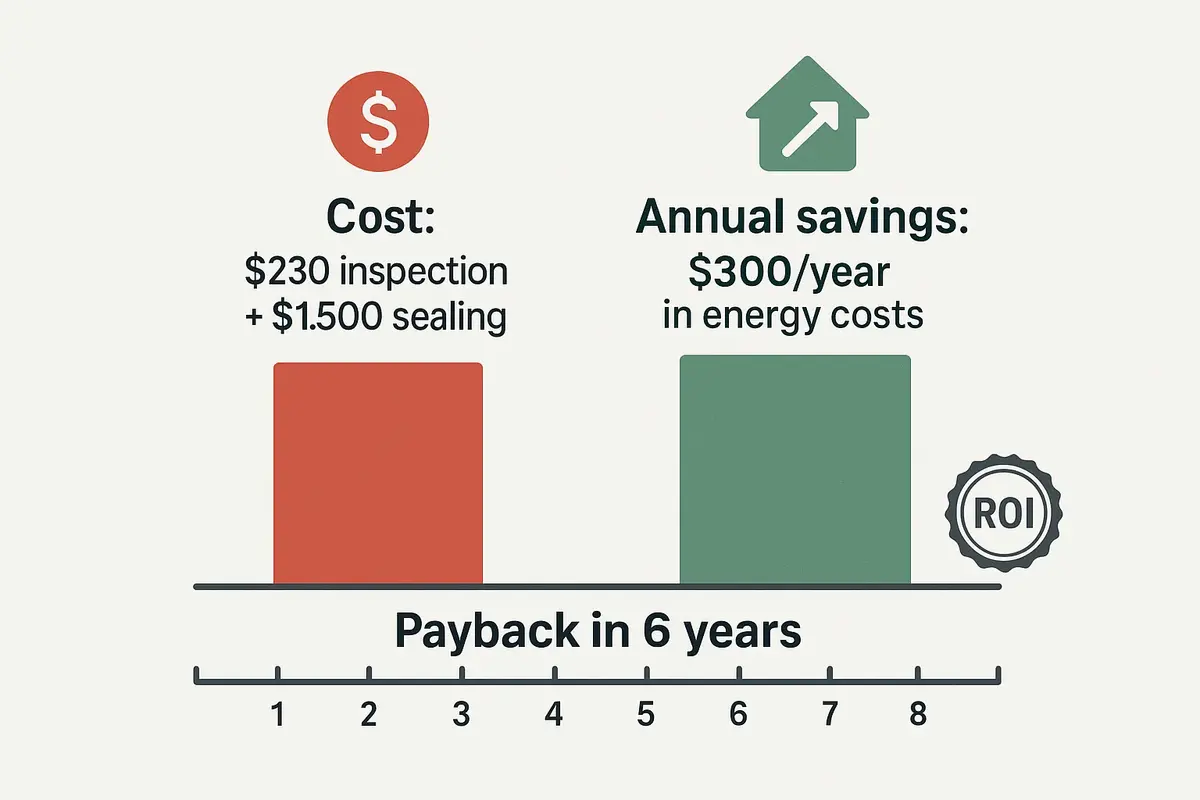
Let’s talk numbers. According to Angi’s 2026 data, the national average for a professional duct inspection is $230, with most homeowners paying between $140 and $380 depending on home size and inspection depth.
At Ninja, our $69 AC tune-up includes a basic visual duct inspection. If we find issues that need a more detailed look — thermal imaging, blaster testing, that kind of thing — we’ll give you a clear quote before moving forward.
Now here’s why this matters. The EPA reports significant duct sealing energy savings — homeowners save an average of 15 percent on heating and cooling costs when they properly seal and insulate their ductwork.
Let’s say your summer cooling bills run about $200 a month. Fifteen percent savings is $30 a month. Over a four-month cooling season, that’s $120. Over a full year when you factor in heating season, you’re looking at $200 to $300 in savings. The inspection pays for itself in the first year.
What about repairs? Duct sealing cost depends on how much needs to be fixed — we’ll give you a clear quote after the inspection shows us what we’re working with. The payback period is usually two to four years. And your home will be more comfortable the entire time — no more hot and cold rooms, less dust, quieter operation.
Also worth mentioning: if you’ve invested in a programmable thermostat to save energy, leaky ducts undermine a lot of that benefit. You’re programming the perfect temperature schedule, but 20 to 30 percent of that carefully conditioned air is leaking into your attic. Fix the ducts first, and your smart thermostat works the way it’s supposed to.
Want to get ahead of problems before they cost you? Our $69 spring tune-up includes that basic duct check. If everything looks good, you’ve got peace of mind. If we spot issues, you can address them now instead of during the first 105-degree day in July. Call us at (801) 997-8909 to schedule.
Frequently Asked Questions
How often should ductwork be inspected?
The National Air Duct Cleaners Association (NADCA) recommends having your ductwork inspected at least once a year. For Utah homes dealing with extreme temperatures, heavy dust, and aging ductwork, annual inspections make good sense. Spring is ideal timing — it gives you a chance to fix any issues before summer puts maximum demand on your cooling system.
What are signs of leaky ductwork?
The most common signs are uneven temperatures between rooms, higher-than-normal energy bills, excessive dust buildup, and rooms that never quite reach the temperature you’ve set. You might also hear whistling or rattling sounds from vents, or notice musty odors when the system runs.
Can I inspect my own ductwork?
You can do a basic visual inspection if your ducts are accessible. Check for obvious damage, listen for unusual sounds, and test airflow at registers using the tissue paper method. That said, a professional inspection uses specialized equipment like thermal imaging cameras and blaster tests that you won’t have at home.
How long does ductwork last?
NADCA estimates that ductwork typically lasts 10 to 15 years before it needs replacement, though this depends heavily on climate and maintenance. In Utah’s extreme conditions, ductwork can deteriorate faster. Many Wasatch Front homes still have original ducts from the 1970s through 1990s, which means they’re well past the recommended replacement window.
Is duct cleaning the same as duct inspection?
No. Duct cleaning removes dust, debris, and contaminants from inside your ducts. It’s about air quality. Duct inspection examines the structural condition of your ductwork — looking for leaks, damage, disconnections, and insulation problems. It’s about system efficiency. Spring is an ideal time for both HVAC duct cleaning and inspection. Inspection should happen first so you know what you’re working with before deciding whether cleaning makes sense.
For more details on keeping your whole system in good shape, take a look at our guide to HVAC maintenance.
Spring Is the Right Time
You’ve got a narrow window between when the furnace shuts off and when you really need the AC. That’s when smart homeowners get their ductwork inspected. If you’re navigating that seasonal transition, our guide on switching from heat to AC walks you through the proper procedure to protect your equipment.
ENERGY STAR’s data says 20 to 30 percent of your conditioned air is likely escaping through duct leaks right now. That’s not a small problem. It’s affecting your comfort, your energy bills, and how hard your system has to work.
The good news? It’s fixable. And catching it in spring means you’re not scrambling for help on the hottest day of summer.
Give us a call at (801) 997-8909 to schedule a spring inspection or tune-up. We’ll take a thorough look at your ductwork, show you exactly what we find, and give you honest answers about what needs attention and what can wait. No pressure, no upselling — just straightforward information from a Utah state licensed, family-owned company that’s been doing this work for over 20 years.
Need help? Learn more about our duct cleaning service or call us at (801) 997-8909.