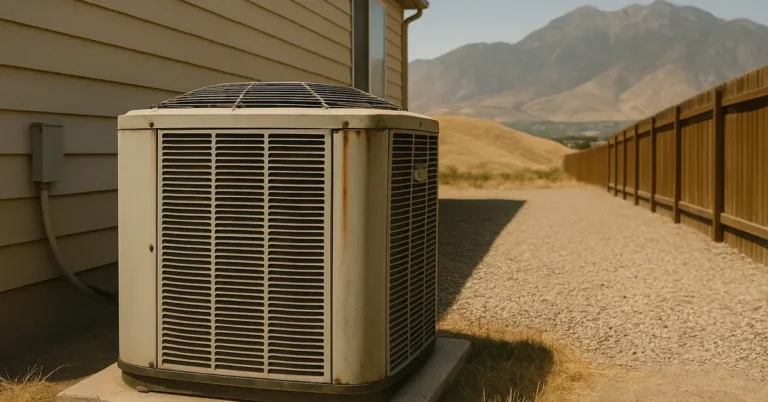
You flip the thermostat to cool on the first 90-degree day in May. The condenser unit kicks on outside. But instead of that familiar steady hum, you hear struggling. The air coming from the vents feels weak, barely cool.
Here’s what probably happened. Your outdoor AC unit spent the last six months collecting everything Utah winter throws at it — road salt from the January treatments, fine dust from our dry climate, cottonwood debris, and who knows what else. All that grime is packed into the fins, choking off airflow and making your compressor work twice as hard.
The good news? Learning how to clean your AC condenser unit after a Utah winter is one of the easiest things you can do to restore efficiency and save on summer cooling costs. And you can knock it out in an hour or two with basic tools you probably already have.
If your AC needs attention before summer hits, give us a call at (801) 997-8909. We’re happy to help.
Why Utah Winters Are So Hard on Your AC Condenser
Most homeowners don’t think about their AC unit from October through April. But that outdoor AC unit cleaning gets neglected all winter while the condenser sits there taking a beating.
Salt residue from road treatments drifts into your yard and settles on the coils. Utah’s dry, dusty air coats the fins with a layer of fine particles that normal rain would wash away in other climates — except we don’t get much rain. Native plants like cottonwood and juniper drop seeds and debris that work into the unit. Temperature swings — a 60-degree day in February followed by a 20-degree night — stress metal parts and seals. By May, your condenser is covered in crud.
According to the U.S. Department of Energy, dirty condenser coils can increase compressor energy use by 30%. An EPA study found that as little as 0.042 inches of dirt on condensing coils causes a 21% drop in efficiency. Your electric bill goes up while your comfort goes down. And if you ignore it long enough, that extra strain shortens the life of your compressor — the most expensive part to replace.
We wrote a full guide on spring AC maintenance. Check out our Spring AC Startup Checklist for the complete rundown.

When to Clean Your AC Condenser in Utah
Timing matters with this job. Clean too early and a late freeze could damage wet parts. Wait too long and you’re running a dirty system during the first heat wave.
Best time? Late March to early April 2026, after the last freeze risk but before cooling season kicks in. Check the 10-day forecast. If overnight lows are staying above 40 degrees across the Salt Lake Valley, you’re good to go.
Most Utah homes can get by with one deep cleaning per year. But if you live near a major road where salt spray is heavy, or you’re in a dusty area like West Jordan or Herriman where new construction stirs up dirt, consider condenser coil cleaning twice — once in spring and again mid-summer.
What You’ll Need
This isn’t a hard job. Here’s what you need:
- Garden hose with adjustable spray nozzle (NOT a pressure washer — more on that in a minute)
- Coil cleaner spray (optional but worth the $10-15 for Utah’s heavy buildup)
- Screwdriver or nut driver to remove the top grille
- Soft brush or shop vacuum
- Fin comb if you’ve got bent fins
- Work gloves and safety glasses
One note about water. Utah’s hard water can leave mineral deposits on the coils if you’re not careful. If you’ve got a whole-home water softener, use that hose connection. If not, just rinse well so you’re not leaving standing water to evaporate and deposit minerals.

How to Clean Your AC Condenser: Step-by-Step
Step 1: Turn Off Power at the Breaker
Don’t just turn off the thermostat. You need to kill power at the breaker box. This is non-negotiable — you’re about to spray water on an electrical device.
Most outdoor units have a disconnect box mounted on the exterior wall nearby. Pull the fuse block or flip the breaker. If you’re not sure which breaker controls the AC, flip the main breaker for the outdoor unit.
Step 2: Clear Debris From Around the Unit
Remove any leaves, dead grass, cottonwood seeds, Russian olive debris — whatever piled up over the winter. We’ve pulled rodent nests out of units before, so check for that too.
Clear at least two to three feet all the way around the unit. Your condenser needs airflow from all sides to work well. If you put a protective cover on for winter, pull it off now. Speaking of clearance — proper AC condenser placement means maintaining that 2-3 foot clearance year-round, not just during cleaning. Shrubs, fences, or debris that restrict airflow can cut efficiency by 20% or more.
Step 3: Remove the Top Grille and Fan
The top panel is usually held on with four to six screws. Remove them and gently lift the fan assembly. It’s still connected to wiring, so don’t yank it — just set it aside carefully.
While you’ve got it open, check the fan blades for damage or debris. If one blade is cracked or bent, the whole fan assembly needs replacement. That’s a job for a pro.
Step 4: Remove Loose Debris From Inside
Use a shop vacuum or soft brush to pull out the loose stuff inside the unit. Leaves, dirt, dust buildup — all of it needs to come out. Work from the top down so you’re not pushing debris deeper into the fins.
Be gentle. Those aluminum fins bend easily. Utah’s fine dust tends to cake on and create hard spots, which can tempt you to scrub harder — resist that urge.
Step 5: Apply Coil Cleaner (Optional but Recommended)
You can skip this step if the coils aren’t too bad. But for Utah conditions — salt, grease from road treatments, stubborn dirt — coil cleaner is worth it.
Spray the foam cleaner on the coils and let it sit for 5 to 10 minutes. The foaming action reaches deep into the fins and dissolves the gunk that water alone won’t budge.
Step 6: Rinse the Coils Thoroughly
Here’s where people mess up. Do NOT use a pressure washer. The pressure will bend those delicate fins and reduce airflow. Garden hose with a gentle spray nozzle is all you need.
Spray from the inside out so you’re pushing dirt away from the coils, not deeper into them. Start at the top and work your way down. Rinse all four sides until the water runs clear.

Step 7: Straighten Bent Fins
If you’ve got bent fins — and you probably do after Utah’s dusty winter — use a fin comb to gently straighten them. Work slowly. These fins are thin aluminum and they don’t forgive rough handling.
Even minor bends restrict airflow, which reduces efficiency. It’s tedious work but it pays off in better cooling.
Step 8: Reassemble and Restore Power
Let the unit dry for 30 to 60 minutes. Once it’s dry, reinstall the fan assembly and top grille. Tighten all the screws. Restore power at the breaker.
Now test it. Set your thermostat to cool and listen. If you need help dialing in the right temperature for this time of year, our guide on spring thermostat settings for Utah breaks it down month by month. You should hear a smooth, steady hum — no struggling, no weird noises. If you hear buzzing, rattling, or grinding, our guide on weird AC noises and what they mean explains which sounds need immediate attention. If it sounds off, call us.
Want a pro to handle your AC condenser cleaning? Our $39 AC tune-up includes cleaning plus a full system safety check, refrigerant level inspection, and electrical testing. Wondering what a full professional tune-up covers? Our guide on what to expect during an AC tune-up explains each step of the process in detail. We catch problems before they turn into expensive repairs.
DIY vs. Professional Condenser Cleaning
Cleaning the condenser yourself saves you $80 to $150 and takes one to two hours. It’s not hard.
But when you hire Ninja HVAC for a $39 tune-up, you’re not just getting a condenser cleaning. You’re getting a Utah state licensed tech who checks refrigerant levels, inspects electrical connections, tests the capacitor, measures airflow, and catches issues you’d never spot on your own.
Last summer we found a refrigerant leak during a routine tune-up in Draper. The homeowner thought the condenser just needed cleaning. If we hadn’t caught it, the compressor would’ve failed by mid-July — a $3,000 repair instead of a $400 fix.
Our recommendation? DIY cleaning between professional tune-ups is smart. But get a pro out at least once a year, ideally in spring before cooling season. And while you’re doing spring maintenance, don’t forget the filter inside — if anyone in your household deals with seasonal allergies, our guide on spring allergies and HVAC air quality explains which filters actually reduce pollen indoors. For a broader look at keeping your system in top shape year-round, check out our HVAC maintenance tips for homeowners. You can schedule that through our Home Health Plan, which covers annual tune-ups and priority scheduling.
What If Cleaning Doesn’t Fix the Problem?
You cleaned the condenser. The unit still won’t cool. Now what?
A dirty condenser is one of the most common causes of poor cooling, but it’s not the only one. If cleaning doesn’t restore performance, you’re likely dealing with one of these:
- Refrigerant leak — low refrigerant means weak cooling no matter how clean the coils are. Learn to spot the warning signs in our guide on 5 signs your AC is low on refrigerant
- Failed capacitor — the capacitor starts the compressor and fan motor, and they wear out over time
- Compressor failure — the compressor is the heart of the system, and when it fails, the whole unit stops cooling
- Electrical issues — a bad contactor, failed relay, or loose wiring can prevent the system from running properly
These aren’t DIY fixes. They require diagnostic tools, EPA-certified refrigerant handling, and electrical know-how. Before calling a pro, you can try resetting your air conditioning unit — sometimes a simple power cycle clears the issue. If that doesn’t work, that’s where we come in.
Ninja HVAC offers emergency response with a 120-minute arrival window during business hours, and emergency calls are handled after hours. The $49 dispatch fee applies weekdays 9am-5pm and is applied to your repair; after 5pm, weekends, and holidays it is $149. If your AC isn’t cooling and you’ve already tried cleaning the condenser, don’t suffer through the heat. We wrote a full guide on troubleshooting cooling problems — check out 10 Common Signs Your Central Air Conditioner Needs AC Repair or Replacement.
Frequently Asked Questions
How often should you clean your AC condenser in Utah?
At least once per year in spring, before cooling season starts. If you live near heavy traffic where road salt and dust are constant, or you’re in a high-construction area, consider cleaning twice — once in spring and again mid-summer. Utah’s dry, dusty climate speeds up condenser fouling faster than humid climates where rain naturally rinses the coils.
Can I use a pressure washer on my AC condenser?
No. Pressure washers generate enough force to bend the delicate aluminum fins on the condenser coils. Bent fins restrict airflow and reduce efficiency. Use a garden hose with a gentle spray nozzle instead. It’s effective and won’t damage the fins.
What is the best cleaner for AC condenser coils?
Foaming coil cleaner designed for HVAC systems works best. The foam goes deep into the fins and dissolves salt, grease, and stubborn dirt that water alone won’t remove. You can find it at any hardware store for $10 to $15. Avoid harsh chemical cleaners that can corrode the aluminum fins.
How do I know if my condenser coils are dirty?
Look at the fins. If they’re visibly caked with dust, dirt, or debris, they need cleaning. Performance signs include weak airflow from vents, the AC running constantly without cooling the house, or unusually high electric bills. A visual inspection after a Utah winter usually tells you everything you need to know.
How much does professional AC condenser cleaning cost?
Standalone cleaning typically runs $80 to $150. At Ninja HVAC, our $39 AC tune-up includes cleaning plus a full system inspection — refrigerant level check, electrical testing, safety inspection, and airflow measurement. It’s a better value than standalone cleaning because we catch problems before they become expensive repairs.
Learning to clean your AC condenser unit after a Utah winter is one of the simplest ways to restore efficiency, lower your cooling bills, and extend the life of your system. An hour of work in April saves you money all summer and keeps your compressor from working overtime.
If you’d rather have professionals handle it — or you want the peace of mind that comes with a full system inspection — we’re here. Give us a call at (801) 997-8909. We’ll make sure your AC is ready before the heat hits.
Need help? Learn more about our professional AC tune up or call us at (801) 997-8909.