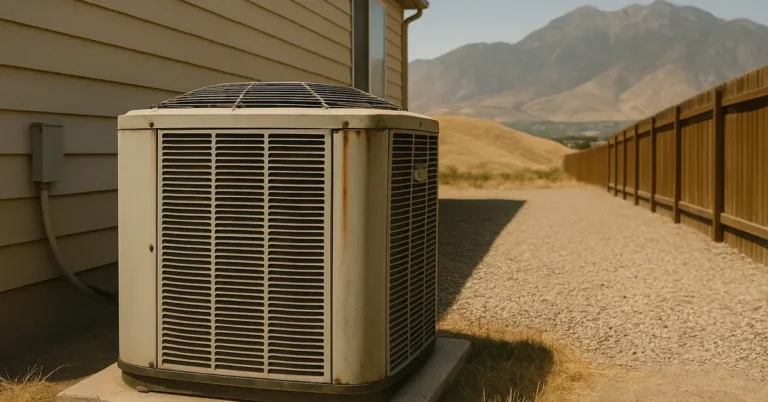
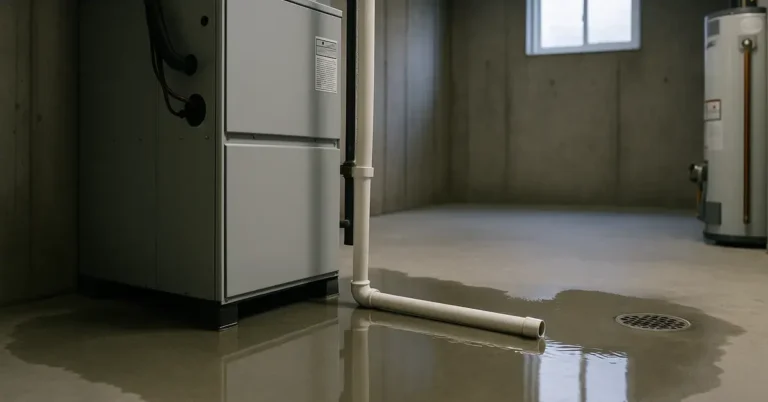
Heard about the R410A refrigerant phase out and wondering if you need to replace your AC right now? Here’s the truth: you don’t. January 1, 2026 was the deadline that rattled a lot of homeowners, but the EPA backed off enforcement on that date for split systems. Your existing R-410A air conditioner isn’t illegal and won’t become illegal. What changed is that makers can’t produce new R-410A systems anymore — but the one cooling your home can stay put as long as it works.
What you should care about is whether your system is worth keeping. When it’s breaking down every summer or struggling to keep up when Salt Lake City hits 107°F, that’s the real question. This refrigerant change gives you a chance to think about performance, cost, and long-term value — not a regulatory gun to your head.
Need help deciding? Give us a call at (801) 997-8909. We’ll walk you through what makes sense for your home.
What the R410A Refrigerant Phase Out Actually Means for Utah Homeowners
This R-410A phase-out is a manufacturing ban, not an operation ban. Starting January 1, 2025, new home AC systems had to use a new refrigerant with a Global Warming Potential of 700 or less — part of the broader AC refrigerant change required by the EPA. R-410A clocks in at 2,088 — nearly three times the new limit. So it’s out for new units.
But here’s what didn’t happen: the EPA didn’t outlaw existing systems. They didn’t mandate replacements. And in late 2025, they said they’d back off enforcement of the January 1, 2026 install deadline for split systems. That means contractors can still install pre-2025 stock without pressure.
Your R-410A system stays legal. Forever. As long as it’s running and you can get it serviced, you’re fine.
Service and repair for R-410A systems will continue. Refrigerant is still available — mostly as reclaimed R-410A recovered from old systems. Pricing may trend up over time as supply shifts from new to reclaimed, but it’s not disappearing overnight. Techs will keep servicing these systems for years, because millions of homes across the Wasatch Front are running R-410A right now.
Bottom line: the phase-out clears the way for better refrigerants. It doesn’t force you into a panic replacement.
Why R-410A Is Being Phased Out
R-410A is an effective refrigerant. Cools great, works well, and it replaced the older R-22 for good reasons. But it has one big problem: it’s a powerful greenhouse gas.
Global Warming Potential measures how much heat a gas traps compared to carbon dioxide. CO2 is the baseline at 1. R-410A? 2,088. That means one pound of R-410A leaked into the air does the warming equal to over 2,000 pounds of CO2.
When you’re talking about millions of AC systems across the country, the cost to the environment adds up fast. That’s why the EPA’s AIM Act — the American Innovation and Manufacturing Act — requires an 85% reduction in HFC production by 2036 compared to 2011-2013 levels. The rule kicked in January 1, 2025, requiring new home systems use refrigerants with a GWP of 700 or less.
Enter R-454B. GWP of 466. That’s a 78% cut compared to R-410A. Same cooling power, far lower impact on the planet. This refrigerant swap is about meeting climate goals without giving up home comfort.
So while your R-410A system isn’t the enemy, the industry is moving toward something better for the planet. And honestly? New refrigerants perform just as well — sometimes better, especially in Utah’s brutal summer heat.
What’s Replacing R-410A in New AC Systems
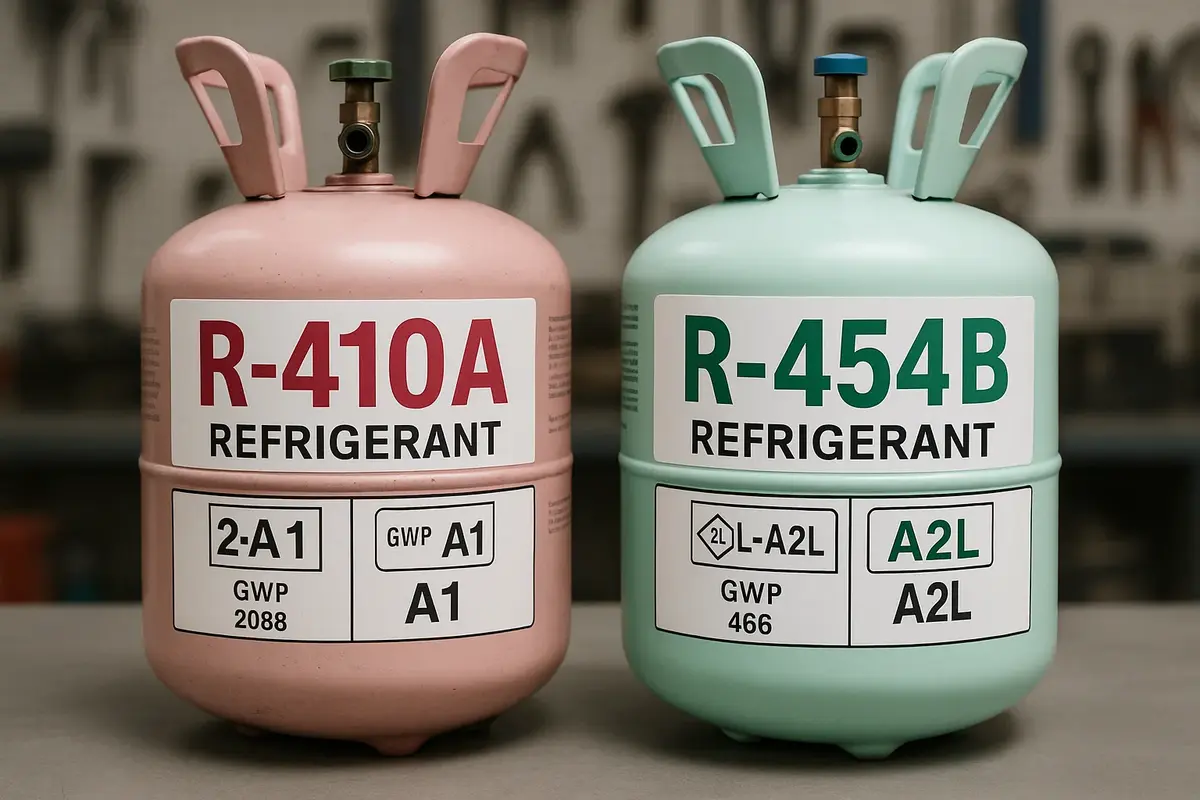
R-454B refrigerant is the main replacement you’ll see in new systems starting in 2026. Most major makers — Goodman, Amana, Carrier, Trane, Lennox — have shifted their home lineups to R-454B. It meets the EPA’s GWP limit and delivers the same performance as R-410A.
Another option is R-32, though it’s less common in the U.S. home market. You’ll see it more in Asia and Europe. It has an even lower GWP of 675 and slightly better efficiency in some conditions, but R-454B has become the industry standard here.
Both R-454B and R-32 fall into a safety class called A2L. That “A” means low toxicity — same as R-410A. “2L” means mildly flammable. And that’s where some homeowners get nervous.
Let’s be clear: mildly flammable doesn’t mean your AC is a fire hazard. A2L refrigerants need specific ignition sources and air mixes to burn — conditions that don’t happen during normal use. ASHRAE 15 safety standards require leak sensors on A2L systems and limit how much refrigerant can go in based on the space. These safeguards are built into every code-compliant system.
Installers need certification to work with A2L refrigerants. That’s not a red flag — it’s a good thing. It means techs are trained on proper handling, leak detection, and safety. When you’re buying a new system in 2026, you want a Utah-certified installer who knows altitude setup and A2L rules.
What’s the outcome? Safer installs, cleaner refrigerant, and systems built for Utah’s specific conditions.
R-454B vs R-410A: Performance in Utah’s Climate
Upgrading doesn’t mean giving up performance. R-454B systems typically hit SEER2 ratings of 16-24, compared to R-410A systems at 15-22. That’s a modest efficiency bump, but the real edge shows up when temps spike.
R-454B has a 5-7% boost in Energy Efficiency Ratio at high temps above 95°F. That matters in Utah. Salt Lake City has hit an all-time high of 107°F — a record matched five times since 2021. All of the top 10 warmest years on record have happened since 2000. When your AC is working hardest, R-454B systems keep efficiency better than R-410A.
That efficiency edge translates to lower electric bills during peak cooling months. July and August in the valley can run your AC nearly nonstop. A system that performs 5-7% better at extreme heat saves real money over a summer.
Now add altitude. Wasatch Front sits at 4,300 feet in Salt Lake City, climbing past 7,000 feet in Park City and the mountain valleys. High altitude cuts air density, which affects refrigerant pressure and system performance. Systems installed at altitude need recalibrated targets — and R-454B systems are no different.
Here’s where installer know-how becomes key. Factory defaults assume sea level. An installer who doesn’t account for altitude can overcharge or undercharge the system, leading to compressor damage, frost buildup, or poor efficiency. Research shows that properly set HVAC systems at high altitude run 15-25% more efficiently than factory defaults.
Buying a new R-454B system in Utah? Ask your installer about altitude setup. That conversation tells you whether they know what they’re doing or they’re just plugging in a unit and hoping for the best.
Want to dive deeper? Check out our post on how Utah’s altitude cuts your AC’s cooling power and why your AC struggles in 95°F heat.
The Real Costs: R-410A Repairs vs New R-454B Systems
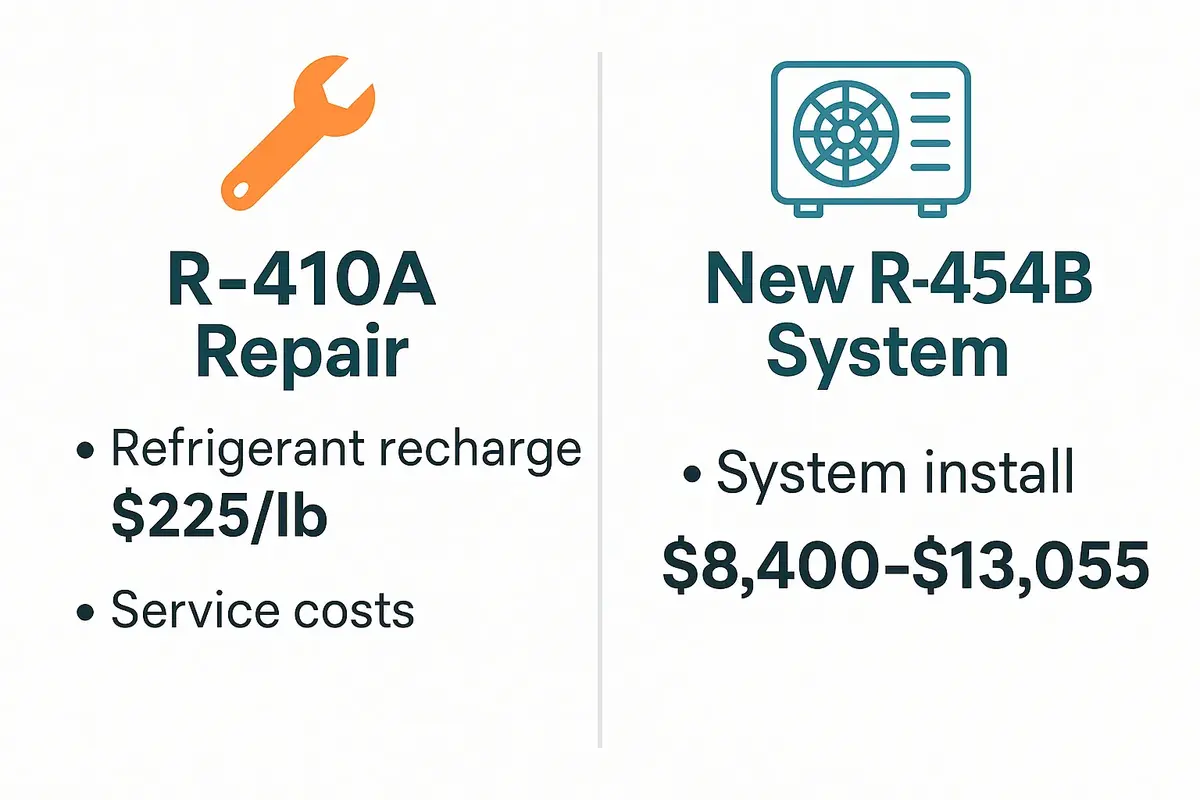
Need a refrigerant recharge for your R-410A system? You’re looking at $225 per pound for R-410A. A full recharge varies depending on system size and how much refrigerant leaked out — pricing is determined after we assess the leak and system condition. That’s not cheap, but it’s a fraction of a full replacement.
Most of the R-410A available now is reclaimed — recovered from old systems, cleaned, and recertified. As supply shifts from new to reclaimed, pricing may trend up. But it’s not vanishing. R-410A will stay available for service and repair for years because there are millions of systems out there that need it.
Now compare that to a new R-454B system. New AC install starts around $8,400 for an economy unit and runs up to $13,055 depending on system size, SEER2 rating, and existing ductwork. Add a furnace replacement and you’re looking at $12,000-$21,000 for a full system. For a full breakdown of replacement pricing, see our guide on how much it costs to replace an AC unit.
Your cost threshold comes down to your system’s age and condition. When your AC is under 8 years old, runs well, and only needs a refrigerant top-off, repairing makes sense. But when it’s 10+ years old, breaking down every summer, and driving up your electric bill, replacement becomes the smarter move — no matter the refrigerant type.
One note on incentives: the federal Section 25C tax credit for high-efficiency HVAC systems expired December 31, 2025. Some state and utility rebates may still exist, but don’t count on federal tax credits when budgeting for 2026. Check current incentive availability before making assumptions.
For more details on replacement costs, see our guide on 2-ton AC unit pricing and our breakdown of 2026 HVAC federal tax credits.
Trying to figure out whether to repair or replace? Give us a call at (801) 997-8909. We’ll run a check, show you the numbers, and let you decide what makes sense.
Should You Replace Your R-410A AC System?
No regulatory deadline is forcing your hand. Your decision to replace comes down to your system’s condition, not EPA rules.
Keep your R-410A system when it’s under 8 years old, hasn’t needed frequent repairs, and cools your home well. Regular care — cleaning coils, replacing filters, checking refrigerant levels — extends lifespan and keeps performance strong. A well-kept R-410A system can run another 5-10 years without issue.
Consider replacement when your system is 10+ years old, breaks down multiple times per season, or struggles to keep your home cool during Utah’s hottest days. These are the same telltale signs your AC is near the end of its useful life. Rising energy bills are another red flag. An aging, poor system works harder and costs more to run. At that point, a new R-454B system pays for itself in lower repair bills and energy savings.
Utah’s extreme heat gives newer systems an edge. When Salt Lake City hits 107°F, that 5-7% efficiency boost of R-454B isn’t theory — it’s the difference between a cool home and a system that can’t keep up. Current AC maxing out every summer? Upgrading makes sense no matter the refrigerant type.
Service will stay available for R-410A systems, but pricing may trend up as reclaimed supply becomes the norm. That’s a long-term thing, not an urgent crisis. System young and solid? Ride it out. On its last legs? Now’s a good time to upgrade to something more efficient.
If You’re Keeping Your R-410A System
Preventive care is your best defense. Annual tune-ups catch small problems before they become expensive failures. We offer AC tune-ups for $69 (weekdays 9 AM-5 PM) — a small cost that saves you from emergency repairs in July.
Leak detection is critical. Refrigerant doesn’t just disappear. Low on refrigerant? There’s a leak. Topping it off without fixing the leak is throwing money away. We use UV dye detection to find leaks before they drain your system dry. For more on R-410A system repairs, see our AC repair services.
Reclaimed R-410A is the current supply standard. It’s tested and certified to perform just like new refrigerant. As long as your system is tight and well-kept, you won’t notice a difference.
For more on keeping your system healthy, check out our guide on what to expect during an AC tune-up and our post on why refrigerant leaks are more than a cooling problem. We also cover 5 signs your AC is low on refrigerant.
If You’re Upgrading to R-454B
Look for systems with SEER2 ratings of 16 or higher. Higher efficiency means lower running costs, especially during Utah’s brutal summers. The upfront cost difference pays back in lower electric bills over the system’s lifespan.
Check that your installer is A2L certified and knows Utah’s altitude rules. Ask directly: “How do you account for altitude when charging refrigerant?” No clear answer? Find someone else.
Confirm that leak sensors are included. A2L systems need them under ASHRAE 15 standards. They’re a safety feature and a tool that alerts you to problems early.
Ask about warranty and local service. A great system with no local service support is a liability. Ninja handles both R-410A service and new R-454B installs — one company, one call, no handoffs to another contractor. Learn more about our AC replacement and installation services.
FAQ: Your R-410A Phase-Out Questions Answered
Is R-410A illegal in 2026?
No. R-410A is not illegal to own, operate, or service. What’s illegal is making new R-410A systems for home use as of January 1, 2025. Your existing system stays legal as long as you own it.
Do I need to replace my R-410A AC system?
Not because of the phase-out. You need to replace it when it’s old, poor, or breaking down a lot. The refrigerant change doesn’t create a replacement deadline — your system’s condition does.
Can I still get R-410A refrigerant in 2026 and beyond?
Yes. R-410A stays available for service and repair, mainly as reclaimed refrigerant recovered from old systems. Pricing may go up over time, but supply won’t disappear overnight. Millions of homes still run R-410A — the service market will support them for years.
What is A2L refrigerant and is it safe?
A2L is a safety class. “A” means low toxicity, and “2L” means mildly flammable. R-454B and R-32 fall into this category. They need specific conditions to burn — conditions that don’t occur during normal use. ASHRAE 15 standards require leak sensors and refrigerant limits to prevent unsafe buildup. Properly installed A2L systems are safe and code-compliant.
How much does R-410A cost in 2026?
At $225 per pound, R-410A pricing adds up fast. A full recharge for a home AC system is priced after assessment, as the total depends on system size and how much refrigerant you need. Leak repair adds to that cost, and that’s priced after we find the leak and check the damage.
When should I replace my AC instead of repairing it?
When your system is 10+ years old, needs frequent repairs, or drives up your energy bills, replacement becomes the smarter choice. A good rule: repair cost exceeds 50% of a new system’s price and the unit is over 8 years old? Replacement makes more sense. AC can’t keep up with Utah’s summer heat? That’s another clear signal it’s time to upgrade.
Conclusion
This R-410A phase-out doesn’t mean your AC system has an expiration date. It means new systems are moving to cleaner refrigerants — and those systems perform just as well, sometimes better, in Utah’s extreme heat and altitude. R-410A system running strong? Keep it. Breaking down or struggling? Now’s a good time to think about an upgrade.
Ninja handles both R-410A service and new R-454B installs. We’re Utah state licensed, family-owned, and we’ve been serving the Wasatch Front for 20+ years. We know altitude setup, extreme heat performance, and what it takes to keep a home cool when Salt Lake hits triple digits.
Give us a call at (801) 997-8909 — we’re open 7 days a week. The $49 weekday dispatch fee (9 AM-5 PM) is applied to your repair. Let’s figure out what makes sense for your home.