You’re ready to install a water softener in your Utah home. Now comes the budget question: what does this actually cost? Not national averages — real Wasatch Front pricing for systems sized to handle our hard water. We install water softeners across Salt Lake and Utah valleys every week, and here’s what homeowners are actually paying.
Ready to get a flat-rate quote? Call Ninja HVAC at (801) 997-8909 for water softener sizing and installation. We’ll walk you through your options with no pressure.
What Does Water Softener Installation Cost in Utah? (2026 Pricing)
Water softener cost in Utah: installed by Ninja, a system runs $2,257 to $6,304, depending on the capacity you choose. Most Wasatch Front homes land between $2,471 for a properly sized 48,000-grain system and $4,175 for a high-capacity model. That’s the complete installed price when your home already has a pre-plumbed softener loop.
Missing a softener loop? Adding one runs $876 to $1,876 on top of the system cost. That’s the biggest variable in total cost — and it’s a one-time expense that makes future replacements straightforward. The loop protects your entire plumbing system from how Utah hard water damages plumbing systems over time, preventing scale buildup in pipes, fixtures, and water-using appliances throughout your home.
Our flat-rate system pricing includes the water softener unit (salt-based ion exchange, sized for Utah hardness), installation into existing softener loop (connect inlet/outlet, run drain line, set control head), system testing and water quality verification, and startup programming for your household size and water usage.
We install water softeners as part of our plumbing service — here’s our water softener installation page for what’s included. Below, we break down exactly what drives that range so you can budget with confidence.
Equipment Pricing by System Type
System capacity drives your upfront cost. Here’s what each type runs, installed into an existing softener loop.
Salt-Based Ion Exchange
This is the standard, proven method. The system runs water through a resin tank that swaps calcium and magnesium ions for sodium ions. Our salt-based systems run from $2,282 for a 32,000-grain unit up to $4,175 for a high-capacity Titan VI Ultima. Most Utah homes need a 48,000-grain system — around $2,471 installed — for three to five people. Salt-based systems are the only type that actually removes hardness minerals from the water. If you’re also considering upgrading to tankless hot water, pair it with a softener from day one — our guide on selecting the right tankless water heater model covers how softeners protect these vulnerable units and extend their warranties.
Salt-Free Conditioners
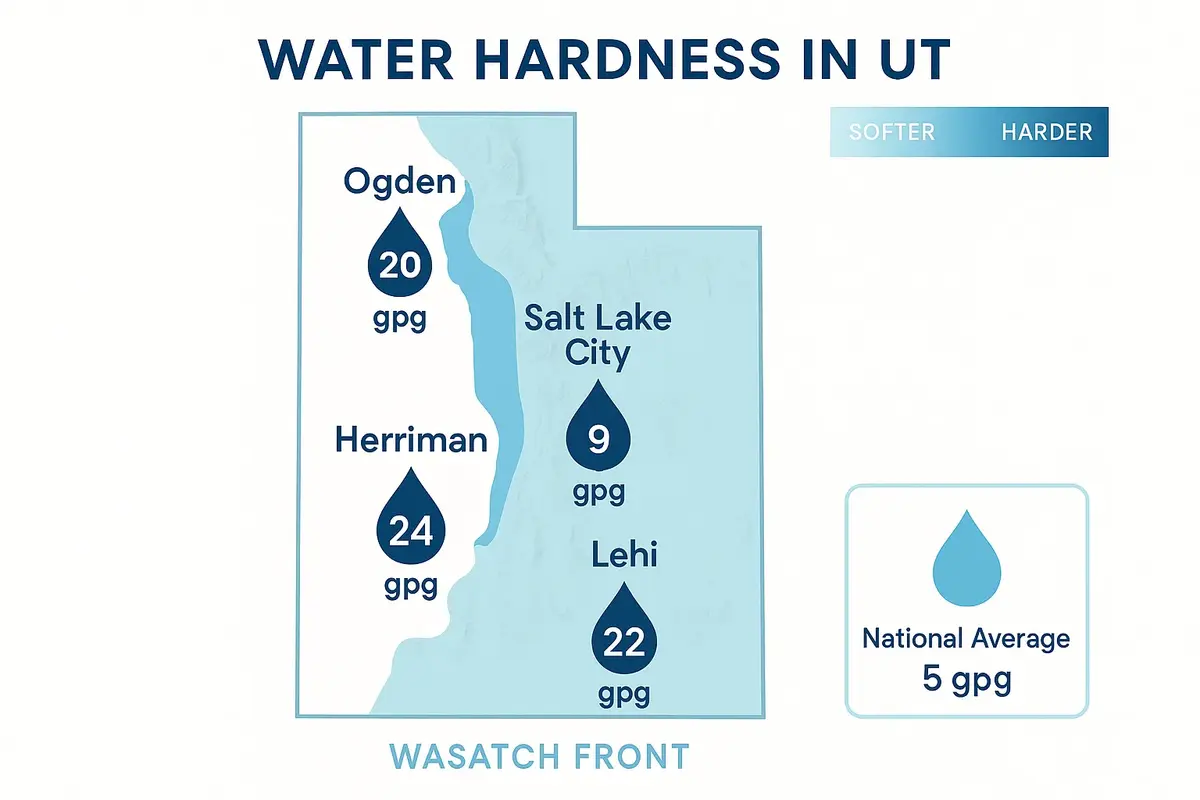
Systems without salt don’t remove hardness. They use catalytic media to change mineral structure so they’re less likely to form scale. The media works reasonably well in moderately hard water — say, 7 to 12 grains. At 20+ grains, it gets overwhelmed. Most Wasatch Front homes measure above 15 grains year-round, which puts them outside the effective range. We rarely recommend salt-free conditioners here. When a conditioner genuinely is the right fit, we price it after testing your water and seeing your setup.
Dual-Tank Systems
Dual-tank systems have two resin tanks. While one is in service, the other regenerates. You never run out of soft water, even during peak usage. Dual tanks make sense for large households with high usage or homes where multiple people shower simultaneously. For most households here, a properly sized single-tank 48,000 or 64,000-grain system is enough. Because capacity and demand vary so much household to household, we price dual-tank setups after assessing your usage — expect them toward the upper end of the system range above. The same careful sizing approach applies to tankless water heater installation pricing and considerations, where matching equipment capacity to demand prevents costly undersizing issues.
Installation Labor Costs on the Wasatch Front
Labor is the other half of total cost, and it depends on how install-ready your home is.
Pre-plumbed softener loop — a dedicated pipe section with shut-off valves where the softener connects — makes installation straightforward. We connect inlet and outlet, run a drain line, set the control head, and test the system. With a loop already in place, that labor is included in the system’s flat-rate price above. Most homes built after 2000 have softener loops.
Missing a loop? We cut into the main water line after the pressure regulator and before the water heater, install a bypass valve, and add the loop. That loop install runs $876 to $1,876 depending on access, pipe length, and whether walls need opening. Complicated installs — tight crawl space, no nearby drain, electrical outlet on the wrong wall — push toward the upper end of that range.
State plumbing code requires an air gap for the discharge line and backflow protection on the inlet. Licensed plumbers know this. These aren’t optional upgrades — they’re code compliance items that affect labor time and cost. Always hire a Utah state-licensed plumber for water softener installation. It’s required for code compliance and protects your warranty. Our guide on selecting a qualified emergency plumber in Utah covers what to look for in licensing, experience, and service guarantees — criteria that apply to all plumbing work, including water treatment installs.
Additional Costs to Budget For
Beyond the unit and labor, there are a few other expenses depending on your setup.
Permits aren’t always required, but some Wasatch Front cities ask for them when adding plumbing or modifying the main line. Check with your local building department for exact permit fees.
If your home needs a softener loop, adding one is the biggest variable — $876 to $1,876 depending on accessibility and how much pipe we run. Homes built before 2000 that have never had a softener typically need a loop. That cost breaks down into materials (PEX or copper pipe, bypass valve, fittings) and labor (cutting into main line, running new pipe, pressure testing). Tight crawl spaces or installs requiring drywall removal push the cost higher.
Need a new outlet near the softener? We price the electrical work after assessing the location. Cost depends on circuit access and distance from the panel.
Drain line work depends on distance to the nearest drain and whether walls need opening. If the nearest drain is 15 feet away and behind drywall, that’s a different scope than a floor drain three feet from the softener. We price it after seeing your setup rather than guess high.
Need help sizing your system or understanding what your home needs? Contact our team for a free system sizing consultation. We’ll assess your setup and give you a clear breakdown with no hidden fees. Finding a trusted plumbing and heating contractor near you who handles both water treatment and HVAC means you get coordinated service that protects your entire home system.
How to Save Money on Installation
Several strategies can bring total cost down without sacrificing quality.
Get multiple quotes. Pricing varies significantly between contractors for the same job. Compare what’s included — some quotes include permits, first year of salt, and annual service. Others are equipment and labor only.
Consider mid-tier brands. You don’t need the most expensive system to get good performance. Brands like Rheem, Whirlpool, and Kenmore perform well without the premium markup. Ask your installer which brands they stock and service regularly — parts availability matters.
Install during winter. Plumbers are busiest in spring and summer when outdoor work picks up. Schedule your softener install in November through February when demand is lower. Some contractors offer off-season discounts.
Replacing a water heater at the same time? Ask about package pricing. We often install softeners during water heater replacements — bundling the jobs can save on labor.
Don’t skimp on capacity — undersized systems cost more long-term through increased salt usage and shorter system life. If your water heater is already showing signs of hard water damage, evaluate the repair versus replace decision for aging water heaters before installing a softener, since replacing both simultaneously often saves on labor costs.
Ongoing Costs: Salt, Maintenance, and Electricity
Owning a water softener isn’t expensive, but there are recurring costs.
Salt is the biggest ongoing expense. Typical households here use one to two 40-pound bags monthly. Bags run $5 to $10 — so figure $10 to $20 a month depending on your water usage and how often the system regenerates.
Electricity is minimal. The control valve timer draws a few watts — typically $2 to $5 monthly. You won’t notice it on your electric bill.
Regeneration cycles use 25 to 50 gallons per flush to clean the resin bed. Systems regenerating every seven days use about 200 gallons monthly — 2,400 gallons annually. Over a year, depending on regeneration frequency, that’s 4,000 to 10,000 gallons. At Utah water rates, that’s roughly $20 to $50 per year.
Maintenance is minimal but not zero. Annual service checks — cleaning the brine tank, checking resin condition, verifying settings — keep the system running efficiently. Pair this with annual water heater flushing to remove sediment buildup, and you’ll maximize the lifespan of both your softener and your water heater in Utah’s hard water conditions.
Return on Investment
Payback comes down to measurable savings, and Utah’s hard water accelerates ROI compared to national averages.
Water heaters show the clearest return. In hard water, scale builds up on heating elements and inside the tank. Heaters in 20-grain water might last 5 to 7 years before failing. With soft water, that same unit lasts 10 to 15 years. That’s a 30% to 50% lifespan extension. Tank water heater replacement costs $2,089 to $4,357. Avoiding even one early replacement pays for the softener.
Energy savings compound. Scale on heating elements acts as insulation, forcing the heater to work harder. Studies show households with soft water save 22% to 29% on water heating costs. On a $60 monthly bill, that’s $13 to $17 per month — $156 to $204 yearly.
Appliances last longer. Dishwashers, washing machines, and any water-using appliance experiences less mineral buildup. Soft water also prevents weak toilet flushing from clogged rim jets, one of the most common hard water complaints in Utah homes. Industry studies show 30% to 50% lifespan extension when supplied with soft water. Combine softened water with essential HVAC and plumbing maintenance tips to maximize the return on every system in your home.
The payback math: mid-range 48,000-grain systems save you roughly $180 per year on energy costs. Add the avoided early water heater replacement — say, 3 years earlier than it should’ve failed, costing $3,000 — and you’ve recovered your investment in 5 to 8 years. After that, the savings keep accruing. For a complete breakdown of the decision factors and data behind evaluating whether your Utah home needs a water softener, we’ve compiled the hardness levels by city and the appliance damage costs you can expect without treatment.
Frequently Asked Questions
Why is water softener installation so expensive?
Cost reflects both equipment and skilled labor required to integrate it into your plumbing system. Installations here cost more than national averages because our extreme hardness (15 to 28 grains per gallon) requires larger-capacity systems. Systems sized for 20+ grain water cost more than smaller systems, but they’re what you need to handle Wasatch Front water without regenerating every three days.
How long does a water softener last?
Properly maintained softeners last 15 to 20 years. The resin bed can last the full lifespan when the system is sized correctly and regenerates at appropriate intervals. Control valves and brine tanks occasionally need service, but major failures are rare with annual maintenance and the right salt.
Can I install a water softener myself?
Possible for someone with plumbing experience when your home has a pre-plumbed softener loop, nearby drain, and accessible outlet. However, state code requires air gaps and backflow prevention, and some cities require a licensed plumber’s signature even for DIY work. Most manufacturers require professional installation to honor warranties. For most homeowners, professional installation is worth the cost for code compliance and warranty protection.
What size water softener do I need?
Homes here typically need a 48,000 to 64,000 grain system for three to five people. Exact size depends on your hardness (test it, don’t guess), daily water usage, and household size. Undersizing leads to frequent regeneration, higher salt costs, and shorter system life. We recommend testing at peak hardness (late summer) and sizing for that number.
How much does it cost to run a water softener?
Ongoing costs are minimal. Salt is the biggest expense — one to two 40-pound bags monthly at $5 to $10 per bag. Electricity adds $2 to $5 monthly. Water used during regeneration adds another $20 to $50 annually depending on local rates and frequency. Annual maintenance keeps systems efficient.
What’s included in the installation cost?
Standard installation includes connecting the system to your softener loop (or adding a loop if needed), running drain line to the nearest drain with proper air gap, installing backflow protection per Utah plumbing code, programming the control head for your household size and hardness level, and testing to verify soft water delivery throughout the house. Permits, electrical work, and extensive drain runs may cost extra depending on your setup.
Conclusion
Installing a water softener in Utah runs $2,257 to $6,304 for the system, plus $876 to $1,876 if your home needs a softener loop added. Investment pays back in extended water heater life, lower energy costs, and fewer appliance replacements — typically within 5 to 8 years.
Ninja Plumbing, Heating & Air installs water softeners across the Wasatch Front. Because we handle both HVAC and plumbing under one roof, we see firsthand what hard water does to Utah homes — shortened water heater lifespans, clogged fixtures, scale buildup throughout the system. We’ve been doing this for 20+ years with no pressure, no sales tactics, just honest advice and clean installs.
Ready to protect your plumbing and stop fighting scale buildup? Give us a call at (801) 997-8909. We’ll test your water, walk you through your options, and give you a clear, flat-rate quote. See our water softener installation service for what’s included.