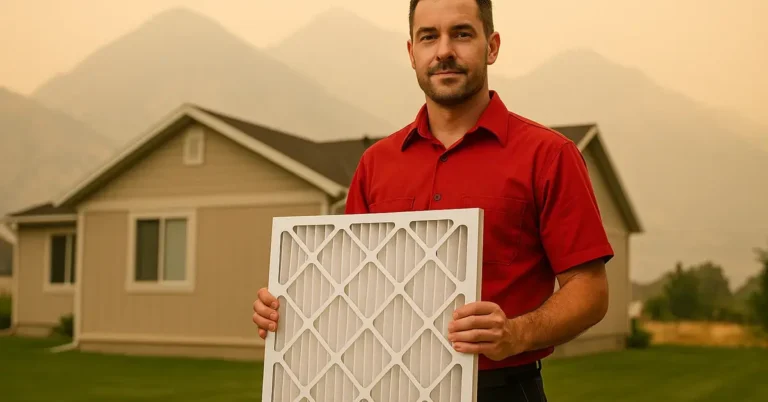
July heat settled over the Wasatch Front this summer and stayed put — the kind that turns an upstairs bedroom into an argument by mid-afternoon.
Plenty of Utah air conditioners quit during that stretch. And plenty of homeowners sat down at the kitchen table that evening with a proposal in front of them and a pen already uncapped.
Nobody’s accusing anyone here. You’re making one of the biggest decisions your house will ever ask of you, in a hot living room, with a box fan pointed at your face. So here are seven questions, each with the answer you want to hear and the answer that should slow you down.
We install these systems on the Wasatch Front every week, and these questions work on us too. Not sure you need to replace at all? Start with how long an AC really lasts in Utah. If yours already quit, call (801) 997-8909 for a straight opinion — no obligation.
The 7 Questions, in One Screen
Say them out loud, in these words.
- Which refrigerant is in this system — R-410A or R-454B?
- Can I see the Manual J load calculation for my house, and who ran it?
- What’s the AHRI reference number for this exact indoor and outdoor match?
- What are you doing about my ductwork?
- Who pulls the permit, and when’s the inspection?
- What’s your Utah DOPL license number?
- What do you measure before you leave?
Every one below comes with a good answer and a slow-down answer, because a quiz you can’t grade isn’t much help.
1. “What Refrigerant Is in This System — R-410A or R-454B?”
This one is brand new, and almost nobody asks it. EPA finalized a rule on May 21, 2026 lifting the January 1, 2026 cutoff on installing residential R-410A equipment manufactured or imported before January 1, 2025. Leftover stock can legally go into your house until it runs out.
Fair is fair — that equipment isn’t defective or illegal, and it’ll cool your house just fine.
Year six is the catch. Under the AIM Act, U.S. production of these refrigerants is capped at 60 percent of baseline levels through 2028, then steps down. So the refrigerant your system needs for a repair later is riding a shrinking supply, and ACCA expects prices to climb.
Good answer: a straight name, a reason, and a price difference. “This one’s R-454B, and here’s what that means later.”
Slow down if: you get a shrug, a “they’re all the same now,” or a salesperson who can’t say what’s on the data plate. Our R-410A phase-out explainer has the rest.
2. “Can I See the Manual J Load Calculation for My House — and Who Ran It?”

Most everywhere else, this is a best practice. In Utah it’s law. Utah Residential Code Section M1401.3 requires equipment to be sized per ACCA Manual S, using loads calculated per ACCA Manual J — and Amendment M1401.3.1 requires whoever runs that calculation to have documented training. So asking who ran it, and what their training is, isn’t rude. It’s a code question.
Why it matters this summer: Utah has gotten hotter, and sizing shortcuts haven’t kept up. A rule of thumb inherited from a milder era was built for a summer this state no longer gets. That’s the gap a real load calculation closes.
One follow-up is ours alone. The Wasatch Front sits high, and the mountain towns above it sit higher still. Thinner air carries less heat, so the old “400 CFM per ton” shorthand doesn’t hold here. Ask whether the calculation was altitude-corrected.
What you want back is a printout with your windows, insulation, and orientation in it. Slow down if the size comes off square footage, off “what you had before,” or off a round number with no paperwork behind it. For the math, see what size AC your Utah home needs and how altitude cuts cooling capacity.
3. “What’s the AHRI Reference Number for This Exact Indoor and Outdoor Match?”
The AHRI certificate and the proposal are supposed to name the same indoor coil. They can disagree, and nothing will flag it for you — you find it by reading one against the other. Not a scandal, just a mismatch worth catching before install day.
That matters because the SEER2 number on a proposal is only true for one certified pairing of outdoor unit and indoor coil. Swap the coil, and the rating stops describing what you’re buying. Ask for the reference number, then look it up in AHRI’s public Directory of Certified Product Performance. Checking a contractor’s homework takes two minutes.
Now the second half: what’s the manufacture date? Utah sits in the DOE North region, where the split-system minimum is 13.4 SEER2 and compliance rides on when equipment was built, not when it’s installed. Older, cheaper inventory can legally go into a Draper basement that couldn’t be sold in Phoenix. Our SEER2 guide for Utah buyers digs into that.
The reference number written right on the proposal is a green light. A bare outdoor model number and “the rating’s on the sticker” is not.
4. “What Are You Doing About My Ductwork?”
Buy a high-efficiency system, blow it into leaky ducts, and you’ve paid for efficiency you’ll never feel.
ENERGY STAR puts the loss at up to 30 percent of the air moving through the duct system, and says sealing and insulating brings efficiency back up by as much as 20 percent. In older homes around Ogden and West Jordan, ducts often run through a crawlspace or a baking attic. The air you paid to cool ends up where nobody’s standing.
Good answer: “We’ll inspect and test the duct system, and here’s what we found.” Somebody went and looked. Slow down if ducts never come up, or if you hear “yours are fine” before anyone has crawled under the house. We put numbers on it in what leaky ducts cost you every year.
5. “Who Pulls the Permit, and When’s the Inspection?”
An AC changeout is permitted mechanical work in Utah jurisdictions. Pulling that permit is the contractor’s job, not yours.
Inspections are the part homeowners underrate — a second set of eyes on an install you paid for and can’t see inside of. Unpermitted work follows the house, not the contractor, and it surfaces years later at resale or on an insurance claim.
What you want to hear: “We pull it, it’s in the price, and inspection usually happens within a week or two.” What should worry you: a permit described as optional, as your errand, or as a line you can decline.
6. “What’s Your Utah DOPL License Number — Can I Look It Up Right Now?”
Utah hands you a credential you can verify yourself, and it takes about a minute. The Division of Occupational and Professional Licensing runs a public license lookup. Type in the name. Read the license.
One wrinkle first. As of April 20, 2026, DOPL introduced the H100 HVAC Contractor classification, replacing the legacy S350 specialty, with existing S350 holders grandfathered through November 30, 2027. Both are legitimate right now, so a letter-and-number difference shouldn’t spook you.
Insurance changed that same day too — Utah raised the minimum liability coverage a licensed contractor has to carry, and asking to see proof is normal. Hearing a license number said out loud, with an invitation to go check it, tells you plenty. A company slogan instead of a number tells you something too.
Ours is on file with DOPL, and you’re welcome to pull it up before you ever dial. When you want a straight conversation, we’re at (801) 997-8909 — family-owned, 20-plus years on the Wasatch Front, 500-plus five-star Google reviews from Utah homeowners. No pressure, no upselling.
7. “What Exactly Do You Measure Before You Leave?”

Almost nobody asks about the last hour of install day. That hour is the difference between an installation and a swap.
ENERGY STAR defines a quality HVAC installation as four things:
- Equipment sized from your home’s actual characteristics, not a rule of thumb
- Airflow verified against the manufacturer’s performance specs
- Refrigerant charged correctly
- Ducts inspected, leakage-tested, and repaired as needed
Skipping it costs money. Improper installation can cut efficiency by up to 30 percent, ENERGY STAR says, and may shorten the equipment’s life. You can buy a great system and take home two-thirds of it.
Elevation adds a layer. At Utah elevations, airflow and charge targets have to account for thinner air, so “we set it to factory spec” isn’t automatically right here. Listen for named measurements — static pressure, temperature split, superheat or subcool — and a commissioning sheet you keep.
Two More Questions Worth Asking Before the Pen Comes Out
These two didn’t make the seven, and they’re the ones that quietly cost people money after the sale. Fine print rarely gets read out loud. Read it anyway.
“Which Rebate Am I Actually Getting — and What Do You Have to Do to Get It?”
Rocky Mountain Power’s wattsmart Homes heating and cooling list currently pays rebates on ductless heat pumps, air source heat pumps, and dual fuel heat pumps. What it doesn’t list is a rebate for a plain central air conditioner replacement. Amounts move around from year to year, so pull up the current list yourself — that’s the utility’s own page.
For a gas-furnace home in Herriman or Saratoga Springs, the dual fuel rebate is the one within reach, though it means choosing a heat pump instead of a straight AC. Our heat pump vs. air conditioner comparison lays out both sides.
Two traps almost nobody mentions: your installer has to be a program-participating contractor, and the application is due within 180 days of installation. The bigger conversion rebates are for electric-resistance-heat homes, and most Utah homes run on gas.
“What Does the Warranty Cover — and What Voids It?”
Warranties get blended into one sentence all the time. The manufacturer covers parts. Your contractor covers labor. Only one of those is a promise the person at your table controls.
Registration is where coverage quietly disappears. Most manufacturers want the system registered within a set window after installation, or coverage drops to a shorter default — so ask who files it and when. They usually expect documented annual maintenance too, which is one reason Home Health Plan members keep that paperwork in one place.
“It’s got a 10-year warranty,” full stop, isn’t an answer. Years for parts, years for labor, and who files the registration — that’s an answer.
What to Do Once You Have the Answers
Asked all seven and collected a couple of proposals? Line them up side by side next — a different job with its own rules, and we wrote it out in how to compare HVAC quotes in Utah.
Money deserves more room than a paragraph, so budgeting for an AC replacement handles that side.
A contractor who fields all seven without getting defensive has told you most of what you need to know about how they’ll treat your house.
Frequently Asked Questions
Is there still a federal tax credit for a new AC in Utah?
No. The IRS states that the Energy Efficient Home Improvement Credit (25C) applies to property placed in service before December 31, 2025, so a system installed after that doesn’t qualify. Utah Clean Energy’s Utah Energy Hub says the same. If somebody is still pitching a federal credit, slow down and ask more questions. Here’s which HVAC tax credits actually expired and the one exception that didn’t.
What SEER2 rating is required for a new AC in Utah?
Utah falls in the DOE North region, where the minimum for split-system central air conditioners is 13.4 SEER2. Whether you should buy past that minimum is a separate question, and our SEER2 guide works through the math.
Should I replace my furnace at the same time as my AC?
Not always, but do ask. Your indoor coil sits on the furnace, and a certified efficiency rating only holds for a matched pairing. If the furnace is near the end anyway, doing both at once buys a better-matched system and one round of labor. Enbridge Gas Utah’s ThermWise program — many neighbors still call it Dominion — has its own furnace rebates worth checking.
How long should an AC replacement take?
Straight changeouts — condenser and coil going back in the same places — are usually a one-day job. Add time if ductwork needs modifying or the new equipment doesn’t fit the old footprint. Ask for the timeline in writing.
Is it cheaper to replace an AC in the off-season?
Equipment pricing comes from manufacturers, not the calendar, so don’t count on a seasonal discount on the box. What spring and fall give you is easier scheduling — and a decision you’re not making inside a hot house.
The Person Who’s Glad You Asked
None of these questions is about catching somebody in a lie. They’re about finding the person who’s glad you asked — and a good contractor gets more comfortable under questions like these, not less.
Ask us all seven. We’d rather answer them at your kitchen table than have you wonder about it later. Call (801) 997-8909 and we’ll come take a look — family-owned and operated, Utah state licensed, 20-plus years serving Utah homes. No pressure, no upselling, just honest work.