Last summer, a Lehi homeowner got three quotes for a new AC. Same house, same problem, three wildly different numbers: $7,200, $9,800, and $11,500. The lowest looked great—until she noticed they’d sized the system for sea level. At 4,500 feet, that unit would’ve run nonstop and never kept up. She went with the middle quote. Three summers later, her house hits 68 degrees even when it’s 105 outside.
You’re about to spend $12,000 to $22,000 on equipment that’ll run for 15 to 20 years. The quote you pick matters. If you need help reading quotes or want a second opinion, give us a call at (801) 997-8909.
Why Getting Multiple HVAC Quotes in Utah Isn’t Optional
With 535+ licensed HVAC contractors in Utah, you’ve got options. Homeowners who get three quotes save an average of $700 compared to those who take the first offer. But it’s not just about price.
Different contractors recommend different solutions. One might suggest a 15 SEER2 system. Another pushes a heat pump instead of a traditional AC. A third says your ducts need work first. Those differences show you who knows Utah’s climate—and who’s just selling boxes.
Your goal? Find the contractor who understands altitude derating, follows building codes, and gives you enough detail to decide.
How to Verify Your HVAC Contractor Is Licensed in Utah
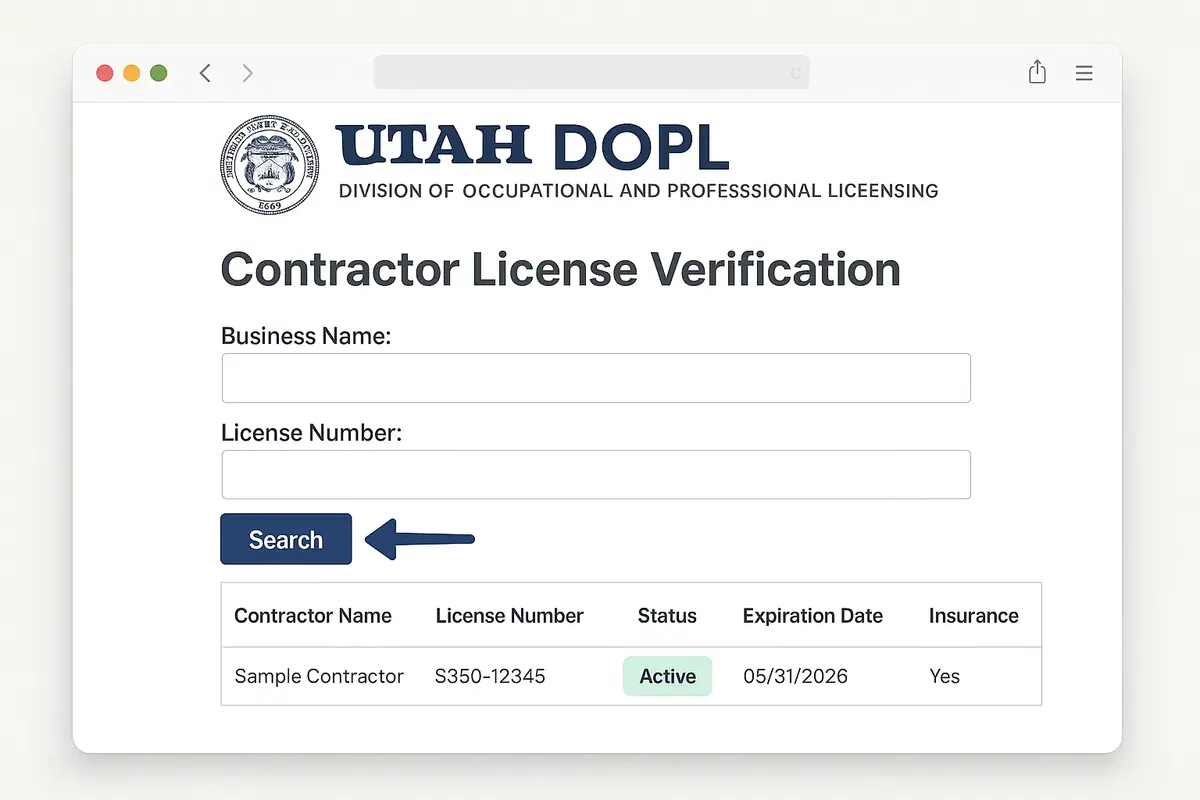
Before you look at numbers, check the license. Every HVAC contractor in Utah needs an S350 Specialty Contractor license through DOPL. That means 4,000 hours of paid work or a degree, pre-license training, and $100K/$300K liability insurance.
Verify it in 60 seconds. Go to dopl.utah.gov and search by business name or license number. You’ll see status, expiration, and any disciplinary actions. If they won’t give you a license number upfront, walk away.
Homeowners have lost thousands when unlicensed installers skipped permits and manufacturers refused warranty coverage. Don’t skip this step.
What Every Utah HVAC Quote Must Include
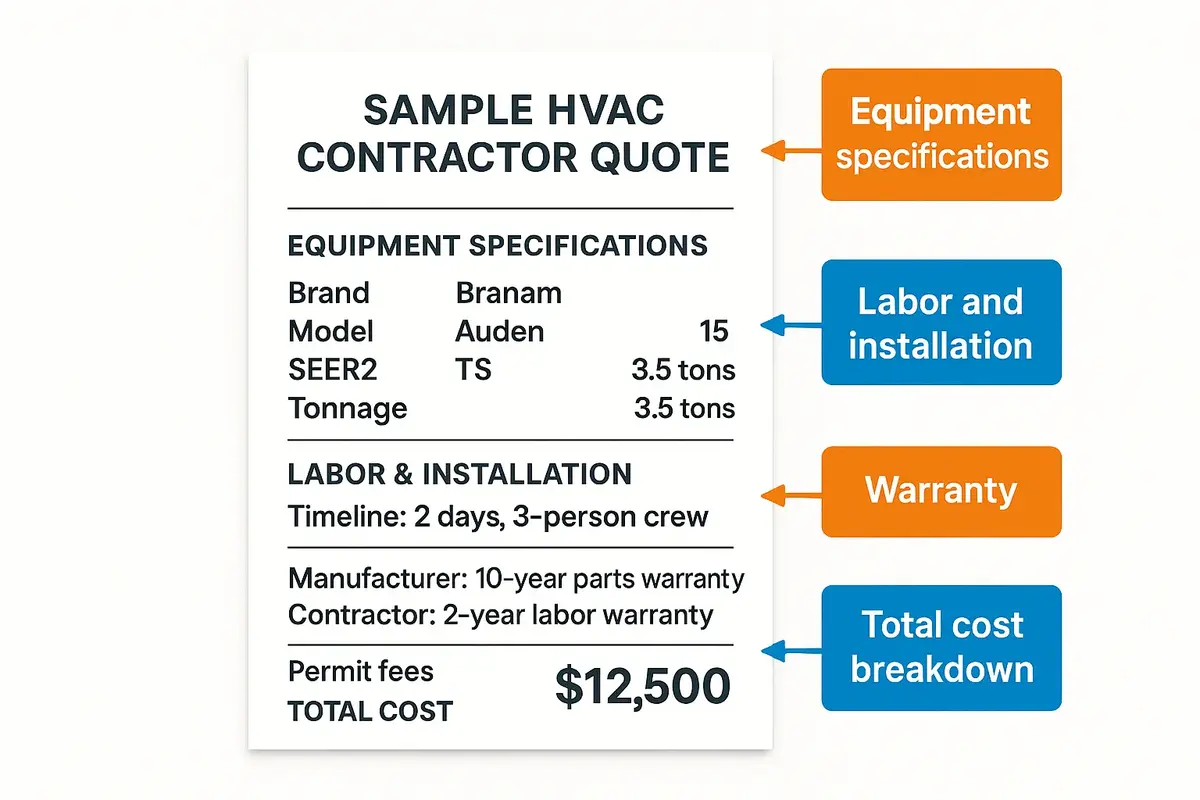
Professional quotes aren’t handwritten on a business card. They’re detailed breakdowns showing what you’re buying, what you’re paying, and what happens when something breaks.
Equipment Details That Actually Matter
Look for brand, model number, SEER2 rating, tonnage, and BTU capacity. Not “contractor grade”—the actual model. In Utah, 14 SEER2 is the federal floor. Get 15+ for our hot summers. Our guide to what SEER2 rating makes sense in Utah walks through the payback math.
Tonnage matters more here because of altitude. A 3-ton unit at sea level doesn’t deliver 3 tons at 4,300 feet. Thinner air means the compressor works harder. Most Salt Lake Valley homes need an extra half-ton to compensate. If the quote skips altitude derating, they didn’t do the math.
Labor, Installation, and Timeline
Expect 1 to 2 days for a replacement. The quote should say how many crew members and what’s included: haul-away, duct mods, electrical upgrades. It should also say who pulls permits and whether the fee is in the price or separate.
Warranty Coverage: What to Demand
Two warranties matter: manufacturer (usually 10 years on parts) and contractor labor (1 to 2 years). Some require annual maintenance to stay valid. The quote should say so upfront—not a year later when your claim gets denied.
Financing a new system? Check our guide on federal tax credits for HVAC. You might qualify for $2,000 back.
The Manual J Calculation: Utah Building Code Requires It
Manual J isn’t optional. It’s code. This calculation sizes your system based on square footage, insulation, windows, orientation, and climate zone. We span three zones in Utah—4B, 5B, and 6B, all dry.
It also accounts for altitude. Park City at 7,000 feet needs a different system than St. George at 2,800 feet. Sizing by square footage alone misses that.
Oversized systems waste 15% to 30% more energy. They cool too fast, shut off before humidity drops, then cycle back on 10 minutes later. You get a cold, clammy house. Undersized systems run all day and never catch up. Manual J prevents both.
Ask to see the report. Contractors who did the work will show you. Contractors who guessed will dodge. We cover sizing in what size AC your Utah home needs and how altitude cuts cooling power.
Utah Climate and Code Factors Your Quote Should Address
We hit 100°F in summer and sub-zero in winter. We’re at altitude. We have hard water. Multi-level homes are common. Good quotes reflect those realities.
Altitude derating is critical. Salt Lake City sits at 4,300 feet. Draper and Herriman are higher. Park City tops 7,000. Every 1,000 feet cuts AC capacity by 4%. That 3-ton unit only delivers 2.5 tons at 5,000 feet. Your quote should show how they adjusted.
Furnaces need altitude adjustments too. High-elevation combustion runs lean—too much air, not enough gas. Burners must be derated or re-jetted to prevent carbon monoxide issues.
Duct sealing and testing is required by code if your air handler is outside the thermal envelope or 20%+ of ducts run through unconditioned space. The quote should say whether testing is needed.
Hard water affects humidifiers and evaporative coolers. Mineral buildup becomes a maintenance issue. Contractors who know Utah bring this up.
Multi-level homes struggle with single-zone systems. Hot upstairs, cold basement. If your quote skips zoning or two-stage systems, ask why. Read our post on zoning for multi-story homes if you’re tired of 10-degree swings between floors.
Comparing quotes and want another set of eyes? Call us at (801) 997-8909. We’ll explain what you’re seeing.
Red Flags in HVAC Quotes: What Utah Homeowners Need to Watch For
Some red flags are obvious. Others hide. Here’s what should make you pause.
Quotes under $12,000 or over $22,000 without explanation. The typical range for full system replacement in Utah is $12K to $22K. Way outside? Ask why. Maybe it’s a mini-split. Maybe they’re padding. You won’t know unless you ask.
Missing DOPL license number. Licensed contractors put their number on every quote. If it’s missing, they don’t have one or they’re hiding it.
Verbal-only estimates. Contractors who won’t put it in writing can change the price mid-job. You have no recourse.
Same-day decision pressure. “This price ends today” is a sales trick, not professional service. Good contractors give you time to think.
Vague equipment descriptions like “contractor grade” without brand or model. When you’re evaluating HVAC estimates, specific model numbers matter—generic language is code for “cheapest thing we can find.”
Skipping Manual J. Sizing by square footage alone is lazy and usually wrong. If they didn’t measure windows, check insulation, or ask about ducts, they guessed.
Recommending replacement on systems under 10 years old without showing what’s broken. Young systems can fail, but a contractor who declares your 7-year-old furnace “shot” without diagnostics is selling, not fixing. Honest furnace repair always starts with a real diagnosis.
Skipping permit talk. Not every job needs permits, but pros know which do and who pays.
Ignoring altitude. If they sized your system from a national chart without altitude adjustments, it’ll underperform from day one.
Common HVAC Scams in Utah (And How to Avoid Them)
KUTV investigated contractors claiming “cracked heat exchangers” to scare people into new furnaces. The scam: run a quick visual, claim the exchanger is cracked and leaking CO, offer a “today only” discount. Reality? Heat exchanger cracks are rare and need combustion tests to confirm. If they claim a crack but won’t show you or run a CO test, get a second opinion.
Bait-and-switch pricing is common. “$4,995 AC installed!” gets you on the phone. Then they say that only covers a 1.5-ton unit for 900 square feet, and your house needs 3 tons at $9,500. The ad got them in. The upsell is where they profit.
Refrigerant recharge without leak repair. Low refrigerant means there’s a leak. Refrigerant doesn’t evaporate. Topping it off without fixing the leak is a $200 Band-Aid that fails in six months.
License “renting.” A licensed contractor rents their license to unlicensed crews. You think you hired licensed pros. The crew has no training, no insurance, no accountability. Ask to see the license of the person doing the work.
Safety scare tactics. “Your furnace could kill your family tonight” without test results is a sales pitch. Real safety issues—gas leaks, CO, electrical—come with data and clear explanations.
Protection plan: verify credentials through DOPL, get three written quotes, ask for test results if they claim safety issues, get second opinions on major recommendations.
Questions to Ask Every HVAC Contractor Before You Sign
Ask these out loud when choosing an HVAC contractor. Take notes. Compare across quotes.
Can I see your DOPL license and insurance certificate?
Will you do a Manual J load calculation, and can I see the report?
How are you accounting for altitude?
What’s in your labor warranty and how long does it last?
Who handles permits, and is the fee included?
What’s the timeline from contract to completion?
Can you provide local references from the last six months?
How to Compare Quotes Apples-to-Apples
Build a spreadsheet. Contractors down the left. Columns across the top: brand, model, SEER2, tonnage, parts warranty, labor warranty, permits included, haul-away included, total cost.
Fill it in. Patterns emerge fast. One might be $1,500 cheaper because they skipped permit fees. Another uses lower SEER2. A third offers 10-year parts while others offer 5.
Normalize what’s included. Quote A is $8,500 with permits. Quote B is $7,800 without. Add $300 to Quote B. Now you’re comparing real cost.
Factor in warranties. A 2-year labor warranty beats 1-year, especially on high-efficiency systems with complex controls.
Consider service area. A company in Eagle Mountain serving the whole Wasatch Front has longer response times than one five miles away. That matters in July.
Don’t choose on price alone. Value includes expertise, warranty, response time, and whether they know Utah codes. Cheap often costs more long-term.
Need help comparing or want our bid? Call (801) 997-8909. We’ll give you a detailed quote and explain what you’re seeing from others.
What HVAC Replacement Actually Costs in Utah (2026)
Full systems—furnace and AC—run $12,000 to $22,000. For a typical 2,000-square-foot home, expect $14,000 to $20,000 depending on efficiency and complexity. For more detail on AC-specific replacement costs, see our guide on how much to replace an AC unit. If you’re replacing a furnace, check our Utah furnace installation cost breakdown.
Price drivers: altitude derating bumps you half a ton ($500 to $1,000). Duct mods add $1,500 to $5,000. Zoning adds $2,000 to $4,000. High-efficiency systems—16 SEER2+, 96% AFUE furnaces—cost more upfront but save $20 to $50 monthly.
Federal tax credits cut net cost. The Inflation Reduction Act offers up to $2,000 for high-efficiency systems. Read our 2026 tax credit guide before choosing your tier.
Most contractors offer financing. Compare cash prices, not monthly payments. Financing can hide bad deals.
Ready to move forward with a replacement? Learn more about our AC replacement and installation services or call (801) 997-8909 for a detailed quote.
Comparing HVAC Quotes in Utah: Your Questions Answered
How many HVAC quotes should I get?
Three. One gives you no context. Two is a coin flip. Three shows patterns—which recommendations appear twice, which prices are outliers, who did the work.
What should be included in an HVAC quote?
Brand, model, SEER2, tonnage, BTU. Labor and timeline. Parts and labor warranties. Permit handling. Total cost breakdown. Payment terms. Missing any? Red flag.
Why is a low quote a red flag?
Nobody sells below cost. Low quotes mean something’s missing: permits, proper sizing, license, insurance. Or it’s bait-and-switch. Either way, cheap rarely ends cheap.
How do I verify a contractor’s license in Utah?
Visit dopl.utah.gov and search by name or license number. You’ll see status, expiration, disciplinary actions. Takes 60 seconds. Same process works for choosing an emergency plumber—licensing matters across trades.
What is Manual J and do I need one?
Manual J calculates your home’s heating and cooling needs based on size, insulation, windows, orientation, and climate. It’s required by Utah building code for proper sizing. Contractors who skip it and size by square footage are guessing. In Utah, with varying altitude and climate zones, that guess is usually wrong.
Conclusion
Comparing Utah HVAC quotes boils down to three steps: verify the DOPL license, confirm Manual J with altitude adjustments, and compare apples-to-apples on equipment, warranties, and inclusions. The lowest number isn’t always best. The best contractor shows their work, explains pricing, and knows Utah codes.
We’re family-owned with 20+ years helping Utah families stay comfortable. Utah state licensed. Manual J on every install. Altitude accounted for in every system. We care about getting it right—for your home and your family. Need a quote or help reading others? Call (801) 997-8909.