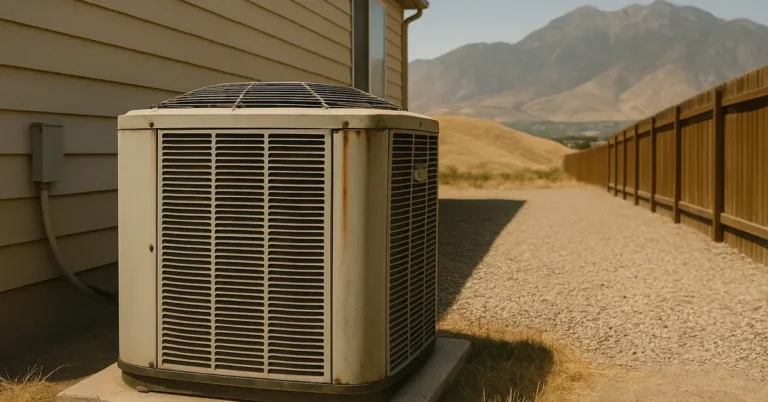
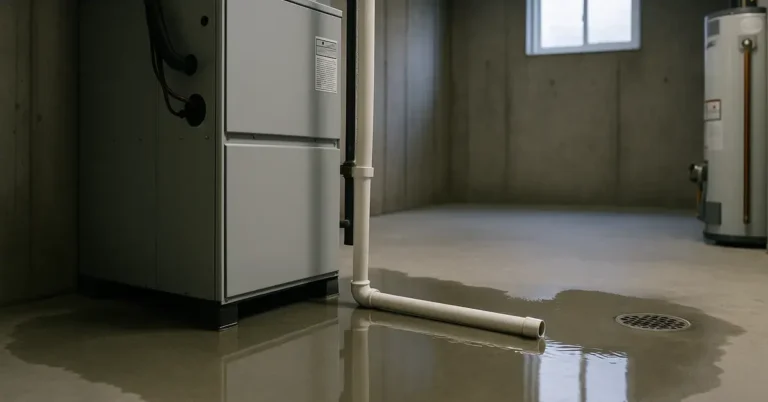
It’s 102 degrees in Lehi. Your AC has been running nonstop since 9 AM, but it’s still 80 degrees inside. You walk outside to check the unit and catch a faint, sweet smell near the condenser. The lines running into your house have ice forming on them.
Those are classic refrigerant leak symptoms — and they’re not just an inconvenience. They signal a cascade of problems getting worse by the hour.
Over 20 years fixing HVAC systems across the Wasatch Front taught us that homeowners underestimate refrigerant leaks until it’s too late. What starts as “the AC isn’t cooling quite right” turns into a $2,188-plus compressor replacement in the middle of July when wait times are two days out.
These leaks are more than just a cooling problem in Utah. Our altitude and summer heat make early detection critical.
If you’re seeing refrigerant leak symptoms right now, give us a call at (801) 997-8909. During business hours, we guarantee a 120-minute emergency response across the Wasatch Front.
How to Recognize Refrigerant Leak Symptoms
If you’re seeing signs of refrigerant leak, here’s what to watch for. Ice builds up on the refrigerant lines or evaporator coil. The AC runs constantly but never quite reaches your set temperature. You hear a hissing or bubbling sound near the outdoor unit. If you’re hearing unusual sounds, check out our guide on weird AC noises and what they mean to understand what your system is telling you.
Energy bills creep up even though you haven’t changed how you use the system. Sometimes you’ll smell something faintly sweet or chemical near the outdoor unit.
Our post about 5 signs your AC is low on refrigerant covers the detailed symptoms. Check that for the full breakdown.

Why Refrigerant Leaks Happen in Utah Systems
Your AC doesn’t just leak on its own. If your system is low, there’s a leak somewhere. Here’s what causes them in Utah.
Age and wear are the most common culprits. Older homes in Sugar House, the Avenues, and parts of Provo and Orem often have systems that are 15 to 25 years old — well beyond how long AC units typically last in Utah. The rubber seals dry out. Copper tubing develops pinhole leaks. Connections loosen over time.
Spring weather swings from 30 degrees at night to 70 during the day. That expansion and contraction stresses coils and line connections.
Corrosion happens faster than you’d think. The outdoor condenser sits in the elements year-round — snow, rain, road salt in winter, dust storms in summer. Salt Lake Valley air quality can be rough on metal components. Poor AC condenser placement — boxed in by shrubs or fences, or tucked under a deck — can trap moisture and debris, making corrosion happen even faster.
Altitude is the factor most people miss. The Wasatch Front sits between 4,200 and 6,000 feet above sea level. Lower air pressure at that height affects the pressure inside your lines. If your system wasn’t properly charged for altitude when installed, even a small leak has a bigger impact than it would at sea level.
Sometimes it’s just poor installation or a past DIY repair that didn’t hold.
The Cascade: How a Small Leak Becomes a Big Problem
When your system starts leaking, it’s not a single failure. It’s a chain reaction.
First, the system runs longer to reach the temperature you set. As it worsens, the compressor works harder. There’s not enough refrigerant to transfer heat well. Your energy bills climb. According to the U.S. Department of Energy, HVAC accounts for 48% of home energy use. When your system is 20% low on refrigerant, cooling costs can jump 30 to 50 percent during a Utah summer.
Ice starts forming on the evaporator coil inside your house. Without enough refrigerant, the coil gets too cold. Moisture from the air freezes on it. Airflow drops. The system stops cooling.
Finally, the compressor overheats and fails. Compressors are designed to compress refrigerant vapor, not air. When refrigerant levels drop too low, the compressor overheats. Once it burns out, you’re looking at $2,188 to $3,150 to replace it — or often, a full system replacement.
That’s the cascade. In Utah, it happens faster than in most places.
Why Utah’s Summer Heat Accelerates the Damage
When it’s 100 degrees outside — which happens regularly in the Salt Lake Valley from June through August — your AC runs almost continuously. Salt Lake City recorded 2025 as its warmest year on record, and 2026 temperatures are tracking even higher.
A system that’s low on refrigerant is already struggling. Add extreme heat, and it runs longer cycles, works harder, and overheats faster. A leak that might take a full season to cause problems in a milder climate can destroy a compressor in six weeks here.
At 4,500 feet, your system is already working harder than it would at sea level. A 10% refrigerant loss at altitude has a greater impact than the same loss in Denver or Phoenix.
When your compressor fails during a July heat wave, you’re not just dealing with the cost. Emergency service calls spike in summer. Even with our 120-minute response guarantee, getting a full replacement scheduled can take a few days during peak season.
Prevention is cheaper than emergency repair. Our $69 tune-up includes a refrigerant pressure check that can catch leaks before they cascade into compressor failure. Before summer heat hits, follow our spring AC startup checklist to catch early warning signs of refrigerant issues.
Health Risks: When Refrigerant Becomes a Safety Issue
Let’s be clear about AC leak health risks. Modern refrigerants like R-410A aren’t acutely toxic in the way carbon monoxide is. You’re not going to pass out from a small outdoor leak. But that doesn’t mean they’re harmless.
In high concentrations — especially in poorly ventilated spaces like basements or mechanical rooms — refrigerant displaces oxygen. When you breathe it in, you might feel dizzy. You might get a headache, feel nauseous, or have trouble breathing. Your throat might swell. These symptoms usually show up when there’s a significant indoor leak.
Children and pets are at higher risk. Certain refrigerants are heavier than air and settle near floor level. If your outdoor unit leaks near a backyard play area, that’s a concern. If you’ve got an indoor air handler leaking into a basement where kids or pets spend time, that’s a real problem.

Older systems that still use R-22 (Freon) are more dangerous. R-22 was phased out in 2020. By 2026, replacement costs have skyrocketed. R-22 can cause more severe breathing problems. In rare cases, it can cause heart issues if exposure is prolonged.
Most outdoor leaks aren’t a medical emergency. But if you smell a strong chemical odor, or if anyone in the house feels sick, you should open windows. Turn off the AC. Leave the area. Call a professional.
Can You Stay in Your House with a Refrigerant Leak?
If it’s a small outdoor leak and you’re not smelling anything inside, you’re generally safe to stay in the house. Just get it fixed promptly.
If it’s an indoor leak — if you smell something strong near your air handler, or if the odor is noticeable throughout the house — open windows and shut down the AC. Get some fresh air. If anyone feels dizzy or has trouble breathing, leave the house and seek medical attention.
The Hidden Cost: What Ignoring a Leak Really Costs You
Let’s talk money. Because this is where the “it’s just not cooling great” mindset costs you.
If you catch a leak early — a small pinhole leak in a line or a loose connection — detection typically runs $227 to $687. After we locate the leak, repair costs vary based on what’s damaged. Small repairs run a few hundred dollars. That includes patching or replacing the damaged section, pulling a vacuum on the system, and recharging it with the correct amount for Utah’s altitude.
If the leak has been going on for a while and the evaporator coil has corroded, you’re looking at $2,188 to $3,150 for coil replacement plus refrigerant recharge.
If you ignored it long enough that the compressor overheated and failed, that’s $2,188 to $3,150 for a compressor replacement. At that point, most HVAC techs recommend replacing the whole system.
Then there’s the energy waste. A system that’s 20% low on refrigerant can use 30 to 50 percent more electricity to provide the same cooling. During a Utah summer, that’s an extra $50 to $150 per month on your power bill.
If your system uses R-22, refrigerant refills are expensive. You might pay $150 or more per pound. For many older systems, it’s more cost-effective to replace the whole unit.
The math is simple: A $69 tune-up catches the leak early. Or you pay $2,188-plus for an emergency compressor replacement in the middle of July.
Our Home Health Plan covers two professional tune-ups per year, priority scheduling, and 15% off all repairs for $18.99 a month. If you’re in an older home or your system is more than 10 years old, it’s worth it.

Utah-Specific Factors That Make Refrigerant Leaks Worse
Altitude is the first factor. The Wasatch Front ranges from about 4,200 feet in the Salt Lake Valley to over 6,000 feet in some areas. At that height, air pressure is lower. AC capacity drops by roughly 3% for every 1,000 feet of elevation. So when your charge drops by 10%, you’re already working with reduced capacity due to altitude.
Certified Utah techs know to use manufacturer high-altitude pressure charts when charging systems. If your system wasn’t charged correctly to begin with, a leak speeds up the problems.
Extreme heat is the second factor. Salt Lake City regularly hits 100 degrees or higher in July and August. We saw a record 107 degrees. When it’s that hot, your AC runs nearly nonstop, speeding up compressor wear and failure.
The dry climate paradox is third. Even in dry Utah, a leaking AC can make your home feel sticky. Why? Because an AC system doesn’t just cool air — it dehumidifies. When refrigerant is low, the evaporator coil doesn’t get cold enough to remove moisture from the air.
Older neighborhoods are the fourth factor. Homes in Sugar House, the Avenues, older parts of Provo and Orem — these areas have systems that are 15 to 25 years old. Many still run on R-22, which is phased out and expensive to refill. If you’re in an older home and you haven’t replaced your AC in the last decade, leak symptoms signal it’s time to start planning for a replacement.
How to Detect a Refrigerant Leak (and What Happens Next)
You might spot some of the DIY signs yourself — ice on the lines, AC running but not cooling, higher bills, hissing sounds. But finding the actual leak takes professional tools.

Electronic leak detectors sense refrigerant in the air. UV dye gets injected into the refrigerant, and a UV light makes the leak glow. Nitrogen pressure tests involve pressurizing the system and listening for leaks. The soap bubble test works for accessible joints.
Pros find leaks you can’t see. Micro-leaks — pinhole corrosion in a coil, a cracked brazed joint hidden behind a panel — are invisible without the right equipment.
When we inspect for leak symptoms, we start with a visual check. Then we run a pressure test to confirm the system is losing pressure. If it is, we use electronic detection and UV dye to pinpoint the exact location.
Once we find it, the repair is straightforward: fix or replace the damaged part, pull a vacuum on the system to remove air and moisture, and recharge it with the correct amount. The Utah detail that matters: we use high-altitude pressure charts to make sure the charge is right for your elevation. A system charged to sea-level specs won’t perform right at 4,500 feet.
Repair time varies. A simple line repair might take two to four hours. A coil replacement can take four to eight hours or require a follow-up visit.
If you suspect leak symptoms, give us a call at (801) 997-8909. Our dispatch fee is $49 on weekdays (Monday through Friday, 9 AM to 5 PM), and that fee is applied to your repair.
After 5 PM, weekends, and holidays, the dispatch fee is $149 ($99 for Home Health Plan members). We guarantee a 120-minute emergency response during business hours across the Wasatch Front — one of the fastest in Utah.
Frequently Asked Questions About Refrigerant Leaks
Is a refrigerant leak dangerous?
A small outdoor leak generally isn’t an immediate danger, but it should be fixed promptly. Large indoor leaks, especially in confined or poorly ventilated spaces, can cause dizziness, nausea, and shortness of breath. Children and pets are at higher risk because some refrigerants settle near the floor. If you smell a strong chemical odor or anyone experiences symptoms, leave the area and call a professional.
How much does it cost to fix a refrigerant leak?
Leak detection runs $227 to $687. Small leak repairs typically cost a few hundred dollars after detection. If the leak is in the evaporator coil and requires coil replacement, expect $2,188 to $3,150. If the compressor failed, you’re looking at $2,188 to $3,150 for compressor replacement — or potentially a full system replacement if the unit is older. Early detection saves you a lot of money.
Can you fix a refrigerant leak yourself?
No. Work on refrigerant systems requires EPA 608 certification and specialized equipment. It’s illegal for unlicensed individuals to purchase or handle refrigerant. DIY sealants you might see at the hardware store don’t work reliably and can damage your system. Leave refrigerant work to licensed, Utah state-certified techs.
Catch Refrigerant Leaks Before the Compressor Fails
Leaks aren’t just about losing cool air. They’re health risks when concentrations build up indoors. They’re system killers when compressors overheat. And they’re wallet drains when you’re paying for wasted energy and emergency repairs.
At 4,500 feet with 100-degree days, your AC is already working harder than systems at lower elevations or milder climates. A leak that might be a minor issue elsewhere becomes a ticking time bomb here.
Over 20 years fixing HVAC systems across the Wasatch Front, we’ve seen what happens when homeowners delay repairs. And we’ve seen how much money and stress they save when they catch leaks early.
If your AC isn’t cooling like it should, if you’re seeing ice on the lines, if your bills are climbing, or if you just haven’t had a tune-up in the last year, give us a call at (801) 997-8909. Open 7 days a week, and emergency calls are handled after hours. Our dispatch fee is $49 weekdays 9 AM-5 PM (applied to your repair) and $149 after 5 PM, weekends and holidays.
We guarantee a 120-minute emergency response during business hours — one of the fastest in Utah.
Prevention is cheaper than emergency repair. A $69 tune-up can catch leak symptoms before they cascade into a $2,188-plus compressor failure in the middle of a July heat wave.
Need help? Learn more about our AC repair service or call us at (801) 997-8909.
Homeowners in Salt Lake City can learn more about our Salt Lake City AC repair services.