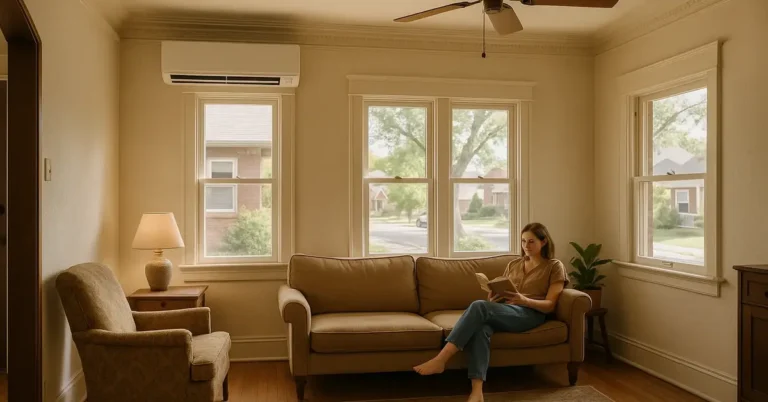
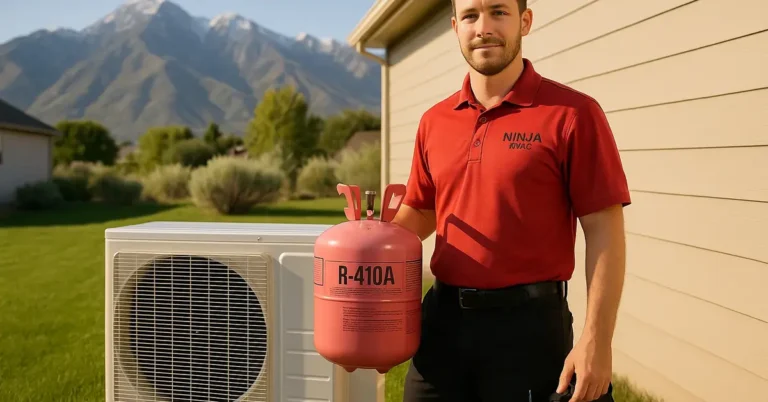
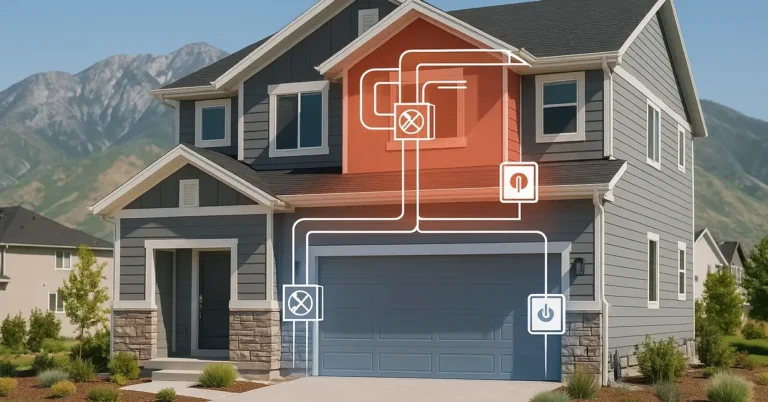
Your AC ran all day yesterday. The house never dropped below 80°F. Outside, the thermometer hit 102°F in Lehi — the fourth time this month it’s crossed 100°F. You’re standing by the thermostat wondering if something’s broken, or if this is just what summer looks like now on the Wasatch Front. Here’s the thing: Utah has been experiencing more 100°F+ days in recent years than the historical average. Your AC isn’t necessarily failing. It might be working exactly as designed — and the design wasn’t built for this many triple-digit days.
If your AC is struggling and you’re not sure whether it’s normal, call us at (801) 997-8909 for an honest AC assessment. We’re happy to take a look and give you an honest assessment.
Why 100°F Is Different: Your AC’s Design Limit
Most residential air conditioning systems in the U.S. are designed to perform optimally up to an outdoor temperature of 95°F. That’s not a marketing claim — it’s an industry standard backed by decades of engineering data. When outdoor temps hit 100°F, you’re not just dealing with “a really hot day.” You’re pushing your system past the parameters it was built to handle.
Think of it this way. Your AC was sized and installed based on a calculation called Manual J, which assumes a maximum outdoor temperature for your climate zone. In Utah, that number is usually 95°F. At that temp, your system is designed to maintain about a 20-degree difference between outdoor and indoor air. So on a 95-degree day, keeping your house at 75°F is well within spec.
But at 100°F, the physics change. The compressor works harder, refrigerant doesn’t absorb heat as efficiently, and the outdoor coil struggles to shed heat when the air around it is that hot. A system that could comfortably cool to 75°F on a 95-degree day might only reach 78-80°F when it’s 100°F outside — and that’s not a malfunction. That’s the system operating at the edge of its design envelope.
When outdoor temps exceed 100°F, a 3-ton AC unit may only provide the cooling capacity of a 2-ton system at peak temperatures. The heat stress doesn’t just slow the system down. It fundamentally changes how much cooling power it can deliver. Your AC isn’t broken — it’s just being asked to do something it wasn’t built for.
What 100°F Actually Does to Your System
The numbers tell part of the story. The physics tell the rest. When outdoor temps cross 100°F and your air conditioner is not keeping up with extreme heat, three things happen inside your AC that don’t happen at 95°F — and they all work against you.
First, compressor efficiency drops. The compressor is the heart of your AC — it pressurizes refrigerant so it can absorb heat from your house and reject it outside. But when outdoor air is 100°F, the compressor has to work harder to achieve the same pressure differential. It’s running at or near maximum capacity just to maintain baseline cooling, which means less headroom for peak demand and more wear on the motor.
Second, refrigerant can’t reject heat as efficiently. Your outdoor coil’s job is to release the heat your refrigerant absorbed inside your home. That heat has to move from the hot refrigerant into the outdoor air. When outdoor air is already 100°F, the temperature difference between refrigerant and air shrinks — and that slows heat transfer. It’s like trying to cool coffee by setting it on a warm counter instead of a cool one. The process still works, but it takes longer and never gets as cold.
Third, continuous runtime becomes the new normal. At 95°F, your system might cycle on and off — running 15 minutes, resting 10, running 15 more. At 100°F, it runs constantly. That’s not a failure mode. It’s equilibrium. The system is delivering exactly as much cooling as the house is gaining heat, and there’s no surplus capacity left to shut down and rest. If your AC is running nonstop on a 100-degree day and holding your house at 78-80°F, it’s doing exactly what it was designed to do at the edge of its capacity.
Is It Normal? When 100°F Performance Means Your System Is Fine
The question you really want answered: should I call someone, or is this just life in a hotter Utah? Here’s the framework we use when homeowners call us during heat waves.
What “Normal Struggle” Looks Like at 100°F
If your AC is running continuously on a 100-degree day and keeping your house between 78-82°F, that’s success. Continuous runtime isn’t a red flag — it’s the system doing what it’s supposed to do. It’s holding equilibrium at the edge of its capacity. The air coming from your vents should still feel cold, just not as icy as it does on a 90-degree day. Your electric bill will spike — 30-50% increases during heat waves are normal when your system runs nonstop.
You might not hit your usual 72°F setpoint, and that’s okay. The system isn’t broken. Outdoor conditions exceeded the design assumptions. Adjust your expectations, close the blinds, and let the system do its job without fighting it.
Red Flags: When to Call Ninja
Here’s when normal struggle crosses into “something’s wrong” territory. If your indoor temp climbs above 85°F on a 100-degree day, your system can’t maintain even a 15-degree difference — that suggests a problem beyond heat stress. Ice forming anywhere on the system (outdoor unit, refrigerant lines, indoor coil) means refrigerant flow is restricted or the system is low on charge. Strange noises — grinding, squealing, clicking — point to mechanical failure. Short cycling (the system turning on and off every few minutes instead of running steady) is a compressor or electrical issue, not normal heat behavior.
Warm air blowing from the vents is the biggest giveaway — if the air isn’t cold at all, you’ve likely lost refrigerant or the compressor has failed.
See red flags? Call Ninja for a diagnostic AC tune-up at (801) 997-8909. We’ll tell you exactly what’s going on — and whether your system needs repair or just needs grace during the heat.
Common Questions About AC Performance When Utah Hits 100°F
What temperature is too hot for AC to work?
Most systems are designed for 95°F max outdoor temps. At 100°F and above, expect reduced performance but not total failure. If outdoor temps exceed 115°F, many systems can’t maintain even a 15-degree difference between outdoor and indoor air — but Utah rarely hits that threshold.
Why is my AC not cooling my house below 80 degrees on a 100-degree day?
This is likely normal. Your system is designed for roughly a 20-degree temperature difference at design conditions. If it’s 100°F outside and your house is holding at 80°F, your AC is working as designed. Not broken. Just being asked to perform beyond its original spec.
Is 100°F too hot for my AC?
No, but it’s beyond the design standard. Most residential AC units are designed for optimal performance up to 95°F outdoor temps. At 100°F, you’re exceeding that threshold — which directly affects AC performance at 100 degrees with reduced capacity and longer runtime. The system still works, but it can’t deliver the same temperature drop as it would on a 95-degree day.
Why does my AC run constantly on hot days?
Continuous runtime on 100°F days is normal and actually efficient — the system is maintaining equilibrium at the edge of its capacity. Short cycling (turning on and off every few minutes) is the red flag. Constant running means your system is working hard but working correctly.
Beat next summer’s heat wave. Schedule a pre-season tune-up at (801) 997-8909 so your system is ready before the next 100-degree day hits. We’re Utah state licensed, family-owned, and we’ve been protecting Wasatch Front homes from summer breakdowns for over 20 years. Here’s what to expect during a tune-up — no pressure, no upselling, just honest work that keeps your system running when you need it most.
- Loading headings...