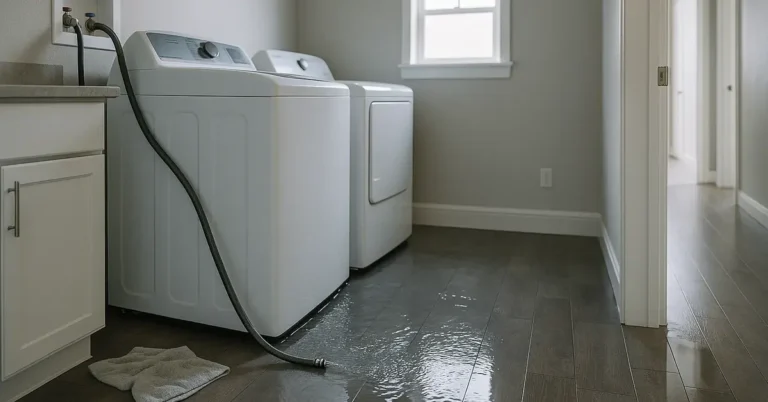
You walk past the water heater on your way to the laundry room and notice it. A puddle. Not huge — maybe the size of a dinner plate — pooling under the bottom of the tank. Your first thought is probably panic. Is this an emergency? Do I need to call someone right now? Will my basement flood?
Leaks from the bottom aren’t always emergencies, but they’re never something you can ignore. Some leaks are quick fixes — a loose valve, a worn seal. Others mean the tank has corroded through, and you’re looking at a replacement. That difference matters, especially in Utah where our extreme hard water makes water heaters work harder and fail faster than almost anywhere else in the country.
By the end of this post, you’ll know exactly what’s causing that puddle, whether you can repair it or need to replace the whole unit, what it’ll cost on the Wasatch Front, and how to prevent it from happening again. Need help right now? Give us a call at (801) 997-8909 — we guarantee a 120-minute response during business hours, and emergency calls are handled after hours.
What to Do Right Now If Your Water Heater Is Leaking
Before you do anything else, take these four steps. They’ll minimize water damage and keep you safe while you figure out what’s going on.
First: Turn off the power. Got a gas water heater? Turn the gas control dial to “pilot” or “off.” Electric? Flip the breaker. A leaking water heater that’s still heating water is wasting energy and potentially making the problem worse.
Second: Shut off the cold water supply. Look for a valve on the cold water line running into the top of the tank. Turn it clockwise until it stops. This prevents more water from entering the tank and leaking out the bottom.
Third: Assess the severity. Is this a slow drip, or is water actively pooling and spreading? A slow drip from a valve might wait until morning. A steady stream pooling under the tank means you need help today — that’s a failing tank, and it won’t get better on its own.
Fourth: Contain the water. Throw down towels, set up a bucket, move anything that could get damaged. Mold can start growing within 24 to 48 hours of water exposure, so the faster you dry things out, the better. Significant water on drywall, carpet, or finished flooring? You might be looking at an insurance claim.
Why Water Heaters Leak from the Bottom (Especially in Utah)

Most water heaters leak from the bottom for one of three reasons: a faulty drain valve, sediment buildup that’s corroded the tank, or a malfunctioning temperature and pressure relief valve. Utah’s hard water makes all three more likely — and makes them happen faster.
Wasatch Front water is some of the hardest in the nation. Salt Lake Valley measures 12 to 18 grains per gallon, well into the “very hard” category. St. George and Southern Utah? Even worse. Mineral deposits — calcium, magnesium, lime — settle at the bottom of your tank and harden into a concrete-like layer. Over time, that sediment creates hot spots, accelerates corrosion, and eats through the tank lining. Water heaters that should last 12 to 15 years nationally often fail in 5 to 8 years in untreated Utah homes.
Let’s break down the three main causes and what you’re actually looking at.
Drain Valve Leaks (Usually Fixable)
The drain valve sits at the very bottom of the tank. It’s the spigot you’d use to flush sediment or drain the tank for maintenance. Sometimes it starts dripping because the valve isn’t fully closed — a quarter turn clockwise might fix it. Other times the valve itself wears out, especially after sitting untouched for years.
Leaking drain valves are one of the few water heater problems you can actually repair. When the valve is the problem and your tank is otherwise healthy, a plumber can replace it without replacing the whole unit. Expect this kind of service call to fall within the $84 to $997 range depending on complexity and whether any additional issues are discovered.
Sediment Buildup and Tank Corrosion (Not Fixable)
This is the big one. It’s the #1 cause of bottom leaks we see in Utah, and it’s not repairable.
What happens: hard water minerals settle at the bottom of the tank every time the water heats up. When you’re not flushing the tank regularly — and most homeowners aren’t — that sediment layer gets thicker. It insulates the bottom of the tank from the water, so the burner or heating element has to work harder. Metal gets hotter than it should. Glass lining inside the tank cracks. Steel corrodes. Eventually, it rusts through.
Once the tank itself has corroded, there’s no fix. You can’t patch a rusted-through water heater tank. Leaks only get worse, and the tank will fail completely — usually sooner than you’d like. Hard water can reduce a water heater’s efficiency by up to 48% in extreme cases, and in Utah, those “extreme cases” are just normal Tuesday.
Got rust-colored water coming out of your taps, or a tank over 7 or 8 years old leaking from the bottom? Honest answer is replacement.
Temperature and Pressure Relief Valve
The T&P valve is a safety device. It’s usually mounted on the side or top of the tank, but the discharge tube runs down the side to a few inches above the floor. When that tube is dripping or you see water near the bottom of the tank, it might be the T&P valve releasing pressure.
In Utah, altitude affects how pressure relief valves work. Water boils at different temperatures depending on elevation, and when your valve is improperly rated or starting to fail, it can release water when it shouldn’t. A dripping T&P valve usually means the valve needs replacing — or it could mean your water heater is overheating, which is a bigger problem. Either way, it’s worth a professional look.
Can You Repair It, or Do You Need a New Water Heater?
Your decision comes down to three things: the age of the unit, the source of the leak, and whether the repair cost makes sense compared to replacement.
When the leak is coming from a valve — drain valve or T&P valve — and the tank itself is less than 5 or 6 years old, repair usually makes sense. Those valve replacements are straightforward, and a healthy tank with a replaced valve can run for years.
But when the leak is coming from the tank itself — you see water seeping from the seams, rust on the exterior, or puddles that aren’t near any valve — replacement is your only option. A corroded tank is a failed tank. You’re not repairing that. You’re managing how long before it floods.
Replacement costs on the Wasatch Front: Tank-style water heaters run $2,089 to $4,357 installed, depending on size (40 or 50 gallons), fuel type (gas or electric), and quality tier. A basic 40-gallon gas unit starts around $2,249. A 50-gallon gas unit with better efficiency and a longer warranty runs closer to $4,357.
Tankless water heaters cost more upfront — $6,415 to $7,825 installed — but they handle Utah’s hard water better when you commit to annual descaling. They also never run out of hot water, which matters in bigger households.
Don’t forget the permit. Utah code requires permits for water heater replacements, with costs varying by city. You’ll also need seismic strapping (earthquake safety) and when the unit is going in a garage, it has to sit at least 18 inches above the floor. A good contractor handles all that, but it’s worth knowing the rules.
Want a professional to take a look and give you an honest answer? Give us a call at (801) 997-8909. Our $49 dispatch fee (weekdays 9am-5pm) gets applied to your repair – after 5pm, weekends, and holidays it is $149 – and we’ll tell you straight up whether it makes sense to fix it or replace it.
How to Prevent Bottom Leaks in Utah’s Hard Water

You can’t stop hard water from being hard. But you can manage what it does to your water heater.
Flush the tank every six months when you’re in a high-usage household or you don’t have a water softener. Nationally, the recommendation is once a year. In Utah, that’s not enough. Flushing removes sediment before it hardens into a layer that corrodes the tank. Takes 20 minutes, a garden hose, and a bucket. Or call us and we’ll do it for you.
Replace the anode rod every 3 to 4 years. An anode rod is a sacrificial metal rod inside the tank that attracts corrosion so the tank doesn’t. In soft water areas, anode rods last 5 or 6 years. In Utah, they corrode faster. Never replaced your anode rod and your water heater is more than 4 years old? Probably time.
Consider a water softener when you’re in an extreme hard water area like St. George or certain parts of Utah Valley. A whole-home water softener won’t just extend your water heater’s life — it’ll protect your pipes, your appliances, and your fixtures. You’ll use less soap. Your skin and hair will feel better. It’s one of the best investments you can make in a Utah home.
Set your water heater temperature to 120°F. Higher temps accelerate sediment buildup and increase the risk of scalding. The Department of Energy recommends 120°F as the sweet spot for safety and efficiency.
Get an annual inspection. Our Home Health Plan covers two professional tune-ups per year — one for your HVAC, one for your water heater or plumbing system — plus priority scheduling and 15% off repairs for $18.99 a month. An annual inspection catches early warning signs before they turn into emergency replacements.
Frequently Asked Questions
Is a leaking water heater dangerous?
Depends on the leak. A slow drip from a valve isn’t dangerous, but it can cause water damage and mold growth when you ignore it. A leak from a corroded tank can turn into a flood. Smell gas near a gas water heater, or see water near electrical connections on an electric unit? Shut everything down and call a professional immediately. Those situations are genuinely dangerous.
Can a leaking water heater explode?
Rare, but yes. When the temperature and pressure relief valve fails and the tank overheats, pressure can build until the tank ruptures. That’s why the T&P valve exists — it’s a safety release. Your T&P valve is dripping constantly or you notice your water is scalding hot? Don’t ignore it. That valve is doing its job, and when it fails completely, you’ve got a problem.
How much does it cost to fix a leaking water heater in Utah?
When it’s a valve or a heating element and the tank is still good, you’re looking at somewhere in the $84 to $997 range depending on what needs replacing. Tank itself has failed? You’re not fixing it — you’re replacing it, and that runs $2,089 to $4,357 for a tank-style unit or $6,415 to $7,825 for a tankless system, installed.
Should I replace my water heater if it’s leaking from the bottom?
Tank itself is leaking — not a valve, but the actual tank — yes, replace it. No repair for a corroded tank exists. It’s a valve and the tank is under 6 years old? Repair makes sense. It’s a valve and the tank is 8+ years old? You’re probably better off replacing the whole unit before the tank fails on its own.
How long does it take for a bottom leak to cause serious water damage?
Mold can start growing within 24 to 48 hours of water exposure. A slow drip might take days to cause visible damage. A steady leak can soak carpet, drywall, and flooring in hours. Got a leak? Deal with it today — not next week. Longer you wait, the more expensive the cleanup gets.
Conclusion
A water heater leaking from the bottom isn’t always an emergency, but it’s never something you can put off. Some leaks are fixable. Others mean the tank is done. Either way, Utah’s hard water makes these problems more common and more urgent than they’d be almost anywhere else.
We’ve been doing this for 20+ years on the Wasatch Front. We know what sediment looks like in a 7-year-old Sandy tank that’s never been flushed. We know when a valve is worth replacing and when you’re throwing good money after bad. And we’ll tell you the truth — no pressure, no upselling, just honest advice from people who’ve seen this a thousand times.
Give us a call at (801) 997-8909 — we’re open 7 days a week, and we guarantee a 120-minute emergency response during business hours. Our $49 dispatch fee (M-F 9am-5pm) is applied to your repair; after 5pm, weekends, and holidays it is $149. Let’s figure out what’s going on and get it fixed before it turns into a bigger problem.