It’s the first cold Saturday morning in October. You fire up the furnace for the first time since April. Two minutes later, it shuts off. Then it kicks back on. Then it shuts off again. By noon, you’ve counted seven cycles in twenty minutes, and the house still feels like 64 degrees. This frustrating pattern is called furnace short cycling.
That’s short cycling. Your furnace runs for 2-5 minutes, shuts down, and starts right back up before it finishes heating your home. If your furnace keeps shutting off like this, you’re dealing with a classic short cycling problem. Normal cycles should last 7-15 minutes. When a furnace can’t complete a full cycle, something’s wrong — and ignoring it costs you money, comfort, and eventually a much bigger repair bill.
In this post, we’ll walk through the eight most common causes of furnace short cycling in Utah homes, how to troubleshoot the problem yourself, and when to call in professional furnace repair.
Furnace short cycling right now? Give us a call at (801) 997-8909. We offer a guaranteed 120-minute response during business hours across the Wasatch Front, and emergency calls are handled after hours.
What Is Furnace Short Cycling?
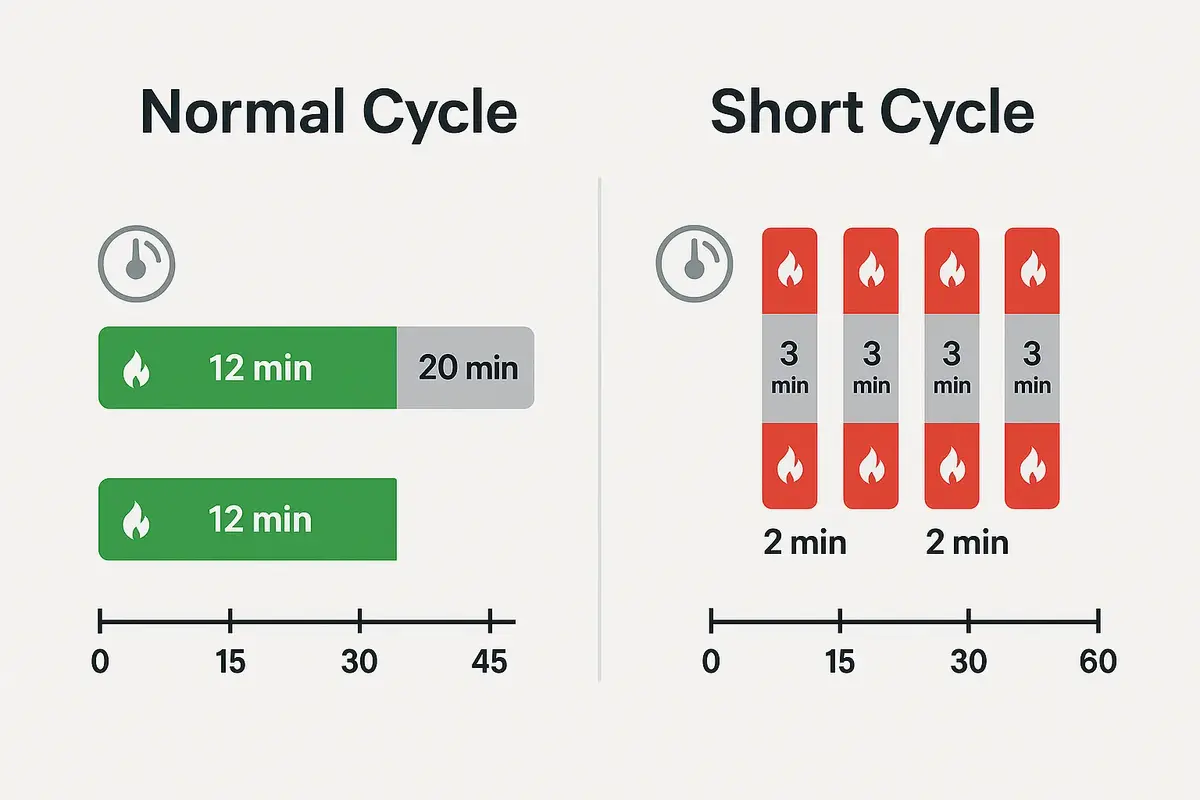
Normal furnace operation works like this: your thermostat calls for heat, the furnace fires up, runs for 7-15 minutes to bring the house up to temp, then shuts off until the thermostat calls again. You might see 3-5 cycles per hour on a cold January night in Lehi. That’s fine.
When your furnace starts then stops after only 2-5 minutes — sometimes less — waits a minute or two, and fires right back up, that’s short cycling. Cycles repeat over and over, but the house never gets warm. Your thermostat stays stuck at 66 even though you set it to 72.
Why does this matter? Three reasons. First, you’re wasting energy. Starting a furnace takes more gas than running it steadily, and those constant startups add 8-12% to your heating bill. That’s $100-$200 over a Utah winter, according to U.S. Department of Energy efficiency studies. Second, every startup wears out components faster. Third, you’re uncomfortable.
It’s a symptom that something in your system is broken, undersized, or struggling to work at Utah’s altitude.
Is Short Cycling Dangerous?
In most cases, short cycling is a comfort and cost problem, not an immediate safety hazard. But there are two scenarios where it becomes dangerous, and both are more common at Utah’s elevation.
First, incomplete combustion. Gas furnaces need the right mix of fuel and oxygen to burn cleanly. At 4,300-5,500 feet — where most Wasatch Front homes sit — there’s less oxygen available than at sea level. When your furnace short cycles because the flame sensor is dirty or the gas valve is malfunctioning, it might not be burning all the gas it’s releasing. Incomplete combustion produces carbon monoxide.
Second, repeated startups stress the heat exchanger. When the furnace overheats because of restricted airflow, the metal expands and contracts dozens of times per hour instead of 3-5. Over months, that can crack the heat exchanger — and a cracked heat exchanger also leaks carbon monoxide into your home.
Most short cycling won’t put your family at immediate risk. But combined with a gas smell, soot around the burners, or your carbon monoxide detector going off, shut the furnace down and call us at (801) 997-8909 immediately.
8 Common Causes of Furnace Short Cycling in Utah Homes
Something interrupts the furnace’s normal operation before it finishes heating your home. Here are the eight causes we see most often on service calls across the Wasatch Front — starting with the simplest fixes and working up to the ones that need a pro.
1. Dirty or Clogged Air Filter
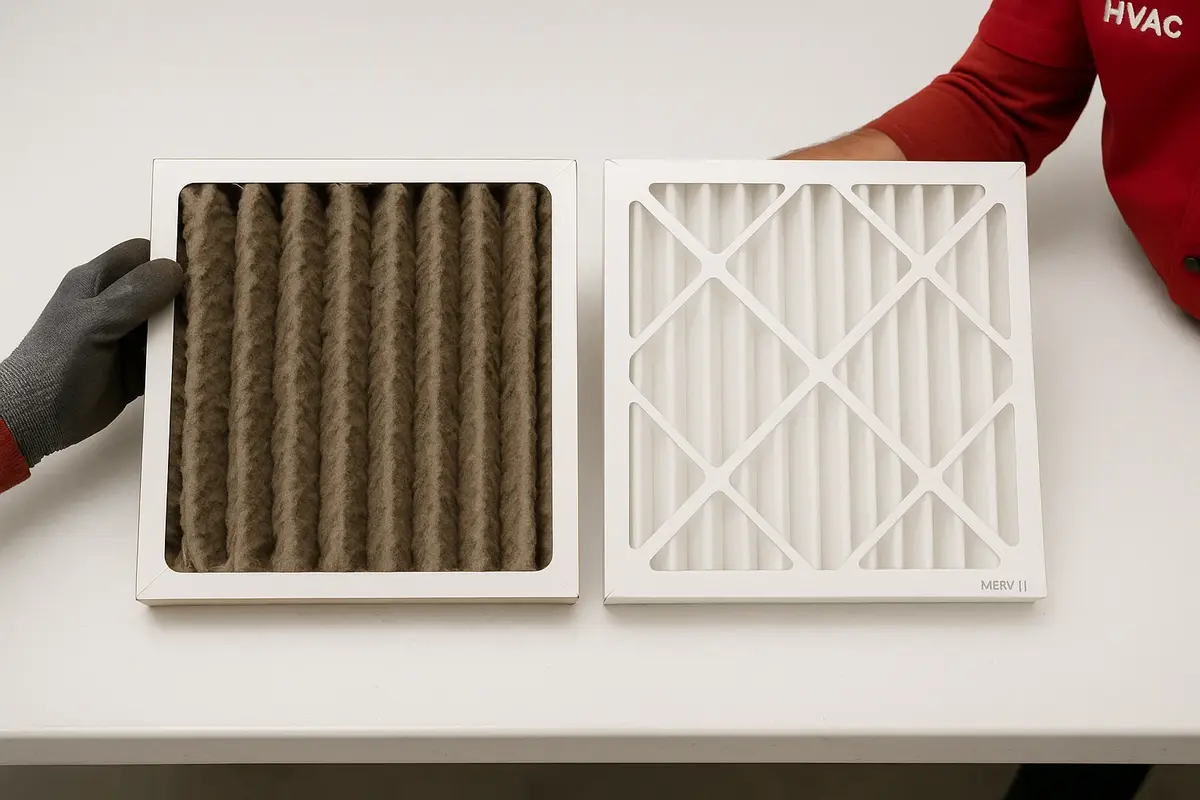
Clogged filters are the #1 cause. They block airflow over the heat exchanger. Furnaces get too hot, the limit switch kicks in as a safety measure, and the system shuts down. Two minutes later, it cools enough to restart. Repeat.
Utah’s dry, dusty climate clogs filters faster than anywhere else. National standards say change your filter every 3 months. In Utah, change it every 1-2 months during heating season — especially if you’re near a canyon mouth or in the Salt Lake Valley during an inversion.
Filters are affordable at any hardware store and swapping one out takes two minutes. Change the filter and the short cycling stops? You just saved yourself a service call.
2. Dirty Flame Sensor
Your furnace has a small metal rod near the burners called a flame sensor. Its job is to confirm the gas is actually burning before allowing more gas into the system. When the sensor can’t detect the flame — usually because it’s coated in carbon buildup — the furnace shuts down after 30-60 seconds as a safety precaution.
October startups are especially common in October when you’re firing up the furnace after six months of sitting dormant. It’s also more critical at Utah’s altitude. With less oxygen available, the flame burns differently than it does at sea level.
Cleaning a flame sensor requires removing the burner assembly and using fine-grit sandpaper — not a beginner DIY job. Flame sensor cleaning is included in our $69 tune-up.
3. Thermostat Issues
If your thermostat thinks the house is already warm when it’s not, it’ll shut the furnace off early. This happens for a few reasons: bad placement, dying batteries, or poor calibration.
Bad placement is huge in Utah mountain homes. We’ve seen thermostats installed on exterior walls next to windows, in hallways that get direct afternoon sun, or in basements that stay 20 degrees colder than the main floor. In a two-story home in the Traverse Mountain area, the basement might be 58 degrees while the upstairs is 74.
Utah’s 30-degree day-night temperature swings also confuse older thermostats. Programmable or smart thermostats can learn your home’s heating patterns and adjust for those swings. We’ve written a guide on programmable thermostat savings in Utah if you want the details.
Start by replacing the thermostat batteries. Doesn’t fix it? Check the placement. Thermostat in a bad spot? Call us — relocating it isn’t a DIY project.
4. Oversized Furnace
Oversized furnaces heat your home so fast that they hit the thermostat setpoint before completing a full cycle. Sounds like a good problem, right? It’s not. Cycles wear out the equipment, waste energy, and create temperature swings — the house goes from 68 to 74 in three minutes, then the furnace shuts off and you’re back to 68 twenty minutes later.
Oversized furnaces are common in Utah because altitude derating is often ignored. Gas furnaces lose efficiency at higher elevations and must be derated for altitude. Homes in Lehi at 4,500 feet need a furnace sized to account for the reduced oxygen available for combustion.
There’s no DIY fix for this. You need a properly sized replacement. Check out our furnace installation cost guide to see what a correctly sized unit runs in Utah.
5. Restricted Airflow (Closed Vents, Blocked Returns)
Closing vents in unused rooms seems like it saves energy. It doesn’t. Reduced airflow through the system causes the same overheating problem as a dirty filter.
Furniture blocking return vents is the other common culprit. We see this a lot in Utah basement apartments — a couch shoved against the return grille, or storage boxes stacked in front of it.
Open all your vents. Walk around and make sure every return grille has at least a foot of clearance. Problem solved.
6. Failing Limit Switch
Limit switches are safety devices that shut the furnace down if the plenum gets too hot. They’re supposed to trip when there’s a real problem — like a clogged filter or restricted airflow. But the switch itself can fail, especially in older furnaces that have been through 20+ Utah winters.
Failing limit switches will trip even when the furnace isn’t actually overheating. Result: short cycling that doesn’t respond to filter changes or airflow checks.
Diagnosing a bad limit switch requires a multimeter and some disassembly. This is a pro job. Already replaced the filter and checked airflow? Give us a call at (801) 997-8909.
7. Leaky or Poorly Sealed Ductwork
If your ducts leak 20-30% of your heated air into an unheated attic or crawlspace, your furnace runs constantly trying to satisfy the thermostat — but it’ll also cycle more frequently because it’s working harder than it should.
Leaky ducts are especially common in Utah homes with long duct runs to second floors or additions. Ducts in unconditioned spaces lose heat faster in our cold winters. In a two-story mountain home with ducts in the attic, we’ve measured 25-degree temperature drops between the furnace and the upstairs registers.
Professional duct sealing improves efficiency by 15-25% and often solves short cycling caused by the furnace working too hard.
8. Aging or Failing Blower Motor
Blower motors move air through your ductwork. When they’re struggling — because of worn bearings, a failing capacitor, or just age — they can’t move enough air to keep the heat exchanger cool.
Signs of a failing blower motor: unusual squealing or grinding noises, intermittent operation, or a bulging capacitor next to the motor. Furnace 15+ years old and showing these symptoms? Motor is probably on its way out.
Blower motor replacement is priced after assessment depending on the motor type. At 15+ years, you’re also looking at an aging heat exchanger, control board, and gas valve. We generally recommend replacing the whole furnace instead of sinking major repair costs into a motor when the rest of the system is on borrowed time.
Our Home Health Plan covers annual tune-ups and priority scheduling. We’ll catch a failing blower motor before it leaves you without heat on a January night. Or call us at (801) 997-8909 if you’re hearing strange noises.
How to Troubleshoot a Short Cycling Furnace
Here’s your step-by-step checklist. Start at the top and work down. One step fixes it? You’re done. Nothing worked? Call a pro.
First, check the air filter. Pull it out. Looks dirty? Replace it. Can’t see light through it when you hold it up to a window? It’s clogged. This fixes most short cycling issues.
Second, check your thermostat. Replace the batteries. Make sure it’s set to “heat” and the fan is set to “auto,” not “on.”
Next, check your vents and returns. Walk through the house. Open every vent. Make sure no furniture, boxes, or rugs are blocking return grilles.
Finally, listen for unusual sounds. Stand next to the furnace during a cycle. Hear grinding, squealing, or rattling? That’s a mechanical problem. Call a pro.
When to stop and call us: Smell gas? Stop immediately and call us at (801) 997-8909. Furnace keeps short cycling after you’ve changed the filter and checked airflow? It’s a flame sensor, limit switch, or mechanical issue — all require a technician.
Don’t attempt to clean the flame sensor yourself unless you’ve done it before. Gas appliances at altitude require precise combustion tuning. For a full seasonal prep guide, check out our furnace maintenance checklist for winter.
Frequently Asked Questions
How long should a furnace run per cycle?
Normal furnace cycles last 7-15 minutes depending on how cold it is outside and how well your home is insulated. On a mild October morning, you might see 7-8 minute cycles. On a January night when it’s 10 degrees in Salt Lake City, cycles can stretch to 12-15 minutes. Anything under 5 minutes is short cycling.
Can a dirty filter cause short cycling?
Yes — it’s the #1 cause we see. Dirty filters block airflow, the heat exchanger overheats, and the limit switch shuts the furnace down to prevent damage. In Utah’s dry, dusty climate, filters clog twice as fast as the national average. Change yours every 1-2 months during heating season.
Why does my furnace turn on and off every 5 minutes?
Most common reasons are a clogged filter, dirty flame sensor, or failing limit switch. Start with the filter — that’s a 2-minute fix. Filter is clean and the problem continues? Likely the flame sensor or the limit switch. Both require a technician.
Will a bad thermostat cause short cycling?
Yes. Thermostats poorly placed — near a window, in direct sun, or on an exterior wall — get false readings and shut the furnace off before your home is actually warm. This is especially common in multi-story Utah homes where the basement is 20 degrees colder than the top floor. Replace the batteries first. Doesn’t help? Thermostat may need to be relocated or replaced.
What causes a furnace to shut off after a few minutes?
Usually it’s a flame sensor issue or a limit switch problem. Flame sensors detect whether the gas is burning — if dirty or corroded, they shut the furnace down after 30-60 seconds as a safety precaution. Limit switches monitor temperature — if the heat exchanger is overheating because of restricted airflow, the limit switch trips and shuts everything down. Both issues need a pro diagnosis.
Preventing Short Cycling: Maintenance Tips for Utah Homeowners
Best way to avoid short cycling? Stay ahead of it.
Change your filter every 1-2 months during heating season. Mark your calendar. Utah’s dry climate clogs filters faster than anywhere else.
Schedule an annual tune-up before October. We clean the flame sensor, test the limit switch, check combustion efficiency, and catch small problems before they become big ones. At Utah’s altitude, combustion analysis isn’t optional — it’s critical for safe operation. Our tune-up runs $69, or it’s included twice a year with the Home Health Plan.
Check your thermostat placement. Got a two-story home and the thermostat is upstairs? You’re probably heating the second floor while the basement stays cold. Smart thermostats can help balance things out.
Preventative maintenance costs less than emergency repairs. And it keeps your family comfortable all winter.
Conclusion
The problem is fixable. Start with the simple checks — filter, thermostat, vents. Half the time, you’ll solve it yourself in ten minutes. Other half requires a pro to diagnose a flame sensor, limit switch, or mechanical issue.
What you shouldn’t do is ignore it. Furnaces that short cycle waste $100-$200 per winter in energy costs, wear out components faster, and eventually fail when you need them most. At Utah’s altitude, combustion issues from short cycling can also create carbon monoxide risks.
Furnace acting up? We’ve been tuning, repairing, and replacing furnaces across the Wasatch Front for 20+ years. Call (801) 997-8909 — we’re open 7 days a week with 120-minute guaranteed response during business hours. Family-owned, Utah state licensed, and we’ll treat your home like it’s our own.